
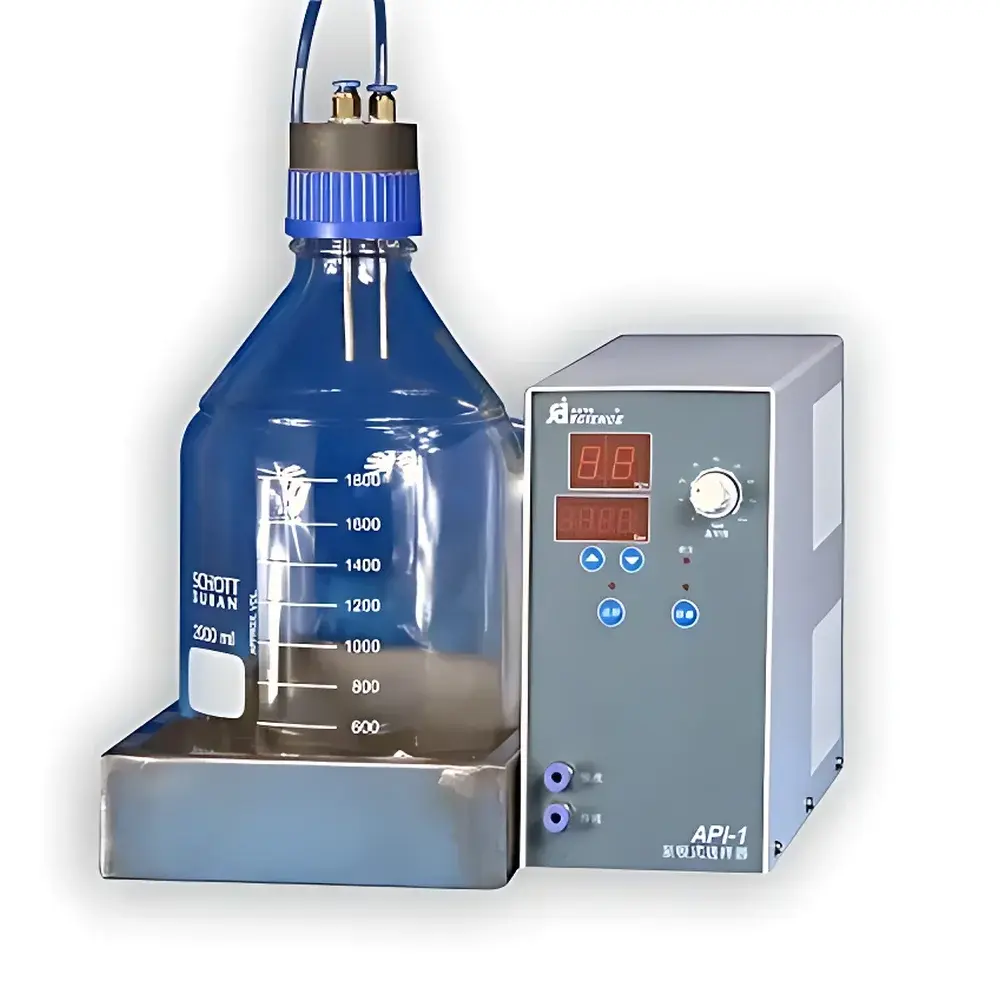
Autosens API-1 Pump-Driven Multifunctional Autosampler
| Brand | Autosens |
|---|---|
| Origin | Tianjin, China |
| Manufacturer Type | Authorized Distributor |
| Product Category | Domestic |
| Model | API-1 |
| Instrument Type | Multifunctional Autosampler |
| Max Sample Capacity | 60 × 2 L vials |
| Minimum Injection Volume | 0.1 µL |
| Loop Volume | 100 µL |
| Positioning Accuracy | < 0.3 mm |
| Motion Axes | XYZ three-dimensional |
| Needle Wash Mode | Internal & external wall cleaning |
| Repeat Injection Capability | Unlimited cycles |
| Pressure Range | 0–75 kPa (continuously adjustable) |
| Pressure Display | 2-digit LED, ±5 kPa accuracy |
| Flow Rate (Pump) | 8 L/min |
| Timing Range | 0.1–99.9 s |
| Timer Resolution | 0.1 s |
| Dimensions (H×W×D) | 180 × 94 × 260 mm |
| Waste Bottle Capacity | 2000 mL per bottle |
| Power Supply | AC 220 V ±10%, 50–60 Hz |
| Power Consumption | ~30 VA |
Overview
The Autosens API-1 Pump-Driven Multifunctional Autosampler is a precision-engineered sample introduction system designed for integration with spectrophotometers, UV-Vis analyzers, and other optical detection platforms requiring automated liquid handling without manual cuvette removal. Unlike syringe-based autosamplers, the API-1 employs a regulated vacuum-driven aspiration mechanism—leveraging a digitally controlled diaphragm pump—to draw, dispense, and rinse samples directly within the instrument’s cuvette chamber. This architecture eliminates mechanical contact with delicate optical cells, reduces carryover risk, and supports unattended operation across extended analytical sequences. The system operates on a pressure-controlled fluidic principle: precise vacuum modulation (0–75 kPa) governs aspiration speed and volume repeatability, while integrated timing logic ensures consistent dwell and purge durations. Its compact footprint and modular interface make it suitable for benchtop deployment in QC laboratories, environmental testing facilities, and academic research settings where robustness, low maintenance, and compliance-ready operation are essential.
Key Features
- Dual independent LED displays: real-time monitoring of system vacuum pressure (2-digit) and programmable aspiration/dispense timing (3-digit, 0.1 s resolution)
- Continuously adjustable vacuum pressure (0–75 kPa) with ±5 kPa display accuracy, enabling method-specific optimization for viscous or volatile samples
- Ergonomic handheld controller integrating start/stop, mode selection (inject/wash/purge), and parameter adjustment—reducing software dependency
- Integrated vacuum pump, control electronics, and 2000 mL waste reservoir housed in a single 180 × 94 × 260 mm chassis for space-constrained environments
- Intelligent waste management: automatic pump shutoff and visual alert (flashing LED) upon 2000 mL reservoir fill level detection
- Intermittent pump actuation strategy maintains stable system pressure during standby and minimizes thermal drift and membrane fatigue
- XYZ three-axis robotic arm with sub-0.3 mm positional repeatability ensures accurate alignment with standard cuvette holders and accessory ports
Sample Compatibility & Compliance
The API-1 accommodates standard 10 mm pathlength quartz, glass, or plastic cuvettes (12.5 × 12.5 × 45 mm) and supports aqueous, organic, and mildly corrosive matrices (pH 2–10). Its non-contact aspiration design avoids cuvette scratching and preserves optical integrity over thousands of cycles. While not certified to ISO/IEC 17025 or FDA 21 CFR Part 11 out-of-the-box, the system’s deterministic timing, auditable pressure/timing logs (via optional RS-232 or analog output), and hardware-enforced safety interlocks align with GLP and GMP documentation requirements. It complies with IEC 61010-1 for electrical safety and meets CE marking directives for laboratory equipment (EMC Directive 2014/30/EU, Low Voltage Directive 2014/35/EU).
Software & Data Management
The API-1 operates autonomously via front-panel controls and handheld interface; no host PC is required for basic sequencing. For advanced integration, optional TTL-triggered I/O enables synchronization with spectrophotometer acquisition triggers (e.g., “start scan” pulse initiates aspiration). Analog voltage outputs (0–5 V) mirror real-time pressure and timer status for external DAQ systems. All operational parameters—including pressure setpoint, timing sequence, and wash cycle count—are retained in non-volatile memory after power loss. Audit trails (timestamped start/stop events, error codes, reservoir full alerts) can be exported via serial interface for inclusion in lab notebooks or LIMS workflows.
Applications
- High-throughput UV-Vis quantification of pharmaceutical actives, excipients, and degradation products per USP and EP 2.2.25
- Environmental water analysis (e.g., nitrate, phosphate, COD) following APHA Standard Methods 4500-NO₃⁻-B and 4500-P E
- Enzyme kinetics assays requiring rapid, reproducible reagent addition and mixing within thermostatted cuvettes
- Quality control of dyes, pigments, and industrial chemicals per ASTM D1209 and ISO 6271
- Method development for colorimetric heavy metal detection (e.g., Pb²⁺, Cd²⁺) using chelating reagents
FAQ
Does the API-1 require a dedicated computer or proprietary software to operate?
No—the system is fully functional via its built-in keypad, dual LED displays, and handheld controller. A computer is only needed for optional data logging or external trigger synchronization.
Can the API-1 be used with microvolume or semi-micro cuvettes?
Yes, provided the cuvette dimensions fall within the XYZ stage’s alignment tolerance (±0.3 mm) and the aspiration probe tip can access the sample meniscus without obstruction. Custom adapters are available upon request.
What maintenance is required for long-term reliability?
Quarterly inspection of the diaphragm pump membrane, replacement of silicone tubing every 6 months (or after 5000 cycles), and periodic cleaning of the needle wash port with 70% ethanol. No calibration certificates are issued, but pressure and timer accuracy can be verified using NIST-traceable manometers and stopwatches.
Is the waste reservoir compatible with acidic or alkaline digestates?
The 2000 mL polypropylene reservoir is chemically resistant to solutions up to pH 10 and 1 M HCl; for stronger acids or oxidizers (e.g., aqua regia), use an optional PTFE-lined secondary containment vessel.





