
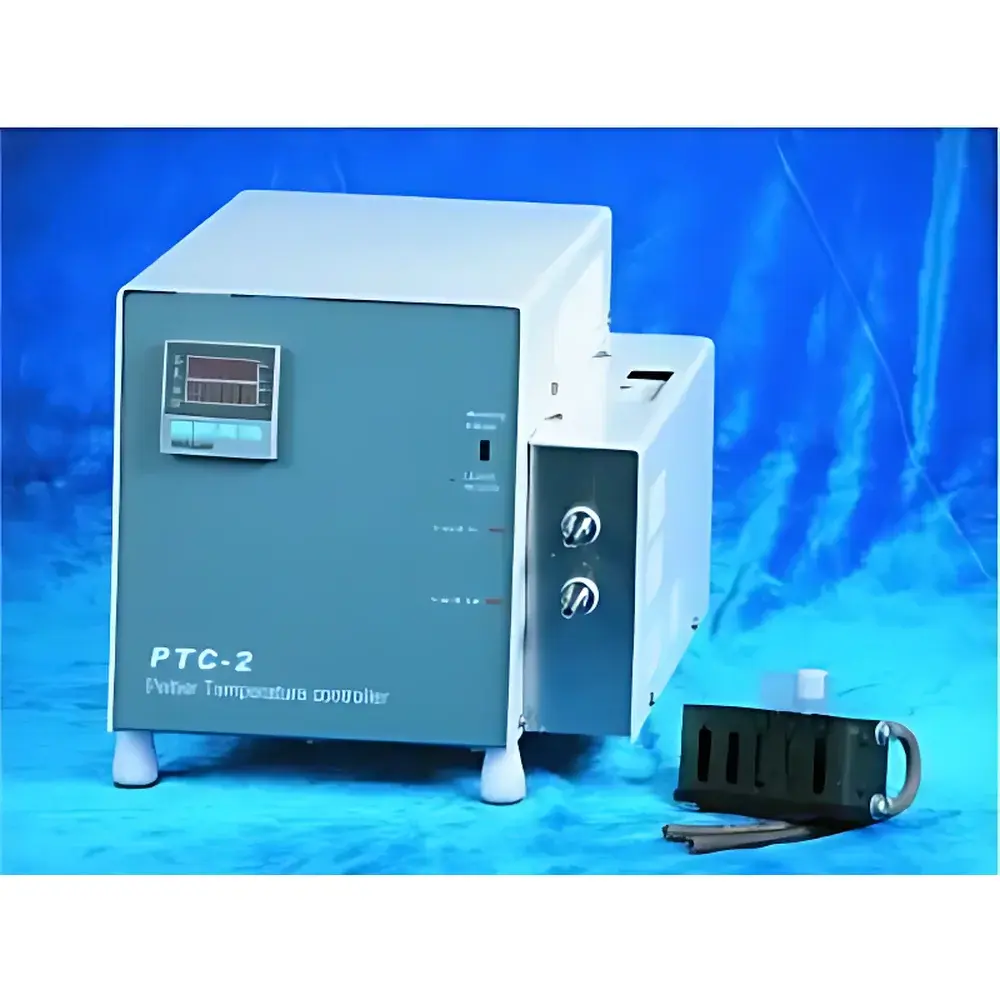
Autosense APTC-2 Circulating Temperature Controller
| Brand | Autosense |
|---|---|
| Model | APTC-2 |
| Temperature Range | 25°C below ambient to 80°C |
| Setpoint Range | 2–70°C |
| Temperature Stability | ±0.2°C |
| Control Accuracy | ±0.5°C |
| Power Consumption | 180 W |
| Input Voltage | 220 V ±10%, 50 Hz |
| Dimensions (W×H×D) | 220 × 185 × 282 mm |
| Weight | 6.5 kg |
Overview
The Autosense APTC-2 Circulating Temperature Controller is a precision-engineered thermal management system designed for laboratory applications requiring stable, repeatable, and responsive temperature control of external samples or analytical devices. Unlike passive thermostats or simple bath heaters, the APTC-2 employs an active liquid circulation architecture—integrating a thermally regulated reservoir, a high-efficiency pump, and a dual-mode (heating/cooling) heat exchanger—to deliver conditioned fluid directly to the target sample interface via external tubing. This design enables rapid thermal equilibration and minimizes thermal lag, making it especially suitable for coupling with chromatographic columns, optical cells, reaction vessels, sensor housings, or other temperature-sensitive instrumentation where spatially localized and dynamically adjustable thermal conditioning is critical.
Key Features
- Wide operational range: Capable of maintaining temperatures from 25°C below ambient up to +80°C, with precise setpoint adjustment between 2°C and 70°C in 0.1°C increments.
- High-stability thermal regulation: Achieves ±0.2°C temperature stability over time under steady-state conditions, with control accuracy better than ±0.5°C across the full setpoint range.
- Integrated recirculating pump: Delivers consistent flow rates (adjustable via front-panel controls) to ensure uniform thermal transfer to externally connected devices without requiring auxiliary fluid handling systems.
- Compact benchtop footprint: Engineered for space-constrained laboratories; dimensions (220 × 185 × 282 mm) allow seamless integration into analytical workstations or instrument racks.
- Robust thermal architecture: Features insulated reservoir construction, PID-based digital temperature control, and over-temperature protection circuitry compliant with IEC 61010-1 safety standards.
- Low-noise operation and energy-efficient design: 180 W nominal power draw supports continuous duty cycles while minimizing thermal load on climate-controlled lab environments.
Sample Compatibility & Compliance
The APTC-2 is compatible with a broad spectrum of external thermal loads—including HPLC/GC column ovens, spectroscopic cuvette holders, microfluidic platforms, and custom-built reaction modules—provided they accept external liquid cooling/heating via standard 6 mm OD silicone or fluoropolymer tubing. Its open-loop circulation design allows users to select compatible heat-transfer fluids (e.g., water, water-glycol mixtures, or low-viscosity silicone oils) based on required low-temperature performance or chemical inertness. The unit conforms to general-purpose laboratory equipment requirements per ISO/IEC 17025 supporting documentation practices and meets electromagnetic compatibility (EMC) Class B limits per EN 61326-1. While not certified for use in regulated GMP or FDA 21 CFR Part 11 environments out-of-the-box, its digital setpoint logging capability (via optional RS232/USB interface) supports traceable calibration records when integrated into validated workflows.
Software & Data Management
The APTC-2 operates via an intuitive front-panel interface with LED display, rotary encoder, and dedicated function keys for setpoint entry, pump speed adjustment, and mode selection (heat-only, cool-only, or auto-switching). Optional serial (RS232) or USB connectivity enables remote parameter configuration and real-time temperature monitoring using third-party data acquisition software (e.g., LabVIEW, Python-based PySerial scripts, or MATLAB Instrument Control Toolbox). When deployed in GLP-compliant settings, users may implement external timestamped logging solutions to satisfy audit trail requirements for temperature-critical experiments. Firmware updates are delivered via downloadable HEX files and require no proprietary vendor software.
Applications
- Chromatography: Precise thermal stabilization of analytical or preparative HPLC/GC columns to improve retention time reproducibility and peak resolution.
- Spectroscopy: Maintaining constant cell temperature during UV-Vis, FTIR, or fluorescence measurements to eliminate thermal drift artifacts.
- Materials testing: Conditioning polymer samples, thin films, or composite substrates prior to mechanical or electrical characterization.
- Biotechnology: Supporting enzyme kinetics assays, protein crystallization trials, or cell-based assays requiring tightly controlled thermal environments.
- Calibration labs: Serving as a stable thermal reference source for verifying thermistor, RTD, or infrared thermometer accuracy across defined temperature points.
FAQ
What types of heat-transfer fluids are recommended for use with the APTC-2?
Deionized water is optimal for operation between 5°C and 70°C. For sub-ambient applications down to –25°C, a 30% propylene glycol/water mixture is recommended. Avoid ethylene glycol in biological or cleanroom environments due to toxicity concerns.
Can the APTC-2 be used in a closed-loop configuration with a jacketed reactor?
Yes—the unit supports both open-loop delivery (to external devices with independent return paths) and closed-loop circulation (when paired with reactors equipped with inlet/outlet ports and sufficient head pressure tolerance). Maximum recommended system volume is 5 L.
Is the temperature sensor calibrated traceably to NIST standards?
The internal PT1000 sensor is factory-calibrated with documented uncertainty; full NIST-traceable calibration certificates are available upon request at time of order, subject to additional lead time and fee.
Does the APTC-2 support ramp-and-hold temperature profiles?
No—this model provides only static setpoint control. For programmable thermal profiling, consider the APTC-2P variant with integrated 10-segment ramp-soak functionality.
What maintenance is required for long-term reliability?
Annual inspection of pump seals, periodic flushing of the fluid loop with deionized water, and verification of reservoir level and heater element resistance are recommended. No consumable parts require scheduled replacement under normal operating conditions.



