
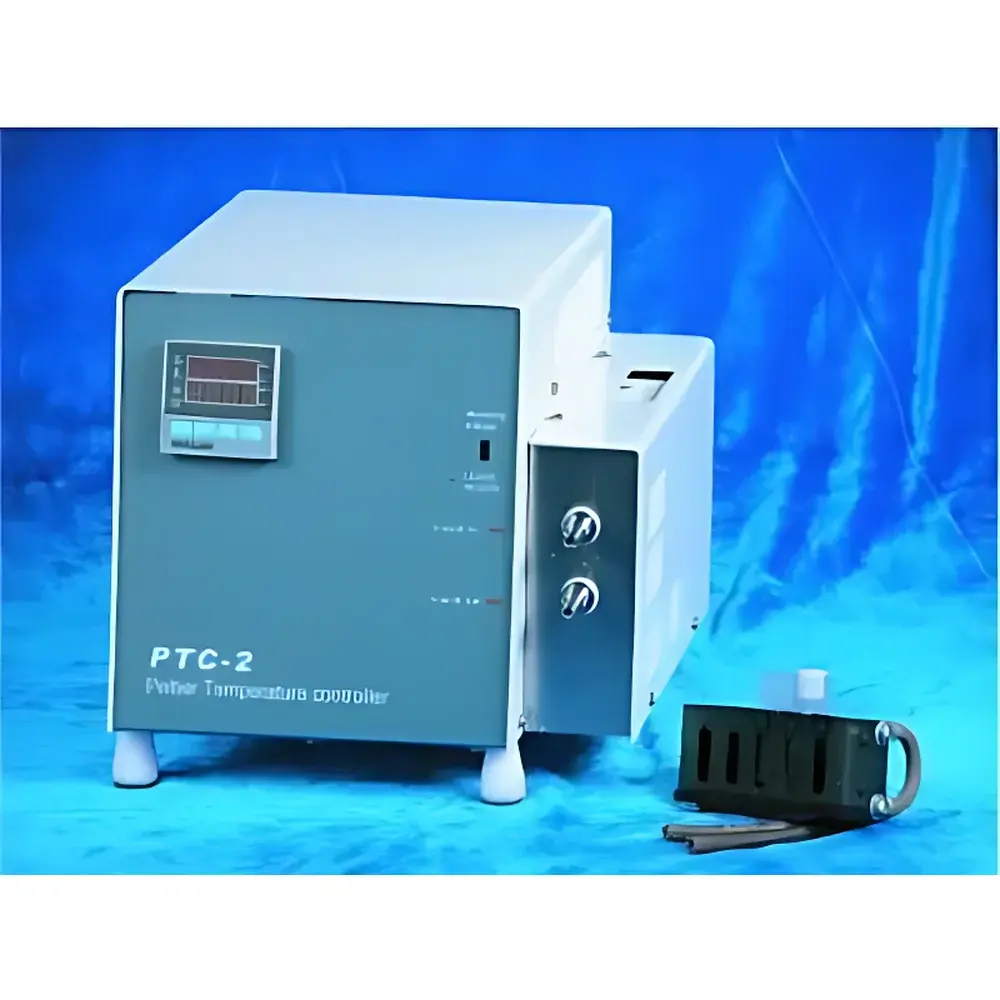
Autosense APTC Series Temperature Controller
| Brand | Autosense |
|---|---|
| Origin | Tianjin, China |
| Manufacturer Type | Authorized Distributor |
| Product Origin | Domestic (China) |
| Model | APTC Series |
| Quotation | Available Upon Request |
| Temperature Range | 25°C below ambient to 80°C |
| Setpoint Range | 2°C to 70°C |
| Temperature Accuracy | ±0.5°C |
| Temperature Stability | ±0.2°C |
| Power Consumption | 180 W |
| Electrical Supply | 220 V AC, 50 Hz |
| Dimensions (W×H×D) | 220 × 185 × 282 mm |
| Net Weight | 6.5 kg |
Overview
The Autosense APTC Series Temperature Controller is a compact, recirculating chiller-heater system engineered for precise thermal regulation of external analytical components and sample stages in laboratory instrumentation. It operates on the principle of forced-liquid circulation—using an integrated pump to deliver temperature-controlled fluid (typically water or water-glycol mixture) through insulated tubing to an external heat exchange interface (e.g., microscope stage adapter, spectrophotometer cuvette holder, or custom sensor mount). Unlike passive air-based thermostats, this active liquid-circulation architecture enables rapid thermal equilibration, high spatial uniformity, and minimal thermal drift—critical for time-resolved spectroscopy, microscopy-based kinetics, and temperature-dependent calibration protocols.
Key Features
- Wide operational range: capable of cooling up to 25°C below ambient temperature and heating up to 80°C, with fine setpoint resolution across 2–70°C
- High-precision digital PID control algorithm ensuring ±0.5°C accuracy and ±0.2°C short-term stability (measured at outlet port under steady-state conditions)
- Integrated fluid reservoir with spill-resistant design and quick-disconnect fittings—eliminates leakage during instrument reconfiguration or maintenance
- Low-noise centrifugal pump (rated for continuous operation) with adjustable flow rate and overheat/low-flow safety cutoffs
- Compact footprint (220 × 185 × 282 mm) and lightweight chassis (6.5 kg) optimized for benchtop integration beneath or adjacent to analytical platforms
- Front-panel LED display with intuitive keypad navigation; real-time monitoring of setpoint, actual outlet temperature, and system status indicators
Sample Compatibility & Compliance
The APTC Series is compatible with a broad spectrum of third-party instruments requiring external thermal coupling—including inverted and upright microscopes (e.g., Zeiss Axio, Nikon Eclipse), UV-Vis spectrophotometers (e.g., Shimadzu UV-2600, Agilent Cary 60), fluorescence readers, electrochemical cells, and custom-built optical setups. Its modular fluid delivery interface supports standard 1/4″ compression fittings and accommodates tubing IDs from 3–6 mm. From a regulatory standpoint, the unit meets IEC 61010-1:2010 safety requirements for laboratory electrical equipment. While not certified for GMP or GLP environments out-of-the-box, its stable thermal output and repeatable performance support compliance with ASTM E29–23 (standard practice for using significant digits in test data), ISO/IEC 17025:2017 (clause 7.2.2 on equipment suitability), and internal SOPs governing temperature-controlled assay validation.
Software & Data Management
The APTC Series operates as a standalone hardware controller with no proprietary software dependency. All configuration and monitoring are performed locally via the front-panel interface. For users requiring remote supervision or data logging, the unit features an optional RS-232 serial port (available on APTC-2 variant) supporting ASCII-based command-response protocol. Integration with LabVIEW, Python (pySerial), or MATLAB is feasible for automated temperature ramping, synchronization with detector triggers, or inclusion in larger instrument clusters. Audit trails and electronic records are maintained externally by host systems; the device itself does not implement FDA 21 CFR Part 11-compliant user authentication or electronic signature functionality.
Applications
- Microscopy: maintaining constant temperature on live-cell imaging stages during time-lapse fluorescence or phase-contrast experiments
- Spectroscopy: stabilizing cuvette temperature in absorbance, fluorescence, or circular dichroism measurements to minimize baseline drift and thermal artifacts
- Chromatography: pre-conditioning detector flow cells or column ovens where auxiliary thermal control supplements primary oven regulation
- Materials testing: thermal cycling of small-scale mechanical or electrical test fixtures in controlled-environment characterization rigs
- Calibration labs: providing traceable, stable thermal references for thermometer or thermocouple verification per ISO 17025 clause 6.4.10
FAQ
What fluids are compatible with the APTC Series?
Deionized water is recommended for operation within 5–60°C. For sub-ambient cooling below 5°C or extended service life, a 30% propylene glycol/water mixture is advised to prevent freezing and reduce corrosion.
Can the APTC be used with vacuum chambers or sealed enclosures?
Yes—provided the external heat exchanger is mounted to the chamber wall with appropriate thermal interface material and fluid lines are routed through a sealed feedthrough fitting.
Is the temperature sensor calibrated traceable to NIST standards?
The internal Pt100 sensor is factory-calibrated; full NIST-traceable calibration documentation is available as an optional add-on service upon request.
Does the unit include a built-in timer or programmable ramping function?
No—the APTC Series provides static setpoint control only. Programmable temperature ramps require external logic (e.g., PLC or PC-based scripting) interfaced via RS-232.
What maintenance is required for long-term reliability?
Annual inspection of pump seals, reservoir cleanliness, and tubing integrity is recommended. Fluid should be replaced every 6 months under continuous operation or when conductivity exceeds 5 µS/cm.



