
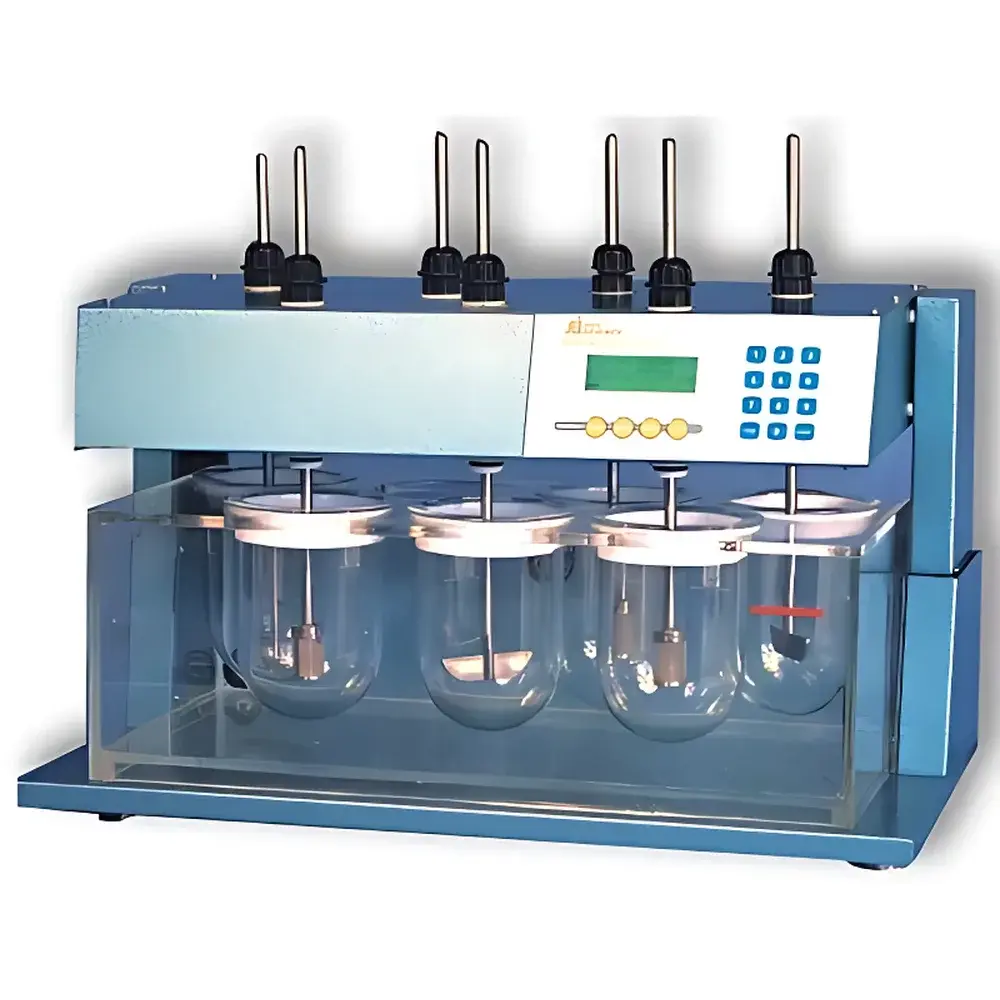
Autosense ASD-7B Intelligent Pharmaceutical Dissolution Tester
| Number of dissolution vessels | 7 |
|---|---|
| Rotational speed range | 25–250 rpm |
| Speed resolution | 1 rpm |
| Speed accuracy | ±2% |
| Water bath temperature range | Ambient +5°C to 60°C |
| Temperature control accuracy | ±0.1°C |
| Maximum cumulative timing | 99 h 59 min |
| Number of programmable sampling intervals | 10 |
| Maximum interval duration | 9 h 59 min |
| Auto power-on/off timer range | 99 h 59 min |
| Power consumption | 1300 W |
| Input voltage | 220 V ±10%, 50 Hz |
| Dimensions (W×H×D) | 670 × 470 × 420 mm |
| Net weight | ~42 kg |
Overview
The Autosense ASD-7B Intelligent Pharmaceutical Dissolution Tester is a fully programmable, benchtop dissolution apparatus engineered for compliance with pharmacopoeial standards—including USP , EP 2.9.3, and ChP 0931—and designed to support routine quality control (QC), formulation development, and bioequivalence studies in pharmaceutical laboratories. It operates on the paddle (USP Apparatus 2) and basket (USP Apparatus 1) dissolution principles, enabling precise simulation of gastrointestinal fluid dynamics through controlled hydrodynamic conditions. The system integrates a high-stability water bath with forced-circulation heating, digitally regulated rotational drive mechanics, and real-time parameter monitoring—ensuring reproducible dissolution profiles across all seven vessels under identical environmental conditions. Its architecture adheres to fundamental Good Manufacturing Practice (GMP) and Good Laboratory Practice (GLP) requirements for instrument qualification, including documented calibration traceability, audit-ready event logging, and deterministic operational repeatability.
Key Features
- Seven independent dissolution vessels with standardized 1000 mL borosilicate glass cups (compliant with USP/EP dimensional tolerances and optical clarity specifications)
- SPWM-controlled stepper motor drive for paddles/baskets—delivering smooth, jitter-free rotation with ≤±2% speed deviation across the full 25–250 rpm range
- High-flow recirculating water bath system featuring PID-based thermal regulation, achieving ±0.1°C stability and rapid equilibration (<15 min from ambient to 37°C)
- Modular electronic architecture with RS-232 and optional USB interfaces, supporting integration with external autosamplers, UV spectrophotometers, or HPLC systems
- Onboard non-volatile memory storing up to 10 user-defined dissolution methods—including vessel temperature, rotation speed, sampling intervals, and timed power scheduling
- Comprehensive self-diagnostic suite covering motor stall detection, temperature sensor validation, bath level monitoring, and over-temperature shutdown safeguards
- Stainless steel shafts and mesh baskets fabricated from medical-grade 316L stainless steel; all wetted parts meet ISO 8536-4 and ASTM F899 biocompatibility criteria
Sample Compatibility & Compliance
The ASD-7B accommodates standard USP-compliant dosage forms—including immediate-release tablets, capsules, extended-release matrix tablets, and orally disintegrating tablets (ODTs)—across all seven vessels simultaneously. Each vessel accepts both 1000 mL dissolution media and accessory fixtures for sinker use, filter placement, and probe insertion. Instrument design conforms to mechanical calibration requirements outlined in USP and ChP 0931, with documented verification protocols available for IQ/OQ/PQ execution. All firmware and hardware configurations satisfy data integrity expectations per FDA 21 CFR Part 11 (when paired with compliant third-party software), and the unit supports ALCOA+ principles through timestamped, immutable parameter logs and operator ID tracking.
Software & Data Management
While the ASD-7B operates autonomously via its embedded microcontroller interface, it provides bidirectional serial communication for seamless integration with validated dissolution data acquisition platforms—including Autosense ANASTAR Chromatography Data System (CDS) and third-party LIMS environments. Exportable CSV-formatted logs include timestamped vessel temperature, actual vs. setpoint rotation speed, elapsed time per interval, and system status flags (e.g., “heating active”, “sampling pending”). Audit trails capture method changes, parameter overrides, and power-cycle events—retained for ≥36 months in accordance with ICH GCP E6(R3) archival guidelines. Optional firmware upgrades maintain alignment with evolving regulatory interpretations of dissolution apparatus performance verification.
Applications
- Routine QC release testing of solid oral dosage forms against pharmacopoeial acceptance criteria (Q values, f2 similarity factor calculations)
- Comparative dissolution profiling during generic product development and ANDA submissions
- Excipient interaction screening under variable pH, surfactant concentration, or agitation intensity
- Dissolution method development and robustness assessment per ICH Q5E and Q2(R2)
- Stability-indicating dissolution assays coupled with UV/Vis or HPLC quantification
- Training and educational use in university pharmacy labs and regulatory training centers
FAQ
Does the ASD-7B support both USP Apparatus 1 and Apparatus 2 configurations?
Yes—the unit accepts interchangeable paddles and baskets with standardized shaft diameters and alignment fixtures, and maintains mechanical compliance with USP dimensional tolerances for both configurations.
Is calibration documentation provided with the instrument?
Each unit ships with a factory calibration certificate covering temperature uniformity (per USP ), rotational speed accuracy, and timing precision—all traceable to NIST-certified reference standards.
Can the ASD-7B be validated for GMP environments?
Yes—its modular architecture, deterministic control logic, and comprehensive event logging enable full IQ/OQ/PQ execution using vendor-supplied protocol templates aligned with ASTM E2500 and Annex 15.
What maintenance is required for long-term reliability?
Routine tasks include quarterly verification of bath circulation flow rate, annual recalibration of PT100 temperature sensors, and biannual inspection of stainless-steel drive components for pitting or wear.
Is remote monitoring supported?
Via RS-232 or optional Ethernet module, the device transmits real-time status and alarm codes to SCADA or centralized lab monitoring systems—though direct web-based control is not natively implemented.






