
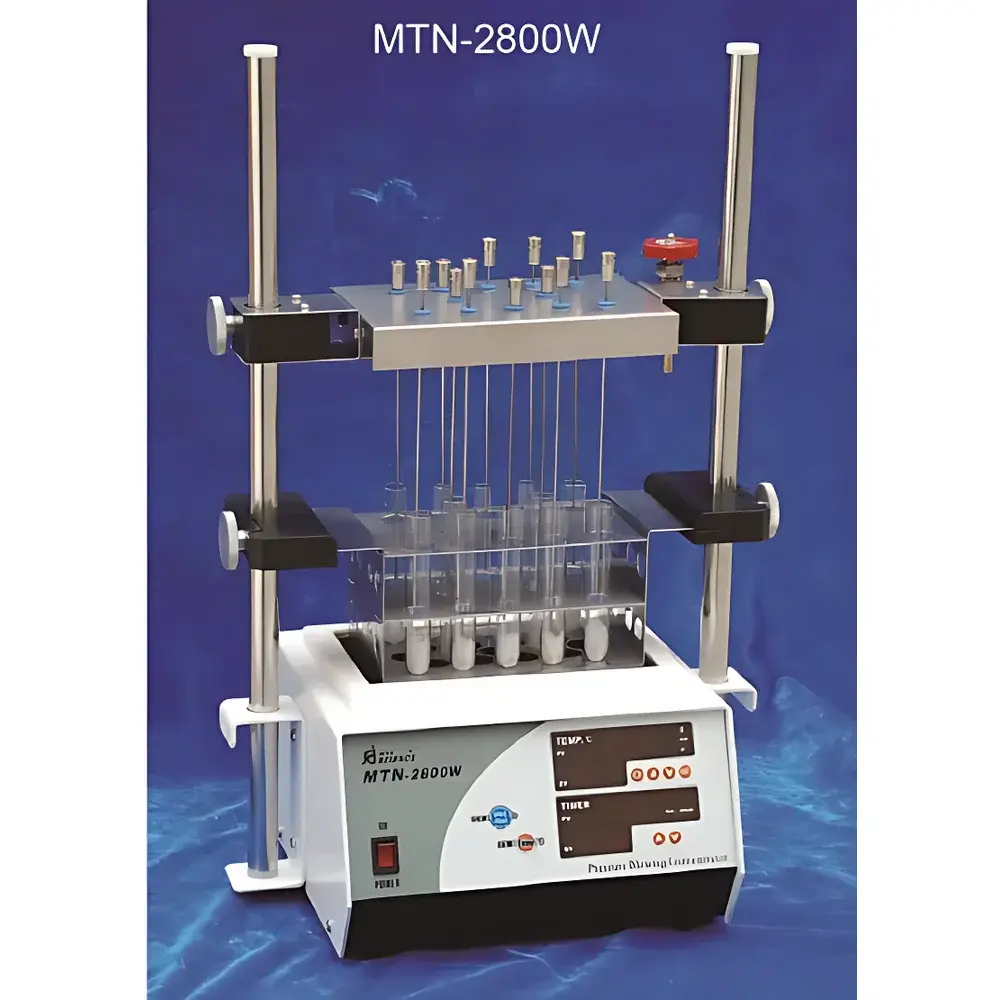
Autosense MTN-2800W Water-Bath Nitrogen Evaporator
| Brand | Autosense |
|---|---|
| Origin | Tianjin, China |
| Model | MTN-2800W |
| Heating Method | Water Bath |
| Temperature Range | Ambient +5°C to 100°C |
| Temperature Stability | ±0.1°C |
| Tube Diameter Compatibility | 13–19 mm |
| Nitrogen Flow Rate | 0–15 L/min |
| Sample Positions | 12 / 24 / 40 |
| Heating Power | 350 W |
| Over-Temperature Protection | 110°C |
| Timer Range | 0–99 h 59 min |
| Display | Dual digital display for set/actual temperature and timer modes (count-up/count-down) |
| Dimensions (W×H×D, main unit only) | 240 × 130 × 215 mm |
| Heating Block Size | 210 × 95 × 150 mm |
| Power Supply | 220 V / 50 Hz |
Overview
The Autosense MTN-2800W Water-Bath Nitrogen Evaporator is an engineered solution for controlled, low-temperature solvent removal in analytical sample preparation workflows. It operates on the principle of gentle nitrogen gas displacement combined with precise water-bath thermal regulation—enabling reproducible concentration of volatile solvents from liquid samples without thermal degradation of thermolabile analytes. Unlike rotary evaporation, which subjects samples to vacuum-induced boiling and potential bumping, the MTN-2800W delivers uniform heat transfer via immersion in a thermostatically stabilized water bath, while directed nitrogen flow accelerates surface evaporation at the meniscus. This method is widely adopted in laboratories performing LC-MS, GC-MS, HPLC, and environmental residue analysis where recovery, precision, and matrix integrity are critical.
Key Features
- Triple-layer temperature control architecture: integrated PT100 sensor directly embedded in the water bath ensures real-time feedback and minimizes spatial thermal gradients across the heating block.
- Dual-mode operation: programmable timer (0–99 h 59 min) supports both count-up and count-down functions; users may select either timed endpoint termination or continuous constant-temperature mode.
- Over-temperature safety system: independent mechanical cutoff activates at 110°C, preventing thermal runaway even if the primary PID controller fails.
- Modular tube rack design: interchangeable aluminum heating blocks accommodate 12-, 24-, or 40-position configurations with standardized 13–19 mm tube diameters—compatible with standard 10–15 mL conical-bottom vials and culture tubes.
- Integrated spill containment: removable water-resistant drip tray beneath the heating block collects accidental spills, protecting internal electronics and extending service life under high-throughput lab conditions.
- Four-digit dual-display interface: simultaneously shows setpoint temperature, actual bath temperature, timer setting, and elapsed/remaining time—eliminating manual recording errors during multi-step protocols.
Sample Compatibility & Compliance
The MTN-2800W is routinely validated for use in regulated environments requiring trace-level quantification, including pesticide residue testing (AOAC 2007.01), veterinary drug screening (EU Commission Decision 2002/657/EC), and pharmaceutical impurity profiling per ICH Q2(R2). Its water-bath design avoids direct contact between heating elements and samples—reducing risk of hot-spot formation and ensuring compliance with USP guidelines for thermal stability during sample prep. While not inherently 21 CFR Part 11 compliant, the instrument supports audit-ready documentation when paired with external electronic lab notebooks (ELNs) that capture timestamped parameter logs, operator IDs, and batch metadata. All materials in contact with the water bath (stainless steel housing, anodized aluminum block, food-grade silicone gaskets) meet ISO 10993 biocompatibility standards for non-invasive laboratory equipment.
Software & Data Management
The MTN-2800W operates as a standalone hardware platform with no embedded firmware or network connectivity. However, its analog-compatible output signals (0–5 V DC proportional to bath temperature) allow integration into centralized lab automation systems via optional analog-to-digital acquisition modules. For GLP/GMP-aligned labs, temperature calibration records—including as-found/as-left data, reference standard traceability (NIST-traceable thermometer), and uncertainty budgets—must be maintained per ISO/IEC 17025 clause 6.4. The unit includes a dedicated calibration port for third-party verification without disassembly. Routine performance qualification (PQ) should verify temperature uniformity (±0.3°C across all positions at 40°C and 80°C), nitrogen flow linearity (0–15 L/min ±2% full scale), and timer accuracy (±15 seconds over 24 hours).
Applications
- Concentration of extracts from solid-phase extraction (SPE) cartridges prior to LC-MS injection.
- Post-derivatization cleanup in amino acid and mycotoxin analysis (e.g., post-PCX-500 column derivatization).
- Preparative drying of plasma, urine, and tissue homogenates in clinical toxicology workflows.
- Routine reduction of mobile phase volume in HPLC method development and gradient optimization studies.
- Environmental monitoring: concentration of PAHs, PCBs, and organochlorine pesticides from large-volume water extracts (EPA Method 525.3).
FAQ
What is the maximum recommended nitrogen pressure for safe operation?
The MTN-2800W is designed for low-pressure nitrogen delivery (≤30 psi / 2 bar). Exceeding this may cause erratic flow distribution or needle misalignment.
Can the unit be used with organic solvents other than acetonitrile or methanol?
Yes—provided the solvent’s flash point exceeds 40°C and vapor pressure remains below 20 kPa at operating temperature. Avoid chlorinated solvents above 60°C due to corrosion risk to brass fittings.
Is the water bath compatible with deionized water only?
Deionized or distilled water is strongly recommended to prevent scale buildup and sensor drift. Tap water use requires quarterly descaling with 5% citric acid solution.
Does the MTN-2800W support remote monitoring or data export?
No native connectivity exists; however, analog voltage outputs enable connection to SCADA or LabVIEW-based supervisory systems for centralized logging.
How often should temperature calibration be performed?
Per ISO/IEC 17025, calibration must occur before first use, after any physical impact or maintenance, and at intervals not exceeding six months—or more frequently if used >8 hours/day in regulated settings.



