
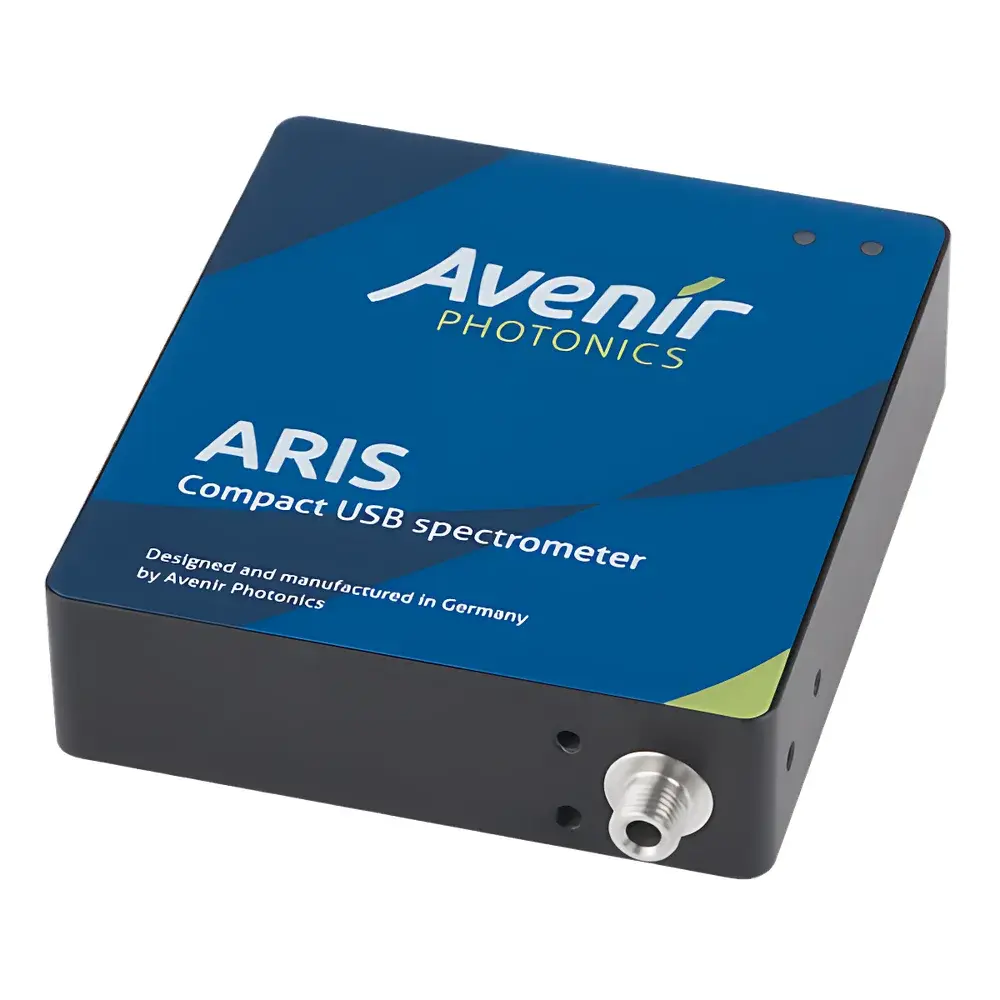
Avenir Aris Compact Fiber Optic Spectrometer
| Brand | Avenir |
|---|---|
| Origin | Germany |
| Model | Aris |
| Spectral Range | 185–970 nm, 185–550 nm, 185–420 nm, 350–840 nm, 510–1020 nm |
| Detector Type | CCD |
| Optical Resolution (FWHM) | 0.33–1.40 nm |
| Signal-to-Noise Ratio | 350:1 or 600:1 |
| Dynamic Range | 1900:1 or 5000:1 |
| Stray Light | < 0.08 % |
| Optical Design | Symmetric Czerny-Turner with 50 mm focal length |
| Numerical Aperture | 0.16 |
| Input Slit | User-replaceable 20 µm (standard) |
| Interface | USB 2.0 Full Speed (Type-C), optional UART/SPI/I²C |
| ADC | 16-bit, 2 MHz |
| Power | 5 V via USB or auxiliary connector (4.4–5.5 V), ≤ 70 mA |
| Dimensions | 67.0 × 74.0 × 19.0 mm |
| Weight | 122 g |
| Operating Temperature | –20 to +60 °C |
| Storage Temperature | –40 to +70 °C |
| Compliance | EU EMC Directive 2014/30/EU, RoHS, REACH SVHC, U.S. Conflict Minerals Act |
Overview
The Avenir Aris Compact Fiber Optic Spectrometer is an engineered solution for high-fidelity spectral acquisition in space-constrained, cost-sensitive, and industrially demanding environments. Based on a symmetric Czerny-Turner optical architecture with a 50 mm focal length and numerical aperture of 0.16, the Aris delivers laboratory-grade wavelength accuracy and photometric stability while occupying a footprint of just 67 × 74 × 19 mm and weighing only 122 g. Its core measurement principle relies on dispersive spectroscopy: incoming light—delivered via SMA-coupled optical fiber—is collimated, diffracted by a user-selectable grating, and focused onto a linear CCD detector array. Wavelength calibration is traceable to NIST-traceable standards, and typical wavelength accuracy is ±1/3 of the specified FWHM resolution—enabling reliable quantitative absorbance, reflectance, and emission analysis across UV-VIS-NIR bands.
Key Features
- High-throughput optical design: Optimized for maximum photon collection efficiency; sensitivity is 2–4× higher than competing spectrometers in its class under identical illumination and integration conditions.
- Low stray light performance: <0.08% stray light (measured using halogen lamp + longpass filter), enabling accurate absorbance measurements up to OD 3.5 without saturation artifacts.
- Modular spectral configuration: Five standard spectral ranges—including deep-UV (185–420 nm), UV/VIS (185–550 nm), and extended NIR (510–1020 nm)—support application-specific optimization without redesigning the platform.
- User-serviceable input slit: Standard 20 µm slit is field-replaceable; optional wider slits (e.g., 50 µm or 100 µm) allow trade-offs between resolution, throughput, and signal-to-noise ratio per application requirements.
- Onboard real-time processing: Integrated microcontroller enables automatic exposure control, spectral averaging, dark/reference subtraction, nonlinearity correction, and buffer management—reducing host computational load and latency.
- Ruggedized industrial readiness: Operates reliably from –20 to +60 °C, meets EN 61326-1 (EMC for laboratory and industrial use), and complies with RoHS, REACH SVHC, and U.S. Conflict Minerals reporting obligations.
Sample Compatibility & Compliance
The Aris accepts input via standardized SMA 905 fiber connectors (custom interfaces available upon request), supporting integration with flow cells, integrating spheres, cuvette holders, remote probes, and process monitoring setups. Its low thermal drift and mechanical stability ensure reproducible measurements across varying ambient conditions—critical for inline QC in pharmaceutical manufacturing, LED binning, water quality monitoring, and UV-curing validation. The device conforms to ISO/IEC 17025-aligned calibration practices; each unit ships with individual calibration and test reports traceable to reference lamps and certified filters. While not FDA 21 CFR Part 11–certified out-of-the-box, its firmware supports audit-trail–capable data logging when integrated with compliant host software—making it suitable for GLP/GMP environments where instrument qualification (IQ/OQ/PQ) is performed per internal SOPs.
Software & Data Management
Avenir provides a Windows-based application suite (compatible with Windows 7 and later) featuring live spectrum visualization, multi-curve overlay, peak detection, absorbance/reflectance conversion, and export to CSV, TXT, or HDF5. The included SDK delivers native C/C++, Python, and LabVIEW APIs with full register-level access to exposure time, gain, averaging count, and onboard processing flags. All spectral data packets include embedded metadata: timestamp (UTC), integration time, detector temperature (monitored via on-die sensor), and calibration coefficients. USB 2.0 Full Speed ensures deterministic transfer latency (<17 ms for full-frame readout with Toshiba TCD1304DG); optional UART and SPI interfaces enable direct integration into embedded PLC or FPGA-based control systems without host dependency.
Applications
- Real-time UV-Vis absorbance monitoring in bioreactor effluent streams
- LED spectral power distribution (SPD) and chromaticity verification during production
- Thin-film thickness measurement via interference fringe analysis
- UV disinfection dose validation using mercury-line intensity tracking
- Colorimetric assay quantification in point-of-care diagnostics
- In-line polymer curing degree assessment via carbonyl peak kinetics
- Environmental water quality screening (nitrate, nitrite, organic matter)
FAQ
What spectral resolution can I expect with the default 20 µm slit?
Typical FWHM resolution ranges from 0.33 nm (UV configuration, 185–420 nm) to 1.40 nm (broadband 185–970 nm), depending on selected grating and wavelength range. Resolution scales approximately linearly with slit width.
Can the Aris operate without a PC?
Yes—the onboard microcontroller supports autonomous operation: trigger-controlled acquisition, buffered storage of up to 63 spectra (Hamamatsu S11639-01), and real-time processing. External GPIO pins enable TTL-triggered start/stop and flash synchronization.
Is radiometric calibration available?
NIST-traceable relative spectral responsivity (RSR) calibration is standard. Absolute irradiance calibration (W/m²/nm) is offered as an optional service using calibrated tungsten-halogen and deuterium sources.
How is thermal stability managed during extended measurements?
The CCD operates uncooled but includes on-chip temperature monitoring; firmware applies dynamic dark-current compensation based on real-time sensor readings—ensuring stable baseline integrity over 8+ hour acquisitions at ambient temperatures up to 60 °C.
Are OEM integration options supported?
Yes—Avenir offers custom firmware builds, mechanical mounting adaptations, conformal coating for harsh environments, and volume licensing for embedded deployment in medical devices, analytical instruments, and industrial IoT nodes.





