
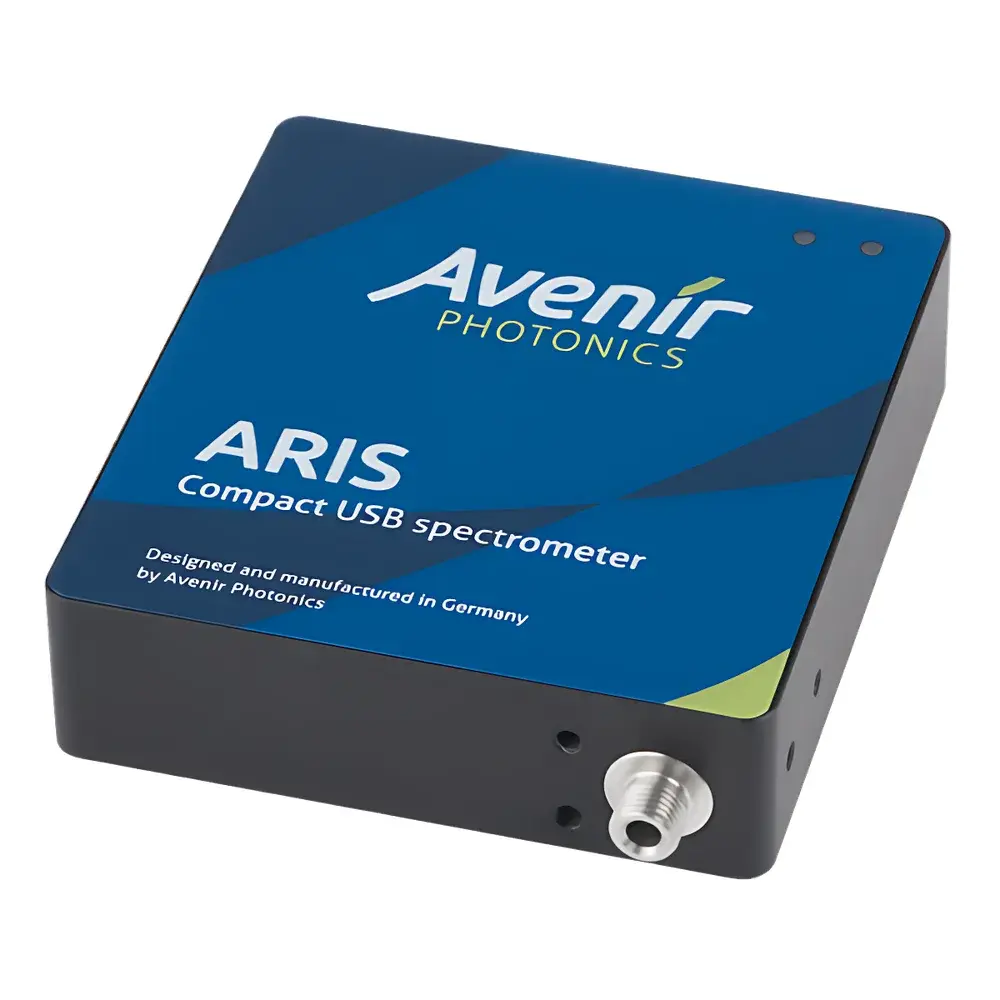
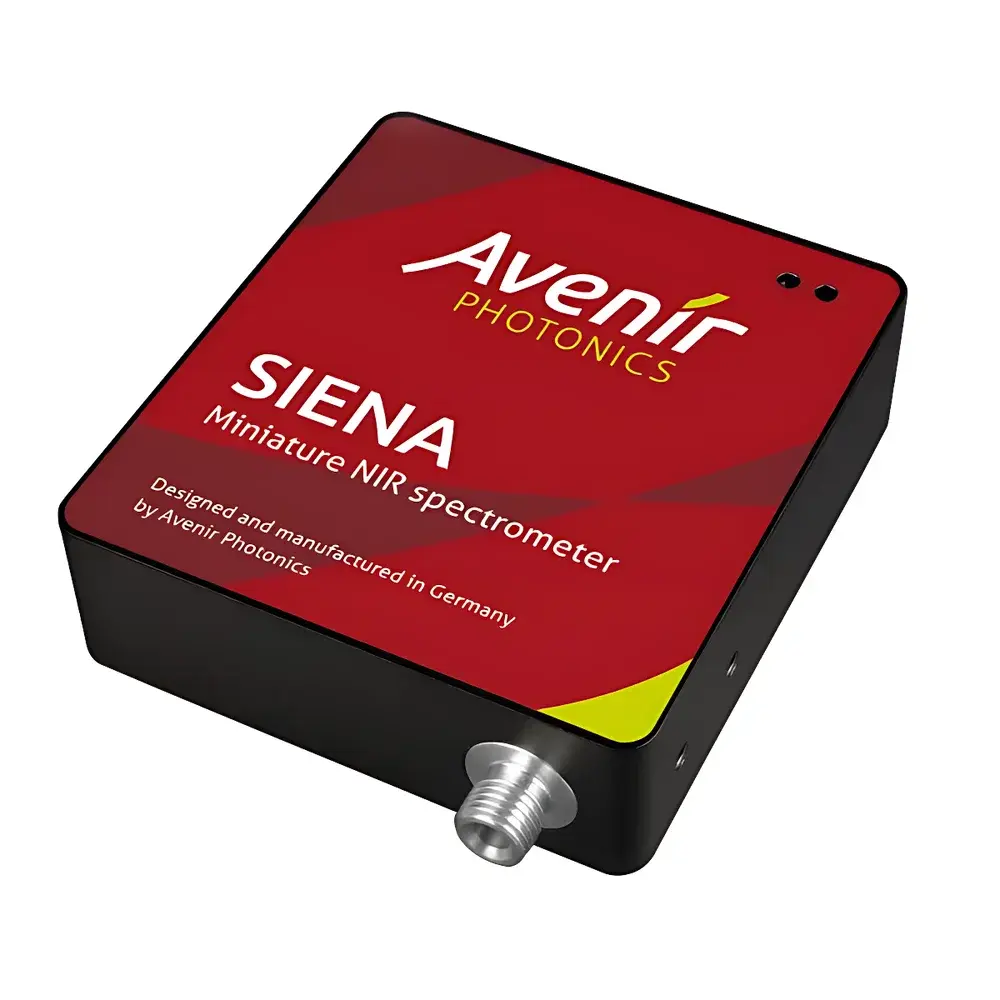
Avenir Aris Fiber Optic Spectrometer
| Brand | Avenir |
|---|---|
| Origin | Germany |
| Manufacturer Type | Authorized Distributor |
| Import Status | Imported |
| Model | Aris |
| Price | Upon Request |
| Spectral Range | 185–970 nm, 185–550 nm, 185–420 nm, 350–840 nm, 510–1020 nm |
| Detector | CCD |
| Optical Resolution (FWHM) | 0.33–1.40 nm |
| Signal-to-Noise Ratio | 350:1 or 600:1 |
| Dynamic Range | 1900:1 or 5000:1 |
| Stray Light | < 0.08 % |
Overview
The Avenir Aris Fiber Optic Spectrometer is a compact, high-performance benchtop spectrometer engineered for precision spectral acquisition in demanding industrial, research, and field-deployable applications. Based on a symmetric high-throughput Czerny-Turner optical architecture with a 50 mm focal length and f/6.3 numerical aperture (NA = 0.16), the Aris delivers exceptional light throughput while maintaining rigorous stray light suppression (< 0.08 %). Its core measurement principle relies on dispersive spectroscopy using ruled or holographic diffraction gratings coupled with linear CCD array detectors—enabling accurate wavelength-resolved intensity quantification across UV-VIS-NIR bands. Designed to bridge the performance gap between laboratory-grade instruments and embedded OEM systems, the Aris supports real-time onboard processing, robust environmental operation (−20 °C to +60 °C), and seamless integration into automated analytical platforms via USB 2.0 Full-Speed, UART, SPI, or I²C interfaces.
Key Features
- Five standardized spectral configurations: 185–970 nm (broadband), 185–550 nm (UV/VIS), 185–420 nm (deep UV), 350–840 nm (VIS), and 510–1020 nm (VIS/NIR)—all selectable at order time
- User-replaceable entrance slit (default 20 µm); optional wider slits available to trade resolution for increased sensitivity
- Onboard 16-bit ADC (2 MHz sampling) with hardware-accelerated dark/offset/nonlinearity correction, spectral averaging, and buffer management (up to 63 spectra stored onboard)
- Integrated microcontroller enabling automatic exposure control, real-time spectral evaluation, and application-specific algorithm execution
- Compact form factor (67.0 × 74.0 × 19.0 mm; 122 g) with industrial-grade thermal and mechanical stability—qualified for continuous operation in non-condensing environments (0–90 % RH)
- Compliance with EU EMC Directive 2014/30/EU, RoHS, REACH SVHC, and U.S. Conflict Minerals Reporting requirements
Sample Compatibility & Compliance
The Aris spectrometer is compatible with standard SMA-905 fiber-optic interfaces (custom connectors available upon request), supporting coupling to halogen, deuterium, LED, or laser sources, as well as integrating spheres, cuvette holders, and remote probes. Its optical design includes built-in order-sorting filters where required, minimizing higher-order diffraction artifacts. The instrument meets critical regulatory expectations for analytical instrumentation: spectral data integrity is preserved through hardware-level timestamping, deterministic exposure control, and repeatable scan triggering—features essential for GLP/GMP-aligned workflows. While not pre-certified for FDA 21 CFR Part 11, its deterministic firmware architecture, audit-ready logging capabilities (via SDK), and traceable calibration reports support validation protocols required in pharmaceutical, food safety, and environmental monitoring applications.
Software & Data Management
Avenir provides a comprehensive Windows-based application suite (Windows 7+) and a cross-platform Software Development Kit (SDK) including C/C++, Python, and LabVIEW libraries. The SDK enables full low-level register access, real-time spectrum streaming, and customizable post-processing pipelines—including baseline correction, peak detection, and multivariate calibration (e.g., PLS regression). All spectral acquisitions include embedded metadata: exposure time, integration count, detector temperature (monitored), and calibration coefficients. Raw data exports support CSV, HDF5, and vendor-neutral JCAMP-DX formats. For regulated environments, users may implement external audit trails and electronic signatures in accordance with internal SOPs—leveraging the device’s deterministic timing and stable USB enumeration behavior.
Applications
- UV-Vis absorbance and reflectance measurements in inline process monitoring (e.g., chemical synthesis, water quality, coating thickness)
- LED and laser diode characterization—including center wavelength, FWHM, and spectral stability under thermal load
- Fluorescence excitation/emission profiling in life science instrumentation and portable diagnostics
- Colorimetric analysis in food, textile, and display manufacturing (CIE XYZ, L*a*b* conversion supported via SDK)
- OEM integration into handheld analyzers, environmental sensors, and educational lab modules requiring rugged, low-power spectral engines
FAQ
What spectral resolution can be achieved with the Aris spectrometer?
Resolution is configuration-dependent: typical FWHM values range from 0.33 nm (185–420 nm UV configuration, 20 µm slit, Toshiba TCD1304DG detector) to 1.40 nm (185–970 nm broadband configuration). Resolution scales approximately linearly with entrance slit width.
Is the Aris spectrometer suitable for quantitative absorbance measurements?
Yes—when paired with calibrated light sources and reference standards, the Aris achieves photometric repeatability better than ±0.5 % over 8-hour sessions. Stray light performance (< 0.08 %) enables reliable absorbance measurements up to 3.0 AU.
Can I customize the grating or detector beyond standard options?
Avenir supports custom grating rulings, blaze wavelengths, and detector substitutions (e.g., Hamamatsu S11639-01, Toshiba TCD1304DG, or back-thinned CCDs) under NRE agreements. Lead times and MOQs apply.
Does the device support external triggering for synchronized measurements?
Yes—the auxiliary 16-pin IDC connector provides TTL-compatible trigger input/output, programmable GPIO, and flash pulse generation—enabling synchronization with lasers, shutters, or motion stages.
What is the minimum integration time and spectral acquisition rate?
Minimum exposure is 4 ms (Toshiba detector) or 2.5 ms (Hamamatsu detector). Full-spectrum transfer to host occurs in ≤17 ms (USB 2.0 Full-Speed), enabling effective frame rates >50 Hz for dynamic processes.
Related Products






