
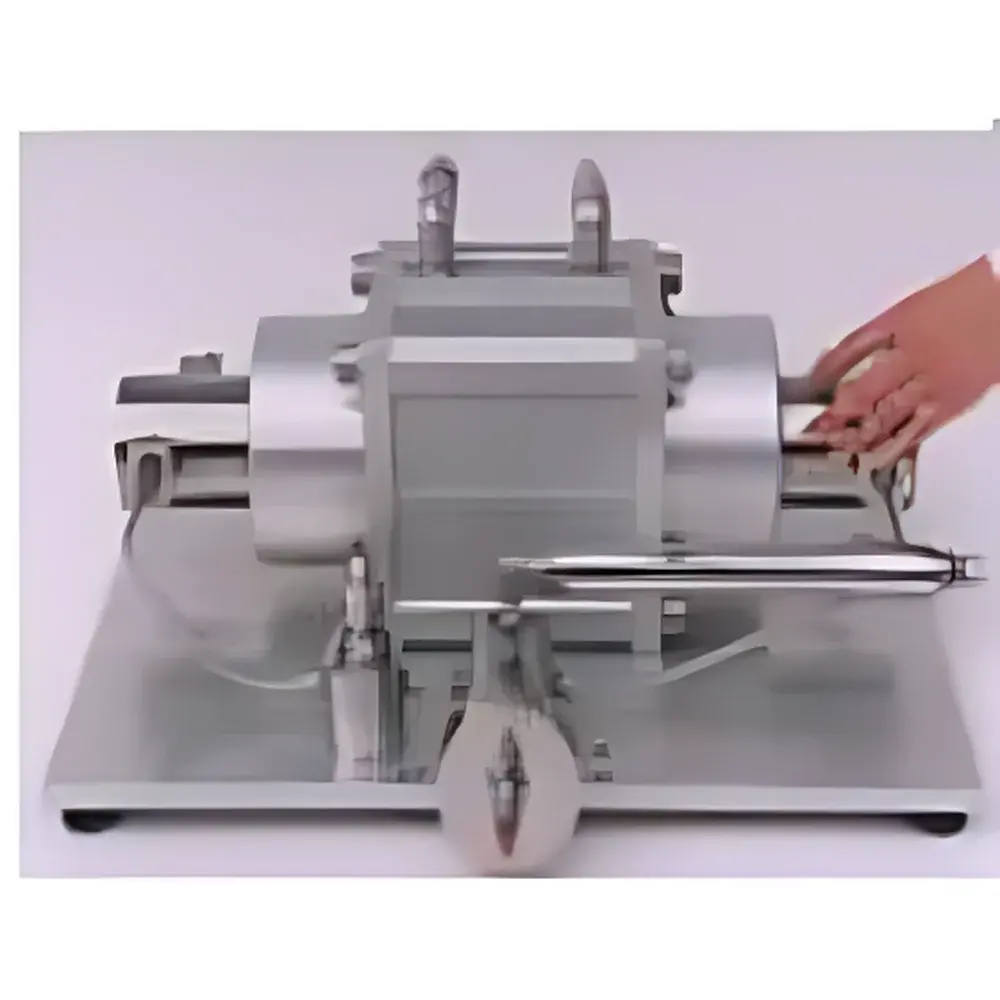
AVESTIN EmulsiFlex-C50 High-Pressure Nano Homogenizer
| Brand | AVESTIN |
|---|---|
| Origin | Canada |
| Manufacturer | Avestin Inc., Ottawa, Canada |
| Model | EmulsiFlex-C50 |
| Max Operating Pressure | 30,000 psi (207 MPa) |
| Flow Rate | 15–50 L/h |
| Minimum Sample Volume | 25 mL |
| Drive Type | Pneumatic Dual-Piston |
| Safety | Auto-circuit cutoff with 20% transient overpressure tolerance |
| Construction Material | ASTM-certified 316L stainless steel |
| Sterilization | Direct steam-in-place (SIP), O-ring-free fluid path |
| Compliance | FDA 21 CFR Part 11-ready architecture, GMP-compliant design |
| Optional Accessories | Extrusion filter, heat exchanger |
| Instrument Category | High-Pressure Cell Disruptor |
Overview
The AVESTIN EmulsiFlex-C50 is a high-pressure nano homogenizer engineered for precision disruption, homogenization, and nano-scale particle size reduction in life science and pharmaceutical R&D and manufacturing environments. Based on the principle of microfluidic shear and controlled cavitation under ultra-high pressure, the EmulsiFlex-C50 subjects samples to instantaneous pressure differentials exceeding 30,000 psi (207 MPa) as they pass through a precisely engineered interaction chamber. This hydrodynamic mechanism enables reproducible lysis of robust microbial cells (e.g., E. coli, yeast, spores), efficient lipid bilayer fusion for liposome formation, and sub-100 nm dispersion of crystalline APIs or colloidal suspensions—without thermal degradation or metal leaching. Designed and assembled in Ottawa, Canada, the C50 platform integrates process scalability with laboratory-grade control fidelity, supporting both early-stage formulation development and cGMP-aligned pilot production.
Key Features
- Ultra-high pressure capability up to 30,000 psi (207 MPa), validated for continuous operation at rated flow rates
- Pneumatic dual-piston drive system delivering stable, pulse-free flow and extended service life under repetitive high-load cycling
- O-ring–free, crevice-free fluid path constructed entirely from electropolished ASTM A276 316L stainless steel—certified compliant with FDA 21 CFR 178.3570 for food-contact and USP Class VI biocompatibility
- Integrated steam-in-place (SIP) sterilization capability; no disassembly required for routine bioburden control per ISO 13408-1 and EU Annex 1 guidelines
- Real-time pressure monitoring with redundant safety interlocks: automatic main circuit cutoff upon deviation >±2% from setpoint, plus 20% transient overpressure tolerance for controlled ramp-up sequences
- Modular architecture supporting optional integration of inline heat exchangers (for temperature-sensitive formulations) and post-homogenization extrusion filters (0.1–0.45 µm)
Sample Compatibility & Compliance
The EmulsiFlex-C50 accommodates aqueous, organic, and mixed-phase systems—including viscous lipid dispersions, protein-rich lysates, nanoparticle suspensions, and sterile-filtered biologics intermediates. Its minimum process volume of 25 mL supports cost-efficient screening of high-value candidates (e.g., mRNA-LNPs, peptide conjugates, or orphan drug actives). All wetted surfaces comply with ASME BPE-2022 surface finish specifications (Ra ≤ 0.4 µm) and meet EHEDG Doc. 8 hygienic design criteria. Documentation packages include IQ/OQ protocols aligned with ASTM E2500-13 and support full validation under ICH Q5A(R2), USP , and FDA Guidance for Industry: Process Validation (2011). The system’s audit trail architecture satisfies 21 CFR Part 11 requirements when paired with validated third-party SCADA or LIMS interfaces.
Software & Data Management
While the EmulsiFlex-C50 operates via an intuitive local HMI with tactile pressure/flow setpoint dials and LED status indicators, its analog and digital I/O ports (4–20 mA, RS-485 Modbus RTU) enable seamless integration into centralized data acquisition networks. Users may log time-stamped pressure profiles, cycle counts, and thermal events for retrospective analysis. When deployed in regulated environments, the device supports electronic signature workflows via external validation-ready software platforms. Raw operational data—including cumulative runtime, maximum pressure excursions, and maintenance alerts—is exportable in CSV or XML formats for trending per ISO 9001:2015 Clause 8.5.2.
Applications
- Cell disruption: Gram-negative and Gram-positive bacteria, yeast, algae, and mammalian cells for intracellular protein recovery
- Liposome & LNPs: Size-controlled unilamellar vesicle formation (PDI <0.12) and encapsulation efficiency optimization
- Nanocrystal stabilization: Top-down milling of poorly water-soluble compounds (BCS Class II/IV) to median diameters <100 nm
- Vaccine adjuvant preparation: Uniform emulsification of oil-in-water systems (e.g., MF59 analogues)
- Exosome isolation: Gentle yet effective membrane fragmentation preceding differential ultracentrifugation
- GMP pilot runs: Scalable batch processing from 25 mL to 50 L/h with identical shear history and particle distribution profiles
FAQ
What is the smallest recommended sample volume for method development?
The validated minimum working volume is 25 mL. Volumes below this threshold risk inconsistent pressure transmission and reduced homogenization efficiency due to compressibility effects in low-mass fluid columns.
Can the EmulsiFlex-C50 be used for sterile processing?
Yes—when equipped with SIP-compatible valves and operated within validated temperature/pressure/time parameters, the system achieves SAL 10⁻⁶ per ISO 11138-3 using saturated steam at ≥121°C for ≥15 min.
Is third-party calibration traceable to NIST standards available?
AVESTIN provides factory calibration certificates traceable to NRC Canada (equivalent to NIST) for pressure transducers and flow meters; on-site recalibration services are offered globally under ISO/IEC 17025-accredited procedures.
How does the C50 differ from benchtop hydraulic homogenizers?
Unlike hydraulic systems prone to pulsation-induced particle aggregation, the pneumatic dual-piston drive delivers laminar, constant-flow dynamics—critical for narrow PDI targets in nanomedicine applications.
Does the system support remote monitoring in a 21 CFR Part 11 environment?
Yes—via secure Modbus TCP integration with validated MES or ELN platforms that enforce role-based access control, electronic signatures, and immutable audit trails.





