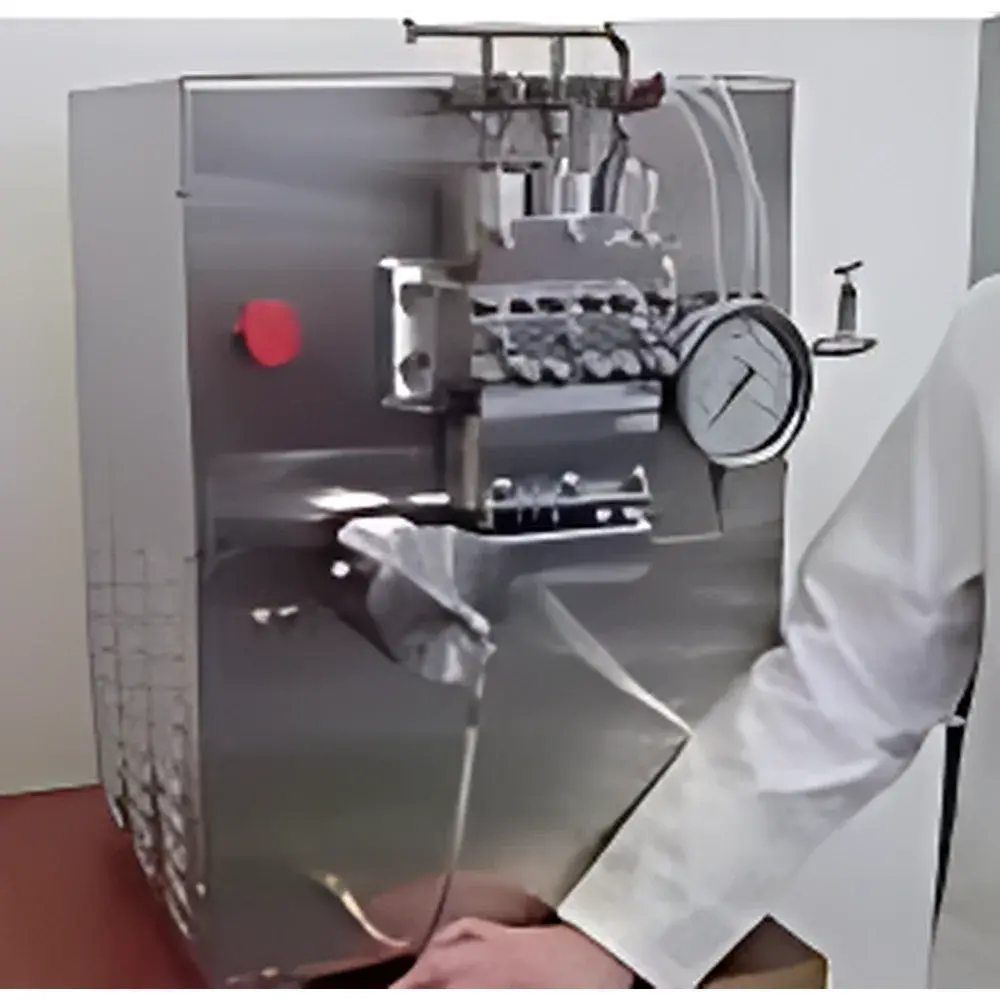
Avestin EmulsiFlex-C55 High-Pressure Homogenizer
| Brand | Avestin |
|---|---|
| Origin | Canada |
| Manufacturer | Avestin Inc., Ottawa, Canada |
| Model | EmulsiFlex-C55 |
| Pressure Range | 0–30,000 psi (0–207 MPa) |
| Flow Rate | 15–50 L/h |
| Minimum Sample Volume | 7 mL |
| Drive Type | Pneumatic Dual-Piston |
| Compliance | GMP, FDA 21 CFR Part 11–ready architecture, ASME BPE–compatible materials |
| Construction Material | Electropolished 316L stainless steel |
| Sterilization | SIP/CIP-capable, O-ring–free fluid path |
| Safety | Auto-cutoff circuit protection, transient overpressure tolerance up to 20% |
Overview
The Avestin EmulsiFlex-C55 is a high-precision, pneumatically driven high-pressure homogenizer engineered for sterile, scalable processing of biopharmaceutical and nanomedicine formulations. Operating on the principle of microfluidic shear and cavitation-induced cell disruption, the C55 delivers consistent, reproducible particle size reduction under precisely controlled pressure conditions up to 30,000 psi (207 MPa). Unlike conventional hydraulic or electric homogenizers, its fully pneumatic drive eliminates risk of lubricant, particulate, or hydrocarbon contamination—making it uniquely suited for GMP-compliant development and manufacturing of liposomes, nanoemulsions, viral vectors, protein aggregates, and nanoparticle suspensions. Designed and assembled in Ottawa, Canada, the EmulsiFlex-C55 meets stringent international regulatory expectations for material traceability, surface finish, and process validation.
Key Features
- Pneumatic dual-piston drive system with zero-lubricant operation—eliminates oil, grease, and particulate ingress into the product stream
- O-ring–free, crevice-free fluid path constructed entirely from electropolished 316L stainless steel (Ra ≤ 0.4 µm), validated for SIP (steam-in-place) and CIP (clean-in-place)
- GMP-compliant pressure sensing via diaphragm-type transducers—no fill-fluid contamination risk inherent to Bourdon-tube gauges
- Double-ended shell-and-tube heat exchanger with segregated coolant and process fluid circuits—prevents cross-contamination during temperature-sensitive processing
- Auto-cutoff safety interlock with real-time pressure monitoring; supports transient overpressure operation up to 120% of setpoint for short-duration process optimization
- Scalable throughput: nominal flow range of 15–50 L/h, with validated minimum sample volume as low as 7 mL—ideal for early-stage formulation screening and expensive API handling
Sample Compatibility & Compliance
The EmulsiFlex-C55 accommodates a broad spectrum of biological and pharmaceutical matrices—including bacterial and yeast lysates, mammalian cell suspensions, lipid dispersions, polymer nanoparticles, and viscous bioconjugates—without compromising sterility or structural integrity. Its fluid-contact surfaces conform to ASME BPE-2023 standards for bioprocessing equipment, and all wetted components are certified compliant with US FDA 21 CFR Parts 11 and 177 (indirect food additives), EU Regulation (EC) No. 1935/2004, and ISO 10993–1 for biocompatibility. The absence of elastomeric seals, combined with full electrochemical passivation and end-to-end traceability documentation, enables seamless integration into GLP/GMP audit workflows and facilitates successful FDA pre-submission inspections.
Software & Data Management
While the base EmulsiFlex-C55 operates via analog pressure control with mechanical safety cutoffs, optional digital instrumentation packages support 21 CFR Part 11–compliant data acquisition. These include calibrated pressure transducers with 0.25% FS accuracy, integrated temperature sensors at inlet/outlet ports, and programmable logic controllers (PLCs) capable of logging timestamped pressure, flow, and thermal profiles. Audit trails are generated with user authentication, electronic signatures, and immutable record retention—fully aligned with Annex 11 and ICH GCP requirements. Data export formats include CSV and XML for direct import into LIMS or QbD platforms.
Applications
- Liposome and lipid nanoparticle (LNP) formulation for mRNA delivery systems
- Cell lysis and inclusion body solubilization in recombinant protein production
- Nanocrystal dispersion for poorly water-soluble APIs (BCS Class II/IV)
- Virus-like particle (VLP) size homogenization and aggregation control
- Stable oil-in-water and water-in-oil nanoemulsions for topical and parenteral delivery
- Exosome isolation and extracellular vesicle size standardization
FAQ
What is the maximum validated particle size reduction achievable with the EmulsiFlex-C55?
Consistent sub-100 nm modal diameters have been demonstrated across multiple independent laboratories for liposomal and polymeric nanocarriers—subject to feedstock composition, number of passes, and thermal management.
Can the system be validated for aseptic processing?
Yes—the entire fluid path is SIP-capable at ≥121°C for ≥15 minutes, with documented temperature mapping and endotoxin reduction validation per ISO 15883 and PDA TR71.
Is the EmulsiFlex-C55 suitable for continuous GMP manufacturing?
It is qualified for clinical-phase manufacturing (Phase I–III) and commercial-scale batch processing; full validation packages—including IQ/OQ/PQ protocols and FAT/SAT documentation—are available upon request.
How does the pneumatic drive compare to electric or hydraulic alternatives in terms of maintenance and reliability?
Pneumatic operation eliminates motor brush wear, gear oil degradation, and hydraulic fluid leakage—reducing scheduled downtime by >40% and extending mean time between failures (MTBF) to >12,000 operating hours.
Does Avestin provide installation qualification support for regulated facilities?
Yes—Avestin’s global field service engineers deliver turnkey IQ/OQ execution, including calibration certificates traceable to NIST standards, surface roughness verification reports, and material compliance dossiers.