
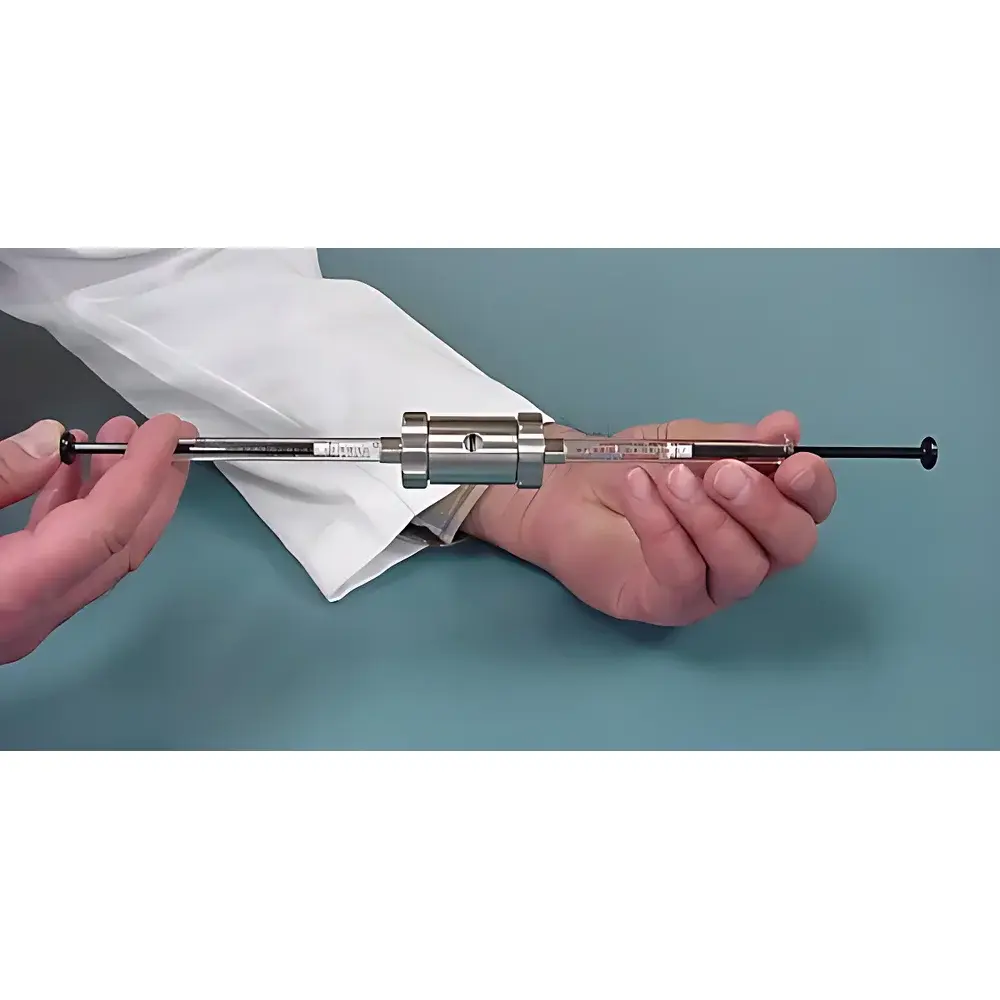
AVESTIN LF1 Liposome Extruder
| Brand | AVESTIN |
|---|---|
| Origin | Canada |
| Model | LF1 |
| Sample Volume | 0.1–1 mL |
| Membrane Pore Sizes | 50, 100, 200, 400, 800, 1000 nm |
| Operating Principle | Manual pressure-driven extrusion through polycarbonate track-etched membranes |
| Weight | <2 kg |
| Temperature Compatibility | Compatible with water bath (ambient to 60 °C) |
| Includes | Two 1 mL glass syringes, one extrusion module, fifty 100 nm membranes |
| Optional Accessories | Stabilizing base clamp, nitrogen-driven automated extrusion system |
Overview
The AVESTIN LF1 Liposome Extruder is a precision-engineered manual extrusion device designed for the reproducible size reduction and homogenization of lipid-based nanostructures—including liposomes, lipid nanoparticles (LNPs), and other vesicular drug delivery systems. It operates on the principle of forced extrusion: a defined sample volume is manually driven under controlled pressure through stacked, track-etched polycarbonate membranes with precisely calibrated pore diameters. This process induces uniform shear and membrane filtration, resulting in narrow polydispersity index (PDI) distributions and highly monodisperse populations critical for pharmaceutical development, biophysical characterization, and regulatory submission. Unlike high-pressure homogenizers or sonication-based methods, the LF1 avoids thermal degradation, oxidation, and mechanical denaturation—making it especially suitable for temperature-sensitive cargoes such as mRNA, proteins, peptides, and labile small molecules. Its compact architecture (<2 kg total mass), modular design, and compatibility with standard laboratory water baths (up to 60 °C) enable seamless integration into GMP-aligned preformulation workflows and academic nanomedicine labs.
Key Features
- Manual extrusion mechanism with ergonomic thumb-press operation—no external power source required.
- Two precision-ground 1 mL borosilicate glass syringes with PTFE-tipped plungers ensure minimal sample adsorption and consistent flow dynamics.
- Interchangeable extrusion module accepts standard 25 mm diameter polycarbonate membranes in six validated pore sizes: 50, 100, 200, 400, 800, and 1000 nm—enabling stepwise size optimization or final polishing.
- Zero residual volume design: complete sample recovery with no dead volume post-extrusion—critical for precious biological payloads and low-yield formulations.
- Full disassembly capability: all wetted parts—including syringe barrels, plungers, spacer rings, and membrane holders—are autoclavable and compatible with ultrasonic cleaning protocols.
- Water-bath compatible thermal management: enables extrusion at physiologically relevant or formulation-optimized temperatures without compromising membrane integrity or lipid phase behavior.
Sample Compatibility & Compliance
The LF1 accommodates aqueous dispersions, ethanol-injection pre-formulations, and detergent-solubilized lipid mixtures across a broad compositional range (e.g., DOPC, DSPC, cholesterol, PEG-lipids, cationic lipids). It is routinely employed in support of ICH Q5A, Q5C, and USP guidelines for nanoparticle characterization. While the LF1 itself is not a regulated medical device, its use aligns with GLP-compliant documentation practices when paired with traceable membrane lots, calibrated syringes, and standardized extrusion cycles (e.g., 11 passes at 25 °C using 100 nm membranes). The system supports audit-ready workflows when integrated with optional nitrogen-driven automation, which provides timestamped pressure logs, cycle counts, and user authentication per FDA 21 CFR Part 11 requirements.
Software & Data Management
The base LF1 model operates without embedded firmware or software. However, when upgraded with the optional nitrogen-driven extrusion module, it interfaces with AVESTIN’s proprietary Extrusion Control Suite (v3.2+), a Windows-based application supporting protocol storage, real-time pressure monitoring (0–100 psi range), programmable pass sequencing, and CSV-exportable extrusion logs. All data files include ISO 8601 timestamps, operator ID fields, and membrane lot traceability metadata—facilitating alignment with electronic lab notebook (ELN) systems and quality management platforms (e.g., Veeva Vault, LabVantage).
Applications
- Preclinical liposome sizing and PDI refinement prior to dynamic light scattering (DLS) or cryo-TEM analysis.
- Process development for mRNA-LNP vaccine candidates requiring tight control over particle diameter (target: 70–100 nm) and encapsulation efficiency.
- Reconstitution of freeze-dried lipid films into unilamellar vesicles with minimized multilamellarity.
- Scale-down modeling for transition from lab-scale extrusion to industrial microfluidic or high-pressure homogenization processes.
- Stability studies assessing size drift under thermal or pH stress conditions via serial extrusion at defined intervals.
FAQ
What is the minimum recommended sample volume for reliable extrusion?
0.1 mL is the validated lower limit; volumes below this may result in inconsistent membrane wetting and incomplete passage.
Can I reuse polycarbonate membranes?
No—membranes are single-use consumables. Reuse risks pore deformation, cross-contamination, and increased PDI due to lipid accumulation.
Is the LF1 compliant with ISO 13485 or FDA registration?
The LF1 is manufactured under AVESTIN’s ISO 13485-certified quality system; however, it is classified as a research-use-only (RUO) instrument and does not require FDA 510(k) clearance.
How do I validate extrusion consistency across operators?
Standardize thumb pressure via training, use the stabilizing base clamp, and document extrusion speed (e.g., 30 seconds per pass); inter-operator CV for Z-average diameter should remain ≤5% when using calibrated 100 nm membranes.
Which membrane pore size should I select for initial liposome sizing?
Start with 100 nm membranes for conventional phospholipid vesicles; reduce to 50 nm for rigid formulations or increase to 200 nm for high-viscosity or polymer-stabilized systems.




