
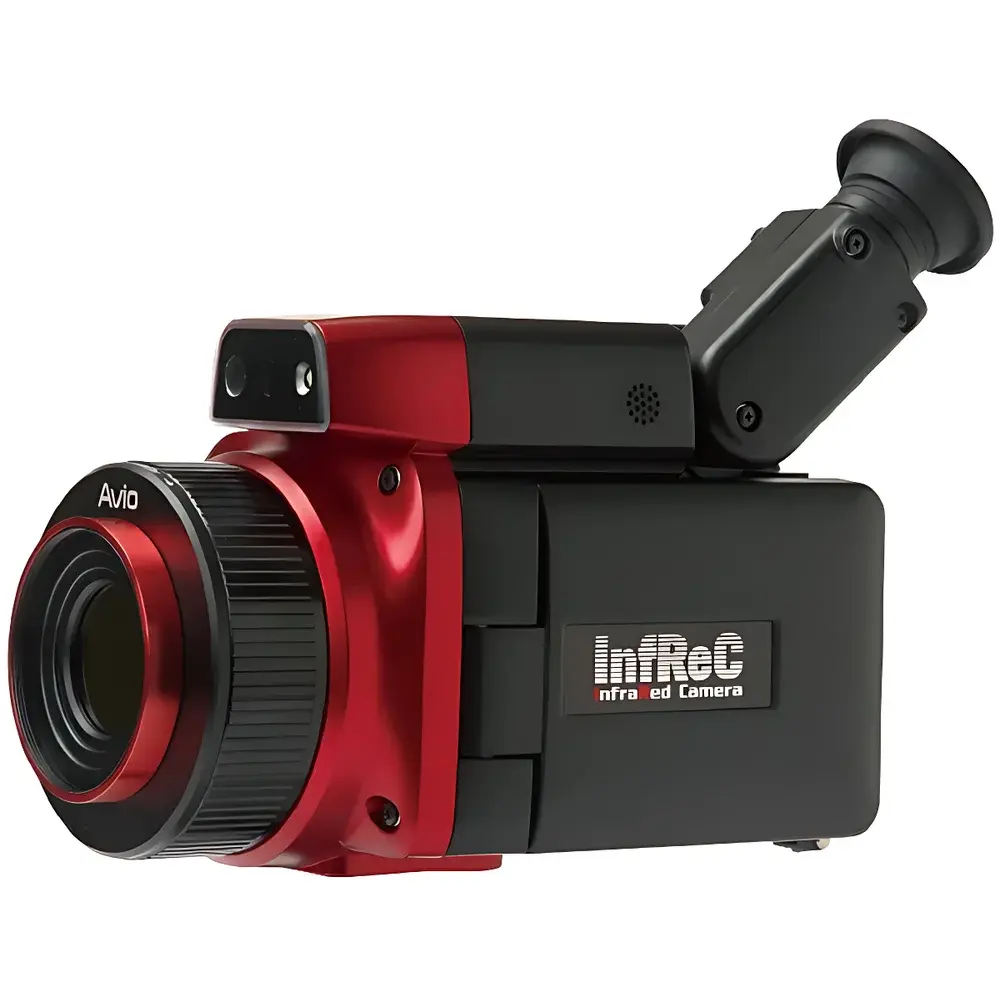
Avio R550 Series Infrared Thermal Imaging Camera
| Brand | Avio |
|---|---|
| Origin | Japan |
| Model | R550 |
| Price Range | USD 14,000–42,000 (FOB) |
| Spectral Range | 8–14 µm |
| Detector Type | Uncooled Microbolometer FPA |
| Measurement Principle | Radiometric Infrared Thermography |
| Temperature Range | −40 °C to 2000 °C (R550Pro), −40 °C to 650 °C (R550) |
| Thermal Sensitivity (NETD) | ≤0.025 °C at 30 °C |
| IR Resolution | 640 × 480 (standard), 1280 × 960 (Super-Resolution mode) |
| Frame Rate | 7.5–120 Hz (region-dependent) |
| Accuracy | ±1 °C or ±1% of reading (at 30 °C reference) |
| Spatial Resolution | 0.58 mrad (SR mode), 0.87 mrad (standard mode) |
| Field of View (Standard Lens) | 32° H × 24° V |
| Focus | Autofocus + Manual |
| Operating Temperature | −15 °C to +50 °C |
| IP Rating | IP54 |
| Battery Life | 2.5 h (Li-ion rechargeable) |
| Weight | 1.3 kg (incl. battery) |
| Compliance | CE (EMC Class A), IEC 60825-1:2007/2014 (Laser Class 2), RoHS |
Overview
The Avio R550 Series Infrared Thermal Imaging Camera is a high-performance, radiometric thermal imager engineered for precision non-contact temperature measurement and dynamic thermal analysis in industrial, R&D, and maintenance environments. Based on uncooled microbolometer focal plane array (FPA) technology operating in the long-wave infrared (LWIR) band (8–14 µm), the R550 delivers calibrated radiometric data traceable to blackbody references. Its dual-model architecture—R550 (−40 °C to 650 °C) and R550Pro (−40 °C to 2000 °C)—enables application-specific deployment across electrical infrastructure monitoring, metallurgical process control, electronics thermal validation, and high-speed transient thermal event capture. The system’s core architecture supports real-time thermographic imaging with frame rates up to 120 Hz in region-of-interest (ROI) windows, enabling quantitative analysis of rapidly evolving thermal phenomena such as switchgear arcing, laser heating dynamics, or combustion front propagation.
Key Features
- High-resolution radiometric imaging: Native 640 × 480 IR resolution with Super-Resolution (SR) mode delivering 1280 × 960 effective pixels for enhanced spatial fidelity and sub-milliradian detail discrimination (0.58 mrad).
- Configurable high-speed acquisition: Region-dependent frame rates—including 120 Hz (640 × 120 ROI), 60 Hz (640 × 240 ROI), and full-frame 30 Hz (R550Pro) or 7.5 Hz (R550)—optimized for both transient event capture and steady-state survey workflows.
- Integrated visible-light imaging: 5 MP CMOS sensor co-aligned with IR optics enables synchronized dual-spectrum capture, adjustable alpha-blended fusion, picture-in-picture overlay, and geometric registration for precise contextual interpretation.
- Advanced optical flexibility: Interchangeable lens options—including 21 µm and 52 µm macro lenses, 2× telephoto, and 2×/3× wide-angle variants—support micro-scale component inspection, large-area facility scanning, and close-focus thermal profiling.
- Robust field operability: IP54-rated enclosure, −15 °C to +50 °C operational range, 3G vibration tolerance, and 30G shock resistance ensure reliability in demanding plant-floor, outdoor, or mobile laboratory conditions.
- Comprehensive radiometric calibration suite: Multi-point emissivity correction, ambient/background temperature compensation, atmospheric transmission modeling, and distance-based attenuation correction—all implemented per ISO 18434-1 and ASTM E1933 guidelines.
Sample Compatibility & Compliance
The R550 Series accommodates a broad spectrum of target materials and geometries without physical contact, including metallic surfaces (oxidized, polished, coated), composite laminates, ceramic substrates, polymer enclosures, and refractory linings. Emissivity values from 0.1 to 1.0 are supported via user-defined tables or inverse emissivity calculation algorithms. The instrument complies with CE marking requirements (EMC Directive 2014/30/EU, LVD Directive 2014/35/EU), meets IEC 60825-1:2007/2014 for integrated Class 2 red laser targeting, and conforms to RoHS 2011/65/EU restrictions on hazardous substances. While not FDA 21 CFR Part 11-certified out-of-the-box, audit-ready data export (JPEG+14-bit radiometric metadata, SVX video with embedded timestamps and GPS optional) supports GLP/GMP-aligned documentation workflows when paired with InfReC Analyzer NS9500Pro software.
Software & Data Management
InfReC Analyzer NS9500Pro (R550Pro) and NS9500Std (R550) provide full-featured post-processing, reporting, and compliance-ready data management. Capabilities include pixel-level temperature profiling, isotherm masking, time-series trend extraction across multiple ROIs, emissivity-mapped thermal maps, and automated report generation in PDF/HTML formats with embedded metadata (camera settings, calibration date, operator ID). All thermal images store 14-bit radiometric data alongside EXIF-compatible headers; SVX video files retain per-frame radiometric integrity and synchronization markers for external trigger alignment. USB 2.0 interface enables direct high-throughput transfer (up to 30 Hz full-frame streaming), while SDHC/SDXC card logging supports continuous recording with configurable alarm-triggered capture and timestamped audio annotations (30 s per frame).
Applications
- Electrical asset health monitoring: Detection of loose connections, load imbalances, and insulation degradation in switchgear, transformers, and bus ducts per IEEE 1827 and NFPA 70B standards.
- Industrial process optimization: Real-time thermal profiling of furnace linings, rolling mill rolls, extrusion dies, and weld pools to validate thermal uniformity and dwell time compliance.
- R&D thermal characterization: Quantitative mapping of thermal resistance in PCB assemblies, battery cell thermal runaway propagation, and LED junction temperature under pulsed drive conditions.
- Mechanical systems diagnostics: Bearing temperature anomaly detection, steam trap functionality verification, and refractory wear assessment in kilns and incinerators.
- Building envelope analysis: Moisture-induced thermal bridging identification and HVAC duct leakage quantification per ASTM C1060 and ISO 6781-3 protocols.
FAQ
What is the difference between R550 and R550Pro models?
The R550Pro extends the upper temperature limit to 2000 °C and supports higher frame rates (up to 120 Hz in ROI modes), whereas the R550 is optimized for general-purpose industrial thermography up to 650 °C with base frame rates of 7.5–30 Hz.
Does the R550 support external triggering for synchronized data acquisition?
Yes—dedicated TTL-compatible external trigger input enables hardware-synchronized start/stop of video recording, ideal for integration with PLCs, oscilloscopes, or motion control systems.
Can radiometric data be exported for third-party analysis?
All JPEG exports embed full 14-bit temperature data per pixel in standardized metadata fields; raw thermal matrices are also extractable via InfReC Analyzer’s batch export function for MATLAB, Python (NumPy), or Excel integration.
Is lens calibration required when swapping optics?
Each interchangeable lens includes factory-calibrated parameters stored in its EEPROM; the camera auto-detects and applies appropriate spatial resolution, FOV, and NETD corrections upon mounting.
How is measurement accuracy validated over time?
The system supports periodic verification using NIST-traceable blackbody sources; built-in self-check routines monitor detector drift, lens transmission stability, and ambient temperature sensor performance—logs are accessible via diagnostic menu and exportable for QA audits.



