
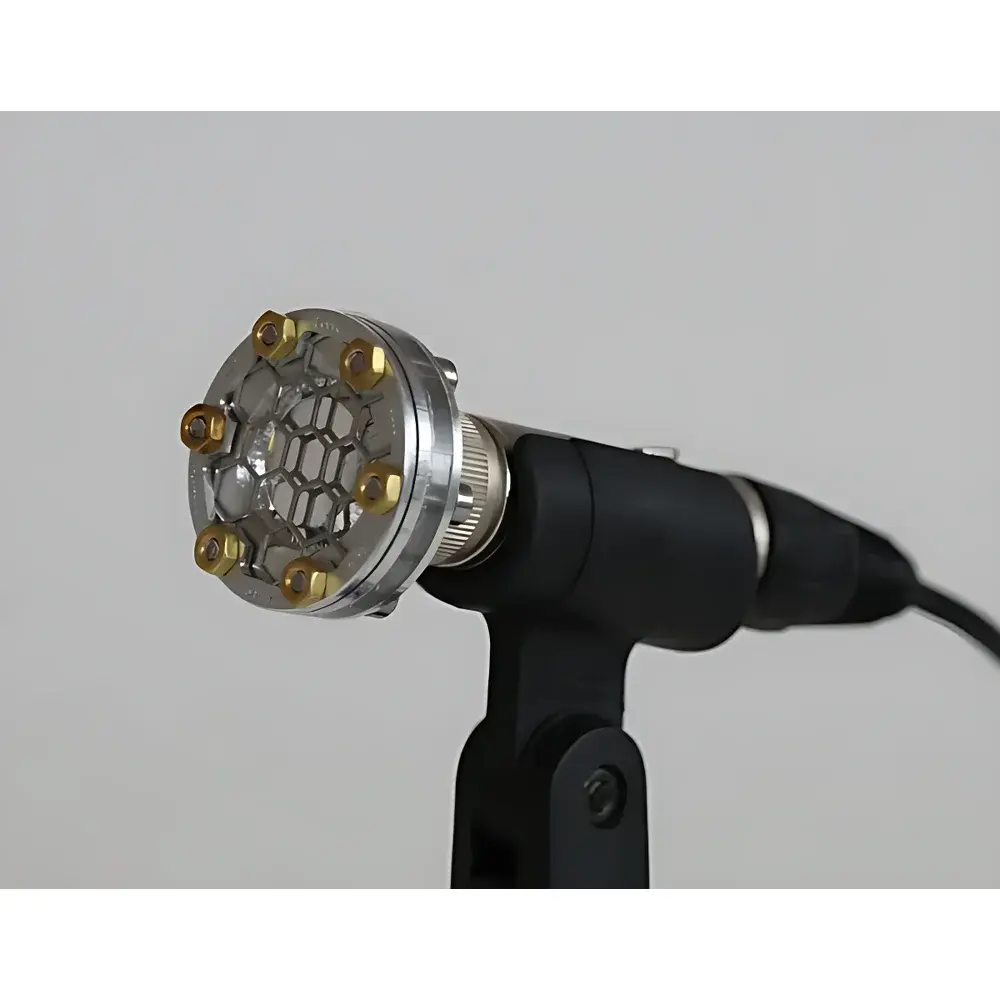
Avisoft CM16/CMPA Ultrasonic Condenser Microphone
| Brand | Avisoft |
|---|---|
| Origin | Germany |
| Model | CM16/CMPA |
| Instrument Type | Ultrasonic Noise Recorder |
| Frequency Range | 2 kHz to 200 kHz |
| Self-Noise | 18 dB SPL |
| Sensitivity | 500 mV/Pa |
| Connector | XLR-5 Male |
| Dimensions | 36 × 36 × 60 mm |
| Weight | 65 g |
| Power Supply | External Polarization via UltraSoundGate Interface |
| Optional Field Accessory | USB Power Adapter |
Overview
The Avisoft CM16/CMPA is a high-fidelity, externally polarized condenser ultrasonic microphone engineered for precise acoustic measurement in the near-ultrasonic and ultrasonic frequency bands. Designed and manufactured in Germany, it operates on the principle of electrostatic transduction, utilizing a precision-machined metal diaphragm and rigid metal backplate architecture to ensure linear phase response and minimal resonance artifacts across its operational bandwidth. Unlike conventional audio microphones limited to 20 kHz, the CM16/CMPA extends acoustic capture capability from 2 kHz up to 200 kHz—enabling reliable detection and quantification of bioacoustic emissions (e.g., bat echolocation calls, rodent ultrasonic vocalizations), industrial ultrasonic leakage, corona discharge signatures, and non-destructive testing (NDT) signals. Its low self-noise floor of 18 dB SPL and high sensitivity of 500 mV/Pa support high signal-to-noise ratio (SNR) recordings even under low-amplitude ultrasonic conditions. The microphone is not standalone; it requires external polarization voltage and signal conditioning provided exclusively by Avisoft’s UltraSoundGate series interfaces (e.g., UltraSoundGate 116 H, 416 H, or 1216), ensuring calibrated, time-synchronized, and low-jitter digital acquisition.
Key Features
- Externally polarized condenser design with metal diaphragm and fixed metal backplate for thermal and mechanical stability
- Flat, balanced frequency response from 2 kHz to 200 kHz—verified per IEC 61094-4 calibration protocols
- Integrated low-noise JFET preamplifier optimized for extended high-frequency gain above 50 kHz
- XLR-5 male connector compliant with AES42-2019 digital microphone interface conventions (analog output variant)
- Compact, lightweight housing (65 g) with IP54-rated protective grille for field-deployable durability
- Compatible with Avisoft’s full UltraSoundGate hardware platform—including multi-channel synchronization and real-time spectral processing capabilities
Sample Compatibility & Compliance
The CM16/CMPA is validated for use with biological, environmental, and industrial ultrasonic sources requiring broadband temporal fidelity. It supports standardized recording workflows aligned with ISO 18405:2017 (Underwater acoustics — Terminology), ASTM E1188-22 (Practice for Collection and Preservation of Information to Determine Acoustic Emission Source Location), and EU Directive 2002/49/EC on environmental noise assessment. When paired with UltraSoundGate interfaces and Avisoft-SASLab Pro software, the system meets GLP-compliant data integrity requirements—including audit-trail logging, user-access controls, and metadata embedding (timestamp, gain, sampling rate, calibration history). All components are CE-marked and RoHS-compliant. Calibration certificates traceable to PTB (Physikalisch-Technische Bundesanstalt) are available upon request.
Software & Data Management
Data acquisition and analysis are performed using Avisoft-SASLab Pro v5.2+, a dedicated platform for ultrasonic bioacoustics and technical sound analysis. The software enables real-time FFT, spectrogram generation (up to 192 kHz FFT resolution), amplitude envelope extraction, automated call detection (via customizable threshold and duration filters), and batch parameter export (e.g., peak frequency, duration, entropy, Wiener entropy). Raw binary data is stored in lossless .wav format with embedded header metadata, supporting post-hoc reprocessing and third-party integration (MATLAB, Python via SciPy/WAV libraries). All acquisition sessions include automatic gain-staging validation and anti-aliasing filter status reporting to ensure measurement repeatability across deployments.
Applications
- Bioacoustics research: Recording and classification of bat species-specific echolocation pulses (25–120 kHz), murine USVs (30–120 kHz), and avian harmonic-rich calls
- Environmental noise monitoring: Detection of ultrasonic components in wind turbine blade noise, HVAC system leaks, and transformer corona activity
- Industrial diagnostics: Non-invasive identification of gas leaks (>30 kHz), bearing wear signatures, and valve chatter in pressurized systems
- Preclinical neuroscience: In vivo ultrasonic vocalization studies in rodent models of neurodevelopmental disorders
- Acoustic metrology: Reference-grade validation of ultrasonic transducers and transceiver arrays in anechoic chamber environments
FAQ
Is the CM16/CMPA compatible with non-Avisoft data acquisition systems?
No—it requires external polarization voltage (200 V DC) and impedance-matched signal conditioning only provided by UltraSoundGate interfaces. Direct connection to standard audio interfaces or DAQ devices will result in signal degradation or damage.
What is the recommended calibration interval?
Avisoft recommends annual recalibration against a primary standard at an accredited laboratory (e.g., PTB or NIST-traceable facility), especially when used in regulatory or publication-critical applications.
Can the microphone be used underwater or in high-humidity environments?
It is rated IP54 for dust and splash resistance but is not submersible. For aquatic applications, Avisoft offers hydrophone variants (e.g., CM16-H) with pressure-compensated housings.
Does the system support real-time triggering based on ultrasonic events?
Yes—UltraSoundGate firmware supports hardware-level threshold-triggered recording with sub-millisecond latency, configurable via SASLab Pro’s Trigger Manager module.
Is FDA 21 CFR Part 11 compliance supported?
When deployed with SASLab Pro in “Audit Mode” and integrated into a validated laboratory information management system (LIMS), electronic records meet ALCOA+ principles and Part 11 requirements for electronic signatures and audit trails.







