
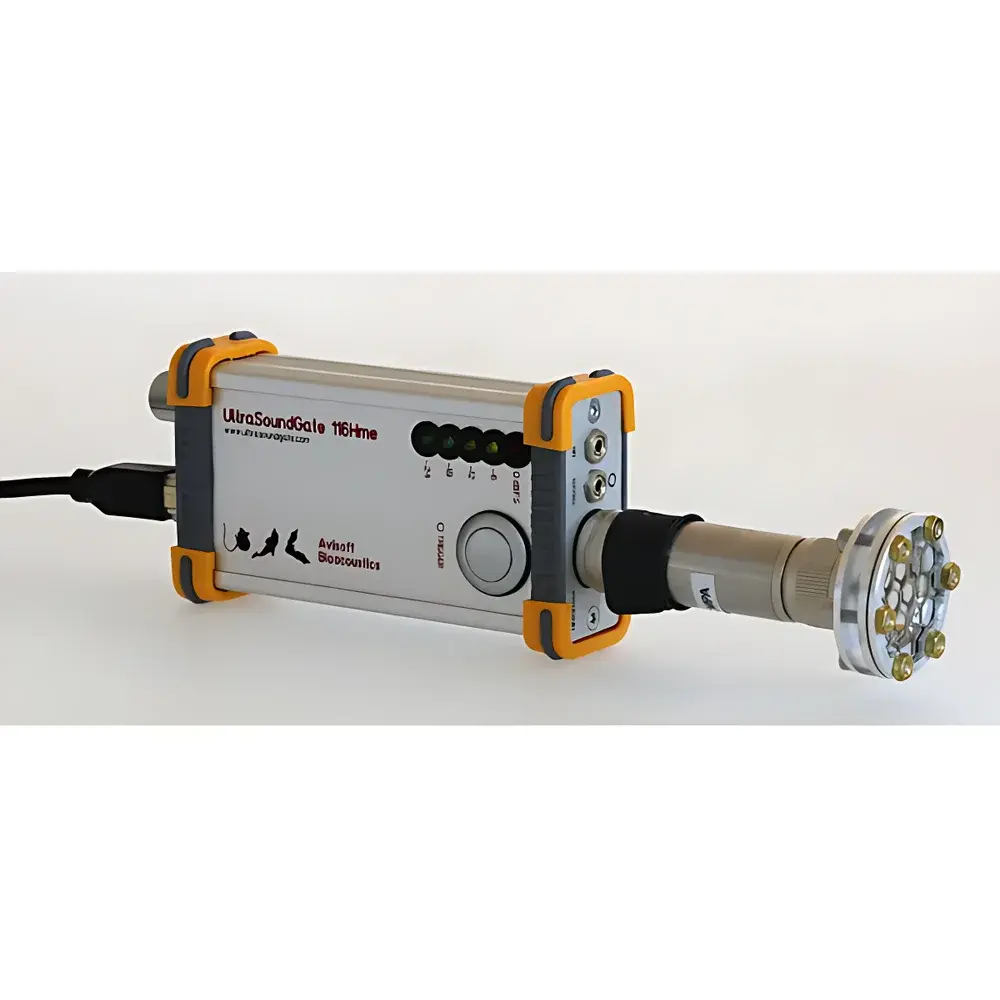
Avisoft UltraSoundGate 116Hm Animal Bioacoustics Recording and Analysis System
| Brand | Avisoft |
|---|---|
| Origin | Germany |
| Model | UltraSoundGate 116Hm |
| Channel Count | Dual-channel (stereo) |
| Sampling Rate | Up to 384 kHz |
| Bit Depth | 24-bit |
| Frequency Range | 0.5 Hz – 250 kHz (ultrasonic-capable) |
| Input Impedance | >10 MΩ |
| Preamp Gain | Adjustable up to +60 dB |
| Power Supply | USB bus-powered or external 5 V DC |
| Environmental Rating | IP54 (dust- and splash-resistant) |
| Software | Avisoft-SASLab Pro v5.2+ |
| Compliance | CE, RoHS, FDA 21 CFR Part 11-ready (audit trail & electronic signature support via optional configuration) |
Overview
The Avisoft UltraSoundGate 116Hm is a high-fidelity, dual-channel ultrasonic audio acquisition and analysis system engineered specifically for bioacoustic research in ethology, neuroethology, behavioral pharmacology, and comparative physiology. Built upon a low-noise, wide-bandwidth analog front-end and precision 24-bit ADC architecture, it captures acoustic emissions across an extended spectral range—from sub-audible infrasound (0.5 Hz) through human hearing (20 kHz) into the ultrasonic domain (up to 250 kHz)—enabling rigorous quantification of vocalizations from bats, rodents, frogs, insects, birds, and marine species. The system operates on the principle of time-domain waveform digitization followed by spectral decomposition using fast Fourier transform (FFT), wavelet-based segmentation, and parametric modeling—providing researchers with traceable, reproducible metrics aligned with ISO 18405:2017 (Underwater acoustics — Terminology) and ASTM E2914-22 (Standard Guide for Bioacoustic Monitoring). Its modular design integrates seamlessly with calibrated condenser microphones (e.g., Avisoft CM16/CMPA series), active ultrasonic speakers, GPS-enabled field recorders, and synchronized video capture devices—making it suitable for both controlled laboratory paradigms (e.g., USV recording in mouse operant chambers) and long-term field deployments.
Key Features
- Dual-channel, USB-powered interface with independent programmable preamplifiers (0–60 dB gain, 10 MΩ input impedance) optimized for low-self-noise (<3 µV RMS) signal integrity
- Real-time 24-bit/384 kHz sampling ensures Nyquist-compliant capture of broadband ultrasonic transients without aliasing artifacts
- IP54-rated enclosure enables robust operation under variable ambient conditions—including humidity, wind, and light rain—during extended野外 deployments
- Integrated environmental sensor suite (optional) logs temperature, relative humidity, barometric pressure, and GPS coordinates synchronized with each .WAV file timestamp
- Hardware-level trigger inputs support precise event alignment with behavioral tracking systems (e.g., EthoVision XT, Noldus), EEG amplifiers, or photodiode-based stimulus onset detection
- Full compatibility with SMPTE and LANC timecode protocols for frame-accurate audio-video synchronization (tested with Sony PCM-M10, Zoom F6, Blackmagic Pocket Cinema Camera)
- Modular expandability: supports up to four UltraSoundGate units daisy-chained via USB hub for multi-microphone array configurations (e.g., beamforming, source localization)
Sample Compatibility & Compliance
The UltraSoundGate 116Hm accommodates diverse biological sound sources—from transient ultrasonic pulses (<1 ms duration) in echolocating bats to harmonic-rich social calls in murine models (e.g., 30–110 kHz USVs in C57BL/6 mice). It complies with GLP/GMP documentation requirements when used with SASLab Pro’s audit-trail-enabled workflow (21 CFR Part 11 compliance achievable via validated installation, user access control, and electronic signature modules). All recorded data are stored in uncompressed, metadata-embedded .WAV format conforming to Microsoft/WAVE RIFF specification (IEEE 754 float or integer encoding), ensuring interoperability with third-party tools including MATLAB (Signal Processing Toolbox), Python (Librosa, SciPy), Praat, Raven Pro, and BORIS. Calibration traceability follows ISO/IEC 17025 guidelines using NIST-traceable pistonphones (e.g., GRAS 42AG) and reference sound level meters.
Software & Data Management
Avisoft-SASLab Pro v5.2+ serves as the analytical core—delivering over 100 quantitative acoustic parameters per call (e.g., duration, peak frequency, entropy, Wiener entropy, jitter, shimmer, amplitude modulation depth, spectral centroid). Its batch-processing engine handles thousands of files via customizable pipelines supporting conditional logic (e.g., “if RMS > 30 dB SPL, extract all syllables between 40–90 kHz”). Spectral visualization includes true-color spectrograms (FFT sizes 64–1024 points), 3D waterfall plots, LPC-derived formant trajectories, Hilbert-envelope extraction, and cross-correlation-based template matching for syllable classification. Geospatial integration allows embedding GPS tracklogs directly into .WAV metadata (BEXT chunk), enabling GIS export (KML/KMZ) for species distribution mapping in QGIS or ArcGIS. XML-based metadata schemas support custom ontologies—facilitating FAIR data principles implementation (Findable, Accessible, Interoperable, Reusable) in institutional repositories.
Applications
- Preclinical rodent models: Quantifying ultrasonic vocalization (USV) profiles in anxiety-, depression-, and autism-related behavioral assays (e.g., social interaction test, fear conditioning)
- Bat echolocation studies: Analyzing pulse structure, Doppler shift compensation, and adaptive call timing in flight corridors or roosting environments
- Avian song learning: Measuring syllable sequencing fidelity, phonological drift, and tutor-pupil similarity matrices during critical developmental windows
- Anuran communication ecology: Characterizing advertisement call modulation in response to anthropogenic noise or climate variables
- Marine bioacoustics: Detecting and classifying cetacean clicks and whistles from hydrophone arrays deployed in passive acoustic monitoring (PAM) networks
- Entomological ultrasonics: Investigating mating call harmonics and jamming avoidance responses in moth-tiger bat coevolutionary systems
FAQ
What is the maximum effective sampling rate for ultrasonic capture?
The UltraSoundGate 116Hm supports real-time sampling at up to 384 kHz (24-bit), permitting faithful digitization of signals up to 192 kHz—well above the upper vocalization limits of most terrestrial mammals.
Can the system operate independently without a host PC?
No—it requires continuous USB connection to a Windows-based computer (Windows 10/11, 64-bit, ≥16 GB RAM recommended) for power, control, and real-time buffer management.
Is calibration verification supported out-of-the-box?
Yes; built-in signal generator output (1 kHz sine, adjustable amplitude) enables end-to-end chain validation. Third-party calibrators (e.g., GRAS, Brüel & Kjær) are fully compatible via standard ¼″ or ½″ microphone couplers.
How does SASLab Pro handle large-scale longitudinal datasets?
Through hierarchical project databases (.SASDB), automated file tagging, SQL-backed metadata indexing, and distributed processing nodes—enabling cohort-level statistical modeling across hundreds of subjects and thousands of recordings.
Does the system meet regulatory requirements for pharmaceutical preclinical studies?
When configured with 21 CFR Part 11-compliant settings (electronic signatures, audit trails, role-based permissions), it satisfies ICH-GCP and FDA expectations for instrument qualification in IND-enabling toxicology and behavioral pharmacology studies.




