
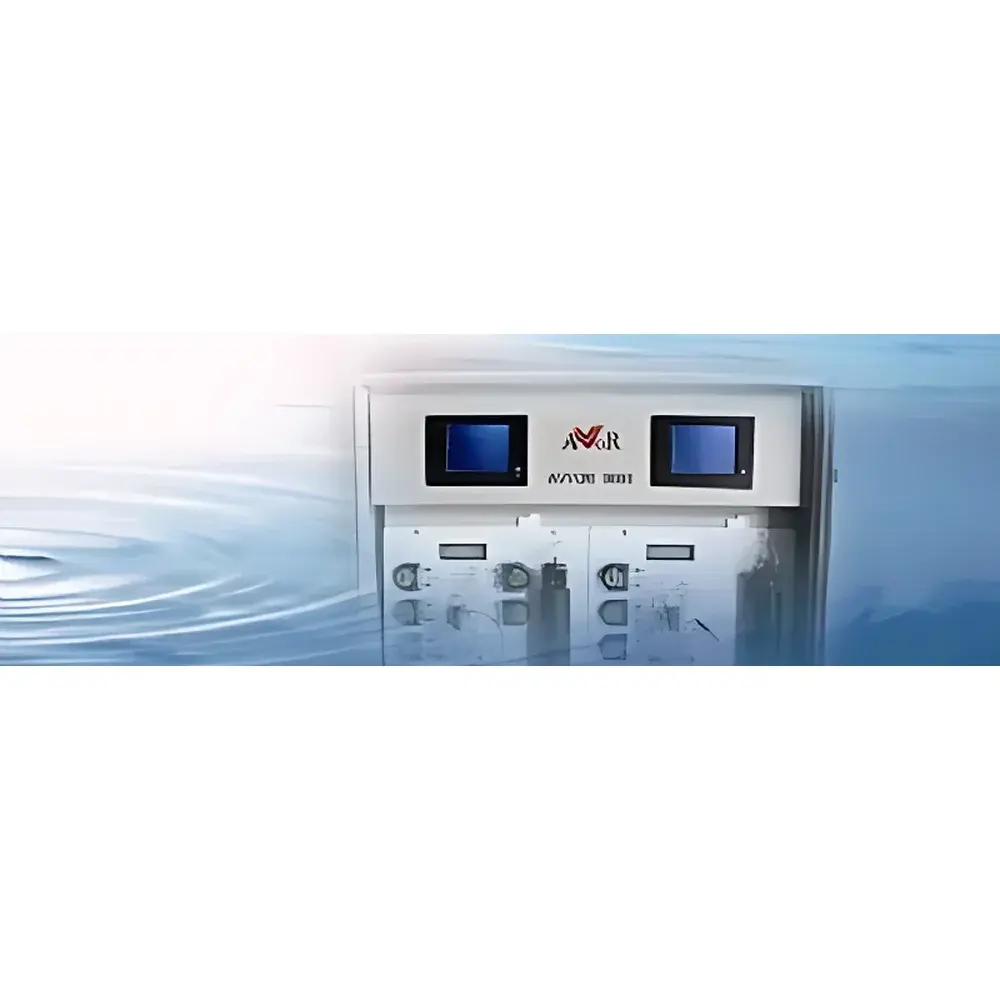
AVVOR 8000 & 9000 Portable and Online Heavy Metals Analyzers (Cu, Cd, Pb, Zn, Ni, As, Hg, Cr, Fe) Using Anodic Stripping Voltammetry
| Brand | AVVOR |
|---|---|
| Origin | Canada |
| Instrument Type | Portable (8000) & Online Continuous Analyzer (9000) |
| Detection Principle | Anodic Stripping Voltammetry (ASV) |
| Detectable Elements | Cu, Cd, Pb, Zn, Ni, As, Hg, Cr (total & Cr⁶⁺), Fe, Mn, Sb, Tl, Se, Co, Mo, Ag, Au, Pd, Sn, U |
| Measurement Time | ≤30 min per sample (8000) |
| Accuracy | ±0.5% of reading |
| Resolution | 0.5 ppt (ng/L) for key elements |
| Compliance | US EPA Methods 7063, 7472, 1001 |
Overview
The AVVOR 8000 Portable Heavy Metals Analyzer and AVVOR 9000 Online Continuous Heavy Metals Analyzer are engineered for precise, field-deployable and real-time quantification of trace-level toxic metals in aqueous matrices. Both instruments operate on the internationally standardized electrochemical principle of Anodic Stripping Voltammetry (ASV), a technique endorsed by the U.S. Environmental Protection Agency (EPA), ASTM International, ISO, and multiple pharmacopeial and food safety standards. ASV enables sub-part-per-trillion (ppt) detection sensitivity through controlled pre-concentration of target metal ions onto a working electrode surface—followed by potential-controlled oxidation (stripping) and high-fidelity current measurement. This method delivers superior selectivity over interferences from organic matter, suspended solids, or complexing agents compared to optical techniques such as ICP-OES or AAS—especially critical in raw wastewater, surface water, and drinking water source monitoring where matrix effects dominate.
Key Features
- Two-platform architecture: AVVOR 8000 for rapid, battery-powered field screening and laboratory validation; AVVOR 9000 for unattended, multi-parameter online monitoring with automated sampling, digestion (if required), and calibration.
- Modular electrode system: Interchangeable working electrodes—including gold, mercury-film, bismuth-film, and bare carbon—optimized for specific element groups (e.g., Au electrode for As/Hg/Se; Hg-film for Cd/Pb/Zn/Cu; Bi-film for Cr/Ni/Co).
- Multi-element capability: AVVOR 8000 supports simultaneous or sequential analysis of up to 20 elements in a single sample; AVVOR 9000 accommodates up to two independent test modules, enabling concurrent measurement of up to 10 heavy metals (e.g., Module 1: As, Hg, Se; Module 2: Zn, Cd, Pb, Cu, Mn, Sb, Tl, Fe, Ni, Sn).
- Regulatory-grade data integrity: Full audit trail, electronic signatures, and time-stamped calibration logs compliant with FDA 21 CFR Part 11 requirements when paired with AVVOR’s validated software suite.
- Ruggedized design: IP67-rated enclosure for AVVOR 8000; NEMA 4X stainless-steel housing with humidity control for AVVOR 9000—suitable for outdoor, industrial, and municipal environments.
- Integrated connectivity: RS-232, RS-485, and optional Wi-Fi/Ethernet interfaces; eight programmable 4–20 mA analog outputs for integration into SCADA or PLC systems.
Sample Compatibility & Compliance
The AVVOR analyzers are validated for use with natural waters (rivers, lakes, groundwater), treated and untreated wastewater, drinking water, seawater, leachates, and digested solid matrices (soils, sediments, sludges, food extracts). Sample preparation follows standardized protocols: filtration (0.45 µm), pH adjustment (typically to pH 4.5–5.5), and optional UV digestion for organometallic species. All operational procedures align with EPA Method 7472 (Hg), 7063 (As), and 1001 (Pb); ASTM D3557-95 (Cd); DIN 38406-16 (Zn, Cd, Pb, Cu, Tl, Ni, Co); ISO 6636-1 (Zn in produce); and AOAC 986.15 (As, Cd, Pb, Se, Zn in food). Instruments support GLP/GMP workflows with automated calibration verification, drift correction, and QC spike recovery tracking.
Software & Data Management
AVVOR ControlSuite™ is a Windows-based application providing full instrument control, method development, and regulatory-compliant data handling. It features method templates aligned with EPA and ASTM standards, real-time voltammogram visualization, automatic peak identification using derivative-based algorithms, and integrated uncertainty calculation per ISO/IEC 17025 guidelines. Data export supports CSV, PDF, and XML formats; raw voltammograms are stored with metadata (electrode ID, temperature, calibration date, operator ID). For AVVOR 9000, the embedded web server enables remote configuration, alarm management (e.g., threshold breach, low reagent alert), and secure HTTPS access—fully compatible with enterprise LIMS integration via HL7 or RESTful API.
Applications
- Environmental compliance monitoring: EPA NPDES permit reporting, watershed surveillance, mine drainage assessment, landfill leachate tracking.
- Drinking water safety: Early-warning detection of lead service line corrosion, chromium contamination events, arsenic hotspots in private wells.
- Industrial process control: Electroplating bath optimization, semiconductor rinse water monitoring, pharmaceutical manufacturing water purification validation.
- Research & education: Speciation studies (e.g., Cr³⁺ vs Cr⁶⁺), bioavailability assays, sediment pore-water analysis, microplastic-associated metal leaching experiments.
- Emergency response: Rapid on-site triage after chemical spills, flood-related contamination events, or post-disaster water safety evaluation.
FAQ
What regulatory methods does the AVVOR 8000/9000 validate against?
US EPA Methods 7063 (arsenic), 7472 (mercury), and 1001 (lead); ASTM D3557-95 (cadmium); ISO 6636-1 (zinc); DIN 38406-16 (multi-element); and AOAC official methods for food and feed matrices.
Can the AVVOR 9000 measure hexavalent chromium (Cr⁶⁺) separately from total chromium?
Yes—using a dedicated gold-working-electrode module and optimized pH-selective deposition protocol, Cr⁶⁺ is quantified independently at detection limits below 0.1 µg/L.
Is sample digestion required for wastewater or sludge samples?
For total recoverable metals in suspended solids or digested sludge, acid digestion (EPA Method 3015A or 3050B) is recommended prior to ASV analysis to ensure complete metal liberation.
How often does the AVVOR 9000 perform automatic calibration?
Calibration frequency is user-configurable—from hourly to weekly—with built-in standard addition capability and drift compensation algorithms.
Does the system support remote diagnostics and firmware updates?
Yes—via secure SSH or HTTPS connection; diagnostic logs include electrode impedance spectra, pump actuation history, and temperature-compensation residuals.
Related Products







