
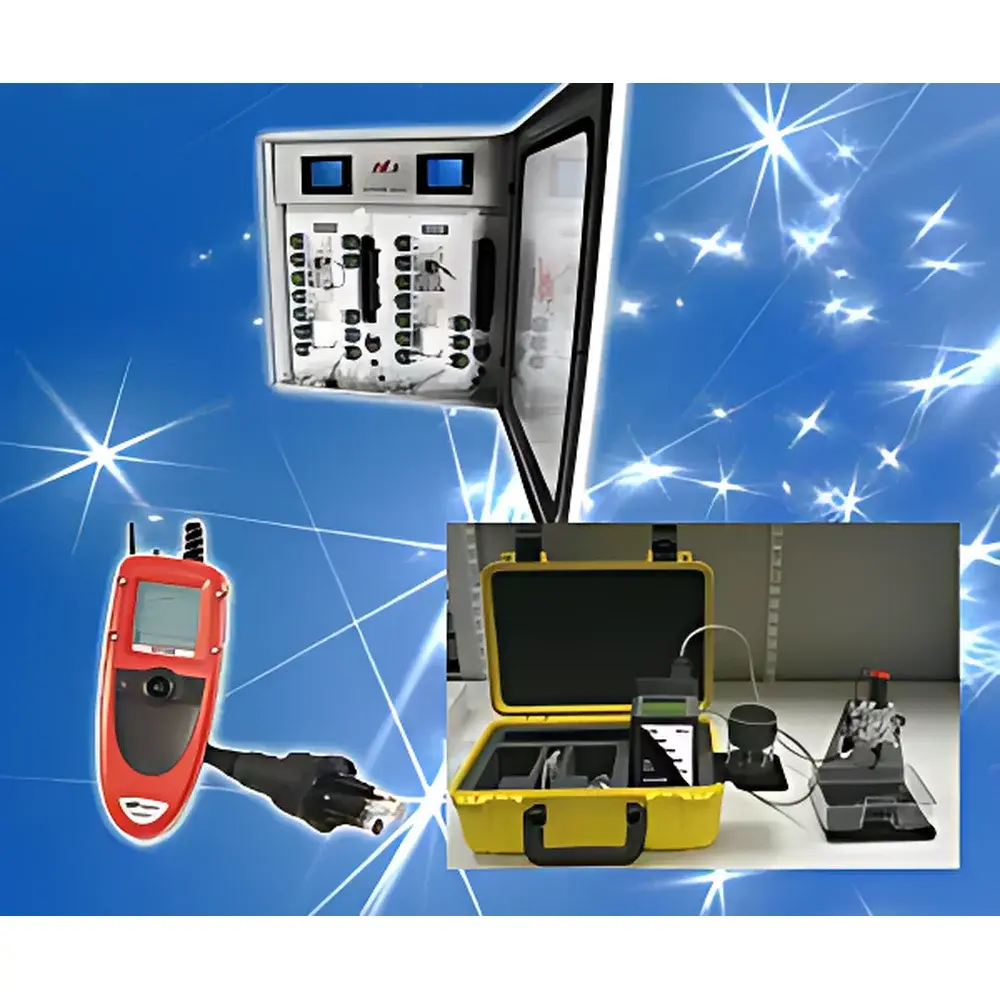
AVVOR 8000 / AVVOR 9000 / Wagtech Metalyser HM1000 Heavy Metals Analyzer for Water Quality
| Origin | Canada |
|---|---|
| Manufacturer Type | Authorized Distributor |
| Origin Category | Imported |
| Models | AVVOR 8000, AVVOR 9000, HM1000 |
| Pricing | Available Upon Request |
Overview
The AVVOR 8000, AVVOR 9000, and Wagtech Metalyser HM1000 represent a family of electrochemical heavy metals analyzers engineered for field-deployable, laboratory-grade quantification of toxic metal ions in aqueous and solid environmental matrices. These instruments employ established electroanalytical principles—primarily anodic stripping voltammetry (ASV) and adsorptive stripping voltammetry (AdSV)—to achieve sub-ppb (ng/L) detection sensitivity for priority contaminants regulated under EPA Method 7000B, ISO 11969, and EN 16468. Unlike optical or atomic spectroscopy-based systems, these analyzers require no high-voltage plasma sources, inert gas supply, or complex sample digestion—enabling rapid, reagent-minimized analysis directly in situ or in mobile labs. The HM1000 serves as a handheld screening tool optimized for rapid triage; the AVVOR 8000 delivers benchtop-level precision with expanded elemental coverage; and the AVVOR 9000 functions as a modular, multi-parameter online monitor compliant with continuous emission monitoring system (CEMS)-adjacent deployment standards.
Key Features
- Sub-ppb detection limits for As(III), Cd(II), Pb(II), Cu(II), Hg(II), Zn(II), Ni(II), Mn(II), Sb(III/V), Tl(I), Se(IV), Cr(VI), Co(II), Mo(VI), Fe(II/III), Ag(I), Au(III), Pd(II), Sn(II/IV) — validated per IUPAC traceability protocols
- Modular electrode architecture: interchangeable working electrodes including gold, mercury-film, bismuth-film, and bare carbon — each selected to optimize sensitivity, selectivity, and antifouling performance for target analytes
- AVVOR 9000 supports up to two independent measurement modules simultaneously, enabling concurrent analysis of up to five metals per module (e.g., Module 1: As/Hg/Se; Module 2: Zn/Cd/Pb/Cu/Mn)
- HM1000 features zero-reagent operation for As, Cd, Cu, Hg, and Pb — eliminating cold-chain logistics and shelf-life constraints associated with standard addition calibrants
- All platforms incorporate temperature-compensated cell control, automatic baseline correction, and adaptive pulse waveform optimization to mitigate matrix interferences from chloride, organic matter, and redox-active species
- AVVOR 8000 achieves <60-second analysis time post-sample introduction; HM1000 delivers results in <90 seconds with <5 minutes total preparation including filtration and pH adjustment
Sample Compatibility & Compliance
These analyzers are validated for direct analysis of raw and filtered surface water (rivers, lakes, reservoirs), groundwater, wastewater effluents, drinking water distribution systems, stormwater runoff, and leachates. With appropriate acid extraction (EPA Method 3050B or 3051A), they extend to soils, sediments, food homogenates, beverage concentrates, and solid waste digests. Each instrument complies with ISO/IEC 17025:2017 requirements for testing laboratories, supports audit-ready data logging aligned with FDA 21 CFR Part 11 (electronic signatures, audit trails), and enables method validation documentation per GLP and ISO 17025 Annex A.5. Calibration verification is performed using NIST-traceable single- and multi-element standard solutions (SRM 3100 series).
Software & Data Management
The proprietary Analytix software suite provides real-time voltammogram visualization, peak deconvolution, automated calibration curve generation (linear, quadratic, or weighted least-squares), and QC flagging (spike recovery, duplicate deviation, blank threshold exceedance). Data export conforms to ASTM E1447 and ISO 11452 formats for LIMS integration. AVVOR 9000 supports Modbus TCP, RS-485, and optional LoRaWAN/Wi-Fi telemetry for SCADA compatibility. All instruments store ≥10,000 test records with timestamp, GPS coordinates (HM1000), operator ID, electrode ID, and environmental metadata (temperature, conductivity, pH if interfaced).
Applications
- Regulatory compliance monitoring for WHO Guidelines for Drinking-water Quality and EU Drinking Water Directive (2020/2184) limits on As, Pb, Cd, Ni, Cr(VI)
- Industrial pretreatment verification at wastewater discharge points per EPA NPDES permit conditions
- Post-remediation verification of soil washing and phytoremediation efficacy
- Source water vulnerability assessment in watershed management programs
- Emergency response screening during chemical spills or mining tailings breaches
- Research applications in biogeochemical cycling studies, nanoparticle fate tracking, and bioavailability modeling
FAQ
What electrode materials are supported, and how do they affect selectivity?
Gold electrodes enable sensitive detection of As, Hg, Se, and Sb; mercury-film electrodes enhance Cd, Pb, Zn, and Cu response but require controlled disposal; bismuth-film offers comparable sensitivity without mercury handling; bare carbon provides broad-spectrum capability for Cr, Co, Mo, and Fe.
Can the AVVOR 9000 operate unattended for extended periods?
Yes — with integrated peristaltic autosampler, temperature-stabilized cell chamber, and remote diagnostics, it supports 30-day unattended operation when paired with scheduled calibration and cleaning cycles.
Is method validation support available for regulatory submissions?
Yes — comprehensive IQ/OQ/PQ documentation packages, SOP templates, and third-party validation assistance are provided for EPA, ISO, and national accreditation body submissions.
How does the HM1000 achieve reagent-free operation?
It utilizes differential pulse anodic stripping voltammetry (DPASV) with in-situ plating on renewable bismuth or gold microelectrodes, eliminating need for external reducing agents or complexing ligands.
Are replacement electrodes and electrolytes supplied with full traceability?
All consumables are manufactured under ISO 9001-certified processes and shipped with CoA referencing NIST SRMs and batch-specific uncertainty budgets.
Related Products







