
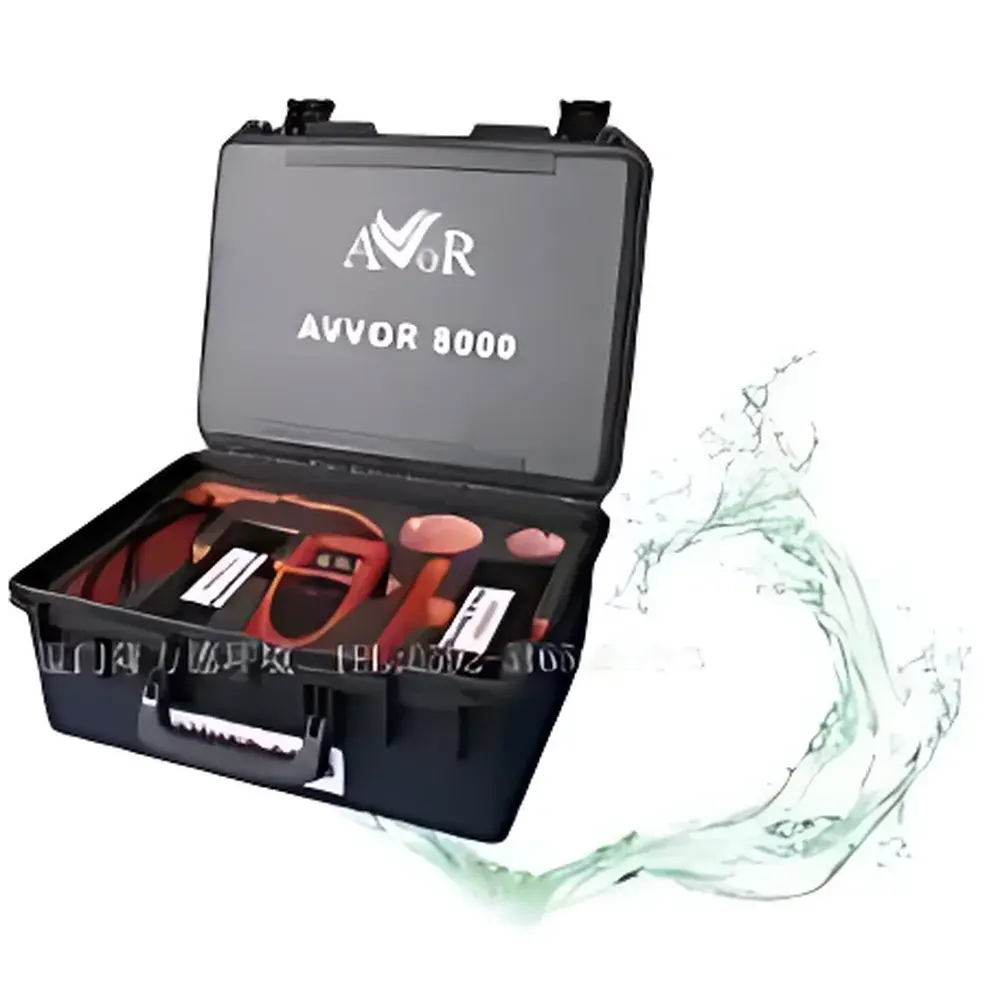
AVVOR 8000 HM-2 Portable Heavy Metals Analyzer
| Brand | AVVOR |
|---|---|
| Origin | Canada |
| Model | AVVOR 8000 HM-2 |
| Detection Principle | Anodic Stripping Voltammetry (ASV) |
| Instrument Type | Portable |
| Measurable Elements | Al, As, B, Cd, Cr(VI), Cu, Fe, Hg, Mn, Ni, Pb, Zn |
| Detection Range | ppb to ppm |
| Ingress Protection | IP68 |
| Power Options | Rechargeable battery / AC adapter / Vehicle cigarette lighter socket |
| Data Logging | Time-stamped internal memory |
| Display | Backlit LCD with touch keypad |
| Connectivity | USB for PC data upload |
| Included Accessories | Sample analysis cups, photometric cuvettes, full set of calibration buffers and reagents for 12 metals |
| Language Support | Multilingual interface |
| Electrode System | Triple-electrode immersed probe (working, reference, auxiliary), integrated stirrer and temperature sensor, modular plug-in working electrodes (up to 3 simultaneously) |
Overview
The AVVOR 8000 HM-2 Portable Heavy Metals Analyzer is an engineered field-deployable electrochemical instrument designed for on-site quantification of trace heavy metal ions in aqueous matrices. It employs anodic stripping voltammetry (ASV)—a highly sensitive electroanalytical technique that combines controlled electrodeposition of metal ions onto a working electrode surface under negative potential, followed by oxidative stripping and current measurement during a linear potential sweep. This principle enables reliable detection at sub-ppb (ng/L) levels for priority contaminants including Cd, Pb, Cu, Hg, As, and Cr(VI), while maintaining linearity across three orders of magnitude (ppb–ppm). Unlike laboratory-based ICP-MS or AAS systems, the HM-2 eliminates the need for acid digestion, solvent extraction, or vacuum-based instrumentation—making it suitable for real-time decision support in environmental compliance, emergency response, and decentralized water quality surveillance.
Key Features
- Triple-electrode immersed probe with integrated temperature sensor and magnetic stirrer—ensures reproducible mass transport and thermal compensation during ASV scans.
- Modular plug-in working electrode architecture: accommodates up to three interchangeable electrodes within a single probe housing, enabling sequential or parallel multi-parameter analysis without external hardware or software configuration.
- Dual handheld meter design: two synchronized units—one dedicated to voltammetric measurement (ASV), the other to photometric analysis—deliver complementary data streams for cross-validated results and expanded elemental coverage (e.g., Cr(VI) via colorimetry, Pb/Cd via ASV).
- IP68-rated ruggedized enclosure: fully dust-tight and submersible up to 1.5 m for 30 minutes—certified for continuous operation in rain, high humidity, dust storms, and temperature extremes from –10 °C to +50 °C.
- Onboard time-stamped data logging: stores ≥10,000 test records with metadata (operator ID, GPS tag optional via Bluetooth pairing, sample ID, method ID, ambient temperature), compliant with GLP audit trail requirements.
- Intuitive multilingual interface: step-by-step graphical prompts guide untrained users through buffer addition, sampling, reagent dosing, and result interpretation—no prior electrochemistry training required.
- Low-cost-per-test operation: pre-formulated, lyophilized reagent kits minimize cold-chain dependency; no consumable membranes, columns, or gases required.
Sample Compatibility & Compliance
The AVVOR 8000 HM-2 is validated for direct analysis of raw surface water, groundwater, wastewater effluents, drinking water, and leachates—without filtration or pre-concentration in most cases. Matrix tolerance has been verified per ASTM D3559 (lead in water), ASTM D5173 (cadmium), and ISO 11969 (arsenic speciation in natural waters). For Cr(VI), photometric mode complies with EPA Method 7196A; for ASV-determined metals, performance meets ISO 10560 (electrochemical determination of trace metals in water) and supports regulatory reporting under EU WFD Annex V and US Clean Water Act Section 304(a) criteria. All firmware and data handling protocols are structured to support 21 CFR Part 11-compliant electronic signatures when paired with optional audit-ready software modules.
Software & Data Management
Data export occurs via USB 2.0 to standard Windows/macOS platforms. The included AVVOR DataLink Suite provides secure CSV/Excel export, customizable report templates (PDF), QC charting (control charts, trend analysis), and batch calibration verification logs. Raw voltammograms and photometric absorbance spectra are stored in open-format .CSV for third-party processing (e.g., MATLAB, OriginLab). Firmware updates are delivered via signed binary packages with SHA-256 checksum validation. Internal memory retains full traceability: each record includes operator ID, timestamp (RTC-synchronized), probe serial number, electrode lot code, and method version—enabling full forensic reconstruction during regulatory audits.
Applications
- Field screening of drinking water sources during disaster response (e.g., post-flood lead contamination, mining-related arsenic plumes).
- Regulatory compliance monitoring at wastewater treatment plant outfalls and industrial discharge points.
- Soil pore water and sediment leachate characterization in brownfield site assessments.
- Agricultural runoff monitoring for micronutrient toxicity (e.g., Cu, Zn) and contaminant accumulation (e.g., Cd in rice paddy irrigation).
- Educational use in university environmental science labs for hands-on electroanalytical method training.
- Contract laboratories performing rapid prescreening prior to confirmatory lab analysis—reducing turnaround time and analytical cost by >60%.
FAQ
What detection limits does the AVVOR 8000 HM-2 achieve for common heavy metals?
Typical ASV-based detection limits are: Pb (0.05 µg/L), Cd (0.03 µg/L), Cu (0.1 µg/L), Zn (0.5 µg/L), Hg (0.02 µg/L), As (0.1 µg/L), and Cr(VI) (0.5 µg/L) using photometric mode—all verified per ISO 10560 repeatability criteria (RSD ≤ 8% at 3× LOD).
Is electrode maintenance required between analyses?
No. The disposable, pre-polished carbon or mercury-film working electrodes are single-use and factory-calibrated. The triple-electrode probe requires only rinsing with deionized water between samples.
Can the instrument be used in seawater or high-salinity matrices?
Yes—with optional salinity correction algorithms activated in firmware v2.4+, which compensate for chloride interference and ionic strength effects on ASV peak resolution.
Does the system meet international calibration traceability standards?
All factory calibrations are traceable to NIST SRM 3109a (multi-element water standard) and BAM CRM 153 (Cr(VI) certified reference material); certificate of conformance accompanies each instrument shipment.
How is data integrity ensured during field deployment?
Internal memory uses write-once EEPROM architecture with cyclic redundancy checking (CRC-32); all exported files include embedded digital signatures verifiable via AVVOR’s public key infrastructure.







