
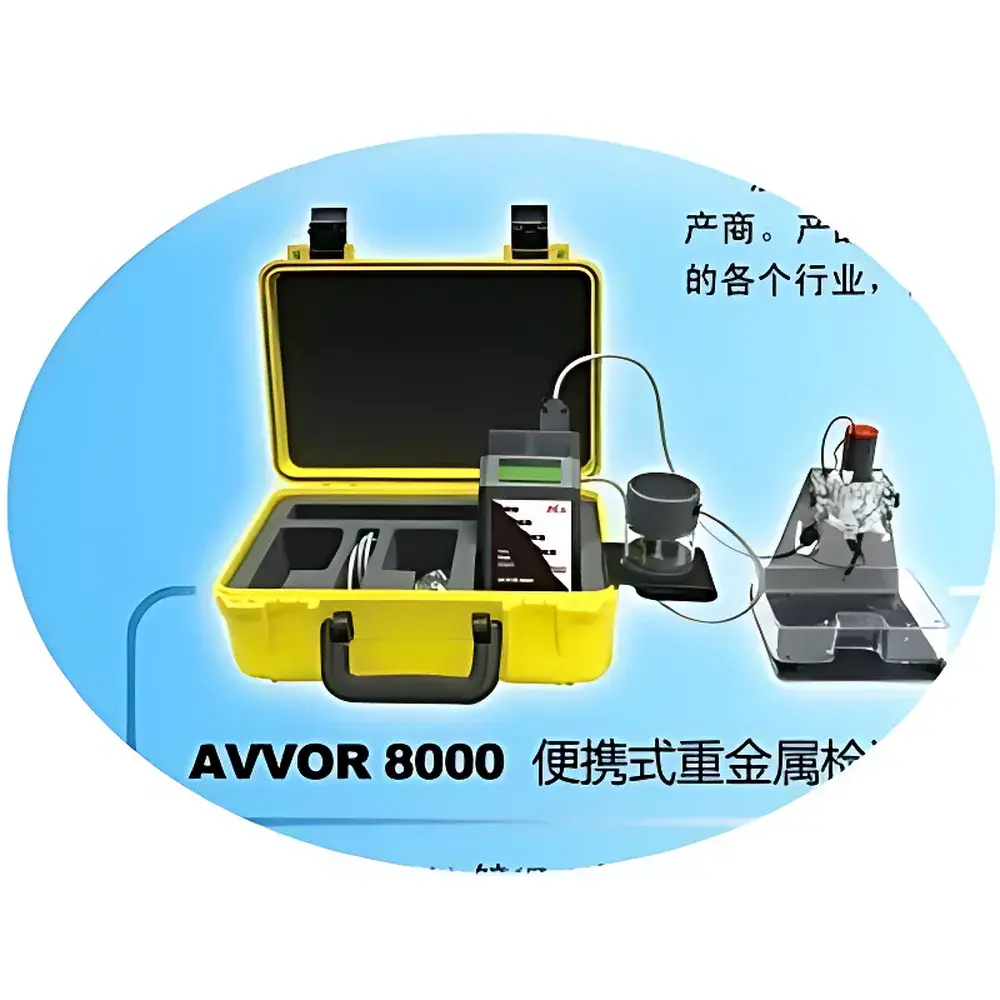
AVVOR 8000 Portable Anodic Stripping Voltammetry (ASV) Heavy Metal Analyzer
| Brand | AVVOR |
|---|---|
| Origin | Canada |
| Model | AVVOR 8000 |
| Detection Principle | Anodic Stripping Voltammetry (ASV) / Differential Pulse Anodic Stripping Voltammetry (DP-ASV) |
| Measurable Elements | Cu, Pb, Zn, Cd, Mn, Sb, Tl, Fe, Ni, As, Hg, Se, Co, Mo, Au, Ag, Cr, Pd, Sn |
| Detection Range | Sub-ppb to low ppm (element-dependent) |
| Portability | Field-deployable with integrated battery and rugged IP67-rated enclosure |
| Compliance | US EPA Methods 7063, 7472, 1001 |
Overview
The AVVOR 8000 Portable Anodic Stripping Voltammetry (ASV) Heavy Metal Analyzer is an electrochemical field instrument engineered for rapid, on-site quantification of trace heavy metal ions in aqueous and solid-phase environmental matrices. It operates on the internationally validated principle of differential pulse anodic stripping voltammetry (DP-ASV), a technique recognized by the U.S. Environmental Protection Agency (EPA) and standardized across multiple regulatory frameworks including ASTM, ISO, DIN, and AOAC. In DP-ASV, target metal ions are first pre-concentrated onto a working electrode (typically mercury-film or bismuth-film modified carbon or gold electrodes) via controlled cathodic deposition. Following a defined rest period, a linear or differential pulse potential scan is applied to oxidize (strip) the accumulated metals, generating current peaks whose magnitude is directly proportional to concentration. This method delivers sub-part-per-trillion (sub-ppt) detection limits for key analytes such as Pb, Cd, Cu, Zn, As, and Hg—enabling reliable compliance monitoring against stringent regulatory thresholds (e.g., EPA Maximum Contaminant Levels, WHO drinking water guidelines).
Key Features
- Field-ready design with integrated rechargeable lithium-ion battery, supporting >8 hours of continuous operation without external power
- Ruggedized IP67-rated enclosure compliant with MIL-STD-810G for shock, dust, and immersion resistance
- Modular electrode system: interchangeable screen-printed carbon electrodes (SPCEs), mercury-film, bismuth-film, and gold microelectrodes optimized for specific element groups and matrix types
- Pre-programmed, method-specific calibration protocols aligned with EPA 7063 (As), EPA 7472 (Hg), and EPA 1001 (Pb)
- On-board data logging with timestamped results, automatic peak identification, and real-time background subtraction
- Minimal consumables: single-use disposable electrodes and low-volume standard solutions reduce cross-contamination risk and operational cost
- Self-contained electrolyte dispensing module with precision micro-dosing for reproducible sample conditioning
Sample Compatibility & Compliance
The AVVOR 8000 supports direct analysis of filtered surface water, groundwater, wastewater effluents, drinking water sources, and leachates. For solid samples—including soils, sediments, foodstuffs, and biological tissues—standardized acid digestion or chelation-assisted extraction (per EPA Method 3050B or 3051A) is required prior to ASV measurement. All validated methods implemented onboard comply with Good Laboratory Practice (GLP) and support audit-ready documentation. The system meets data integrity requirements under FDA 21 CFR Part 11 when used with optional secure software configuration, including electronic signatures, audit trails, and user access controls. Regulatory alignment includes full compatibility with ISO/IEC 17025 quality management systems for accredited environmental testing laboratories.
Software & Data Management
Controlled via the AVVOR AnalyzeSuite™ desktop application (Windows/macOS), the instrument enables method development, multi-point calibration, spectral deconvolution, and automated interference correction. Raw voltammograms are exportable in CSV and native .avv formats for third-party statistical analysis (e.g., PCA, multivariate regression). Cloud-based synchronization (optional subscription) allows centralized data aggregation across distributed monitoring networks. All software modules adhere to ICH-GCP and CLIA-compliant validation protocols, with version-controlled firmware updates traceable to release notes and change logs. Audit trail functionality records operator ID, method parameters, calibration history, and result modifications—ensuring full traceability for regulatory submissions.
Applications
- Regulatory compliance monitoring of drinking water supplies per WHO and EPA standards
- Wastewater treatment plant influent/effluent profiling for permit reporting (NPDES)
- Soil screening at brownfield sites and mining-impacted areas using EPA SW-846 extraction protocols
- Food safety surveillance for heavy metals in infant formula, rice, seafood, and dietary supplements
- Research applications in aquatic toxicology, bioavailability studies, and speciation modeling
- Emergency response during industrial spills or natural disasters requiring immediate metal hazard assessment
FAQ
What regulatory methods does the AVVOR 8000 validate against?
It fully supports US EPA Methods 7063 (arsenic), 7472 (mercury), and 1001 (lead); ASTM D3557-95 (cadmium); DIN 38406-16 (Zn, Cd, Pb, Cu, Tl, Ni, Co); ISO 6636-1 (zinc in produce); and multiple AOAC food testing standards.
Can the instrument analyze unfiltered wastewater samples?
No—samples must be filtered through 0.45 µm membrane filters prior to analysis to prevent electrode fouling and ensure hydrodynamic stability during deposition.
Is mercury required for all electrode configurations?
Mercury-film electrodes are recommended for ultra-trace Hg, Pb, and Cd analysis; however, bismuth-film and gold electrodes eliminate mercury use entirely while maintaining sub-ppb sensitivity for Cu, Zn, Ni, and Co.
How is data integrity ensured during field deployment?
All measurements include embedded metadata (GPS coordinates, ambient temperature, operator ID, method version), and optional 21 CFR Part 11 mode enforces role-based access, electronic signatures, and immutable audit logs.
What sample volume is required per analysis?
Standard analyses require 10–20 mL of aqueous sample; micro-volume adapters support down to 1.5 mL for precious or limited samples.
Related Products







