
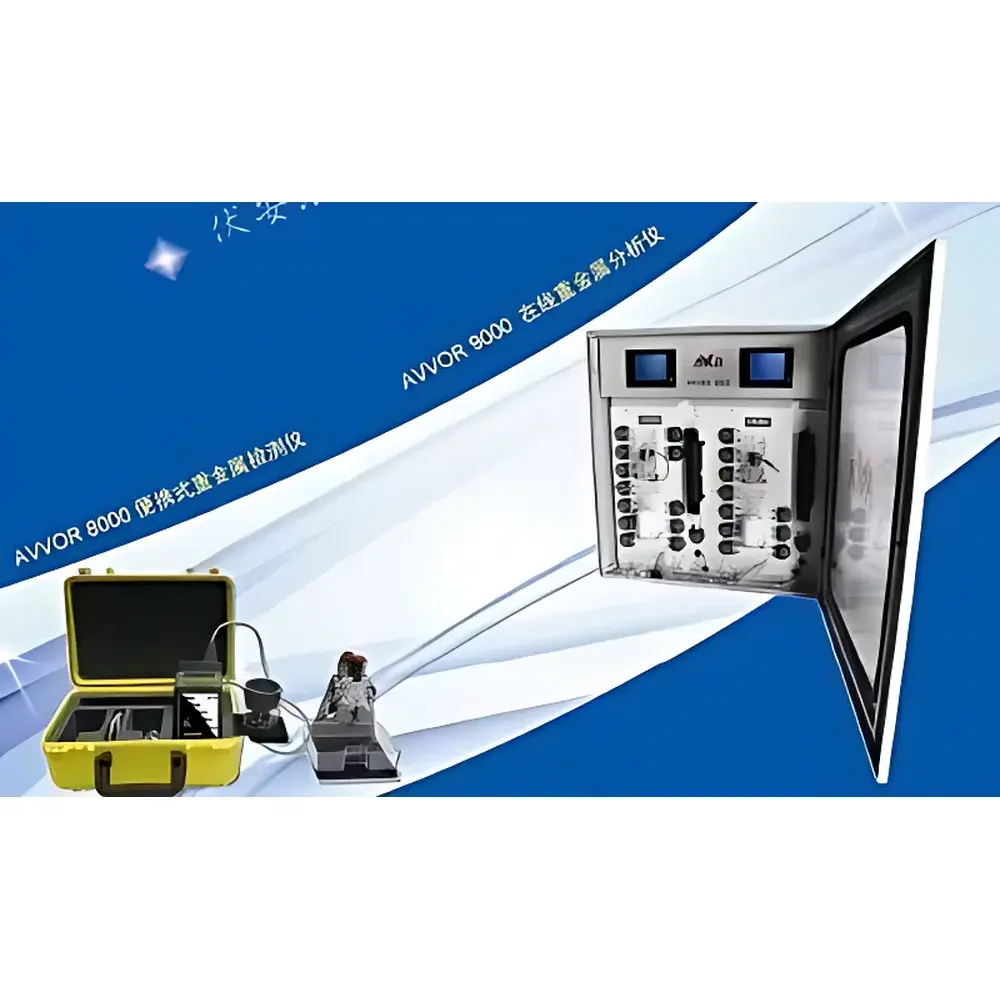
AVVOR 8000 Portable Anodic Stripping Voltammetry (ASV) Heavy Metal Analyzer & AVVOR 9000 Online ASV Heavy Metal Monitoring System
| Brand | AVVOR |
|---|---|
| Origin | Canada |
| Model | AVVOR 8000 (portable), AVVOR 9000 (online) |
| Measurement Principle | Anodic Stripping Voltammetry (ASV) / Differential Pulse Anodic Stripping Voltammetry (DP-ASV) |
| Detection Range | Sub-ppb to low ppb (e.g., 0.05–100 µg/L, matrix-dependent) |
| Supported Elements | Cu, Pb, Zn, Cd, Mn, Sb, Tl, Fe, Ni, As, Hg, Se, Co, Mo, Au, Ag, Cr, Cr(VI), Sn, Pd, U |
| Electrode Options | Gold, Mercury-film, Bismuth-film, Bare Carbon |
| Compliance | US EPA Methods 7063, 7472, 1001 |
| Output Interfaces | 4–20 mA (×8), RS-232, RS-485 |
| Data Management | Onboard LCD (AVVOR 8000), Dual-screen option (AVVOR 9000), PC software with audit trail, GLP-compliant reporting |
| Power | Rechargeable Li-ion battery (AVVOR 8000) |
| Enclosure Rating | IP67 (AVVOR 8000) |
Overview
The AVVOR 8000 Portable and AVVOR 9000 Online Heavy Metal Analyzers are engineered for precise, field-deployable and continuous electrochemical quantification of trace heavy metals in aqueous matrices. Both instruments implement anodic stripping voltammetry (ASV)—a well-established, reference-grade electroanalytical technique endorsed by the U.S. Environmental Protection Agency (EPA), ASTM International, ISO, and AOAC. ASV combines controlled pre-concentration (electrodeposition) of target metal ions onto a working electrode surface under negative potential, followed by oxidative stripping (dissolution) via a precisely ramped or pulsed potential waveform. The resulting current peaks—characteristic in both magnitude and formal potential—are directly proportional to analyte concentration and serve as elemental fingerprints. This principle enables sub-part-per-trillion (sub-ppt) detection limits for key contaminants including Pb, Cd, As, Hg, and Cr(VI), making the systems suitable for regulatory compliance monitoring, source tracking, and early-warning applications across environmental, industrial, and drinking water contexts.
Key Features
- AVVOR 8000: Fully portable, battery-powered analyzer with integrated touchscreen LCD, rugged IP67-rated housing, and onboard method library for rapid deployment in field labs, wastewater outfalls, or emergency response scenarios.
- AVVOR 9000: Modular online platform supporting up to two independent measurement modules per unit; each module accommodates one working electrode (Au, Hg-film, Bi-film, or carbon) and delivers simultaneous multi-element analysis (up to 5 metals per module).
- Electrode flexibility: Application-specific electrode selection ensures optimal sensitivity and selectivity—e.g., mercury-film electrodes for Hg and Cu; bismuth-film for Zn, Cd, Pb; gold electrodes for As(III), Sb(III), and Cr(VI).
- Automated calibration and maintenance: Scheduled self-calibration, blank subtraction, electrode renewal cycles, and fault diagnostics reduce operator dependency and support unattended operation.
- Regulatory-ready data handling: Full audit trail, user access control, electronic signatures, and 21 CFR Part 11–compliant software options available for GMP/GLP environments.
- Robust interfacing: Eight configurable 4–20 mA analog outputs, dual serial ports (RS-232/RS-485), Modbus RTU/TCP support, and optional wireless telemetry enable seamless integration into SCADA, DCS, or LIMS platforms.
Sample Compatibility & Compliance
The AVVOR systems accept raw or pretreated liquid samples—including surface water, groundwater, treated effluent, seawater, drinking water, and leachates—with minimal sample preparation. For solid matrices (soil, sediment, food, or biological tissue), standardized acid digestion or chelation-assisted extraction (per EPA Method 3050B or 3051A) is required prior to analysis. Interferences from organic matter, surfactants, or high ionic strength are mitigated through integrated sample conditioning (filtration, UV digestion, pH adjustment) and differential pulse waveform optimization. All measurement protocols align with internationally recognized standards: US EPA Methods 7063 (As), 7472 (Hg), 1001 (Pb); ASTM D3557-95 (Cd); DIN 38406-16 (Zn, Cd, Pb, Cu, Tl, Ni, Co); ISO 6636-1 (Zn in produce); and AOAC methods for food and feed. Instruments undergo factory verification per ISO/IEC 17025–accredited procedures, and full validation packages—including LOD/LOQ, linearity (R² ≥ 0.999), repeatability (RSD ≤ 5%), and spike recovery (85–115%)—are provided upon request.
Software & Data Management
Both platforms operate via AVVOR Control Suite—a Windows-based application supporting method development, real-time waveform visualization, automated peak integration, and customizable report generation (PDF, CSV, Excel). The software implements secure user roles (Administrator, Analyst, Viewer), time-stamped audit logs, electronic signature capture, and encrypted database storage compliant with FDA 21 CFR Part 11 requirements. For AVVOR 9000 installations, optional cloud-enabled remote monitoring allows centralized fleet management, predictive maintenance alerts, and historical trend analysis across multiple sites. All data exports include metadata (sample ID, operator, timestamp, electrode lot, calibration status, environmental conditions) to satisfy ISO 17025 and EU Water Framework Directive reporting obligations.
Applications
- Regulatory compliance: Routine monitoring of EPA priority pollutants in NPDES discharge permits, Safe Drinking Water Act (SDWA) compliance, and EU WFD River Basin Management Plans.
- Industrial process control: Real-time tracking of metal breakthrough in ion exchange resins, electroplating baths, mining tailings ponds, and semiconductor rinse waters.
- Environmental forensics: Spatial mapping of contamination plumes in groundwater or sediments using portable AVVOR 8000 with GPS-tagged sampling.
- Research & education: Teaching electroanalytical principles, developing novel electrode modifications, or validating speciation protocols (e.g., As(III)/As(V), Cr(III)/Cr(VI)).
- Emergency response: Rapid on-site screening during chemical spills, landfill leachate breaches, or post-flood contamination events.
FAQ
What detection limits can be achieved for lead (Pb) in drinking water?
Typical method detection limits (MDLs) for Pb are 0.05–0.1 µg/L in filtered, low-conductivity drinking water matrices using Hg-film electrodes and optimized DP-ASV waveforms.
Does the AVVOR 9000 require daily manual intervention?
No—fully automated operation includes scheduled cleaning, standard addition calibration, electrode renewal, and system diagnostics; recommended maintenance intervals are weekly for consumables and quarterly for full verification.
Can the same instrument measure both total arsenic and arsenite (AsIII) separately?
Yes—selective detection of AsIII is achieved using gold electrodes under controlled deposition potential; total As requires pre-reduction (e.g., KI/ascorbic acid), enabling speciation without HPLC coupling.
Is method validation support available for laboratory accreditation?
Yes—AVVOR provides comprehensive validation documentation kits, including protocol templates, uncertainty budgets, inter-laboratory comparison data, and technical assistance for ISO/IEC 17025 or CAP accreditation audits.
How is electrode fouling managed during long-term online operation?
Each module integrates automatic mechanical polishing, electrochemical cleaning pulses, and real-time impedance monitoring to detect and compensate for surface passivation—ensuring stable baseline and reproducible response over >30 days of continuous use.
Related Products







