
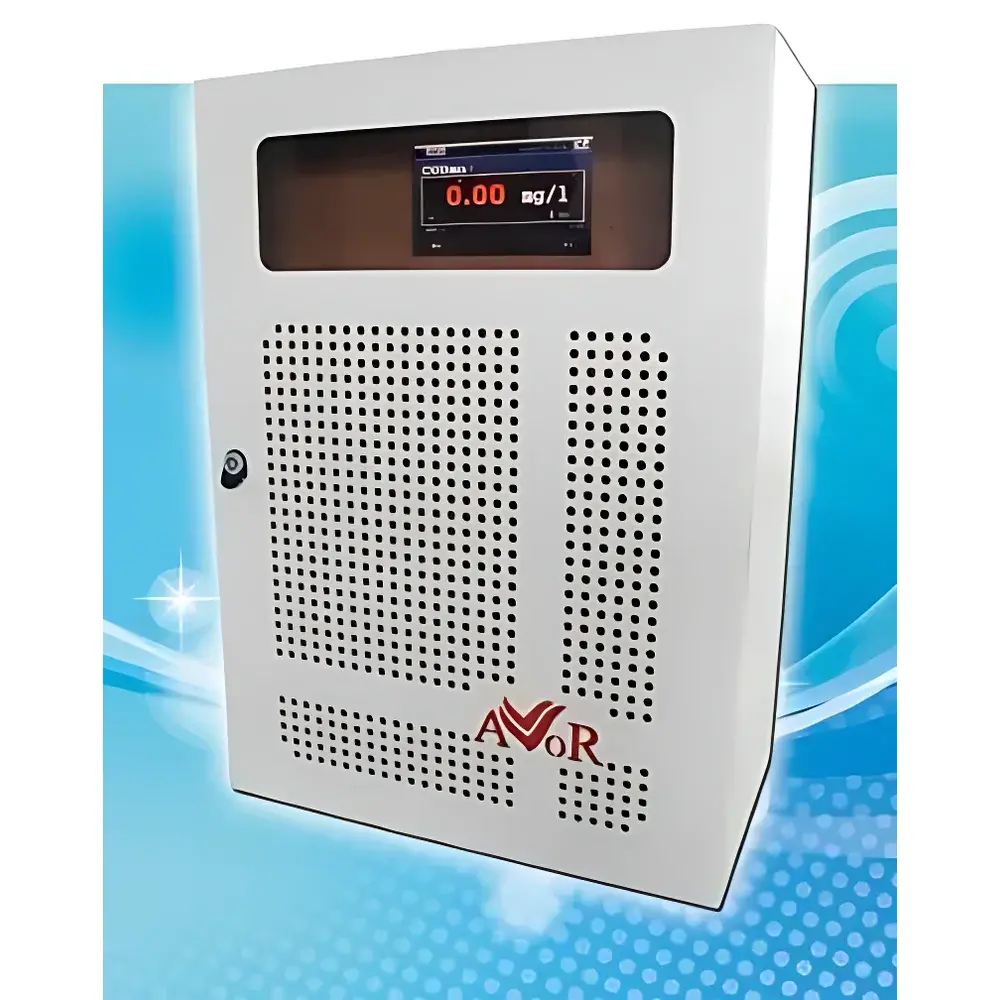
AVVOR 9000-CODmn Permanganate Index Analyzer
| Brand | AVVOR |
|---|---|
| Origin | Canada |
| Model | AVVOR 9000-CODmn |
| Measurement Method | Potassium Permanganate Oxidation–Redox Titration (ISO 8467, GB 11892–1989, HJ/T 100–2003) |
| Range | 0–20 mg/L (standard), optional 0–50 mg/L and 0–100 mg/L |
| LOD | 0.05 mg/L |
| Resolution | 0.01 mg/L |
| Accuracy | ≤ ±3% |
| Sample Matrix | Drinking water and surface water with chloride < 300 mg/L |
| Compliance | Designed for GLP-compliant laboratories |
Overview
The AVVOR 9000-CODmn Permanganate Index Analyzer is a fully automated benchtop instrument engineered for precise, reproducible determination of the permanganate index (also known as CODMn) in potable and surface water samples. It implements the standardized high-temperature potassium permanganate oxidation method—aligned with ISO 8467, China’s GB 11892–1989, and HJ/T 100–2003—wherein samples are acidified with sulfuric acid and reacted with a fixed volume of KMnO4 solution at 97 °C for 30 minutes. Unreacted permanganate is then back-titrated with sodium oxalate, followed by re-titration with standardized KMnO4. Unlike manual titration relying on subjective visual endpoint detection, the AVVOR 9000-CODmn employs real-time ORP (oxidation–reduction potential) monitoring to identify the stoichiometric inflection point—corresponding precisely to the colorimetric endpoint—via dynamic voltage curve analysis. This electrochemical approach eliminates observer bias, ensures long-term electrode stability, and removes the need for routine ORP electrode calibration—even after replacement.
Key Features
- Fully automated liquid handling using isolated micro-peristaltic pumps for sample, acid, KMnO4, Na2C2O4, and rinse reagents—ensuring high volumetric accuracy and inter-run repeatability.
- Integrated pre-heating protocol: Pumps undergo a 2-minute thermal stabilization cycle prior to assay initiation, minimizing flow drift during critical metering phases.
- Intelligent endpoint detection algorithm that analyzes first-derivative ORP signal kinetics—robust against baseline drift, temperature fluctuations, or minor electrode fouling.
- Self-optimizing system calibration: Instrument autonomously adjusts pump timing, heating ramp profiles, and titration step resolution based on real-time reaction kinetics and historical performance data.
- Modular fluidic architecture with quick-release tubing clamps and tool-free valve manifolds—designed for field serviceability and minimal downtime during routine maintenance.
Sample Compatibility & Compliance
The AVVOR 9000-CODmn is validated for use with drinking water, groundwater, rivers, lakes, and reservoirs where chloride concentration remains below 300 mg/L. Elevated chloride interferes with permanganate oxidation selectivity and may cause false-high results; therefore, the analyzer includes built-in chloride interference diagnostics and automatic range selection logic. It is not intended for industrial wastewater or high-organic-load effluents, as the permanganate method lacks full oxidizability for refractory compounds (e.g., pyridine, benzene derivatives) covered under dichromate-based COD assays. The system complies with Good Laboratory Practice (GLP) documentation standards and supports electronic signature, audit trail, and data integrity features required under FDA 21 CFR Part 11 for regulated environmental testing laboratories.
Software & Data Management
Control and data acquisition are managed via AVVOR’s proprietary Analytical Workbench™ software (v4.2+), running on Windows-based host PCs. The interface provides real-time visualization of ORP curves, titration progress, temperature profiles, and pump actuation status. All raw sensor outputs—including mV, temperature, time stamps, and volumetric actuations—are archived in encrypted .awb binary format with SHA-256 checksum validation. Export options include CSV, PDF analytical reports (with embedded metadata: analyst ID, calibration certificate ID, instrument serial number), and LIMS-compatible ASTM E1384-compliant XML. Audit trails record user logins, method modifications, calibration events, and result approvals—retained for ≥36 months with immutable timestamps.
Applications
- Regulatory compliance monitoring for municipal drinking water treatment plants (per GB 5749–2022 and EPA Method 4500-PERM).
- Trend analysis of organic load in watershed surveillance programs and ecological health assessments.
- Validation of activated carbon or ozonation efficiency in pilot-scale water treatment studies.
- Quality control of source water entering advanced oxidation processes (AOPs) where low-level reducible organics must be quantified without dichromate toxicity concerns.
- Academic research on natural organic matter (NOM) reactivity, particularly fulvic/humic acid fractions susceptible to permanganate oxidation.
FAQ
What is the fundamental difference between CODMn and CODCr?
CODMn measures oxygen demand using potassium permanganate under mild acidic, heated conditions—it reflects only readily oxidizable organics and certain inorganics (e.g., Fe2+, NO2−). CODCr, by contrast, uses potassium dichromate in strong sulfuric acid at reflux, achieving ~95% oxidation of most organic compounds.
Does the AVVOR 9000-CODmn require daily electrode calibration?
No. The ORP electrode operates in a stable, narrow potential window specific to the MnO4−/Mn2+ redox couple. Calibration is performed only during initial setup or after electrode replacement—and no further adjustment is needed during routine operation.
Can this instrument analyze seawater or brackish samples?
Not without pretreatment. Chloride concentrations >300 mg/L induce competitive oxidation pathways and interfere with endpoint detection. For such matrices, chloride removal (e.g., AgNO3 precipitation or ion exchange) is mandatory prior to analysis.
How does the system ensure traceability under GLP or ISO/IEC 17025?
Each measurement embeds digital signatures, instrument configuration fingerprints, calibration history, and environmental logs (ambient temperature, humidity). All data files are write-once, timestamped, and cryptographically signed—meeting ALCOA+ principles (Attributable, Legible, Contemporaneous, Original, Accurate, Complete, Consistent, Enduring, Available).
Related Products







