
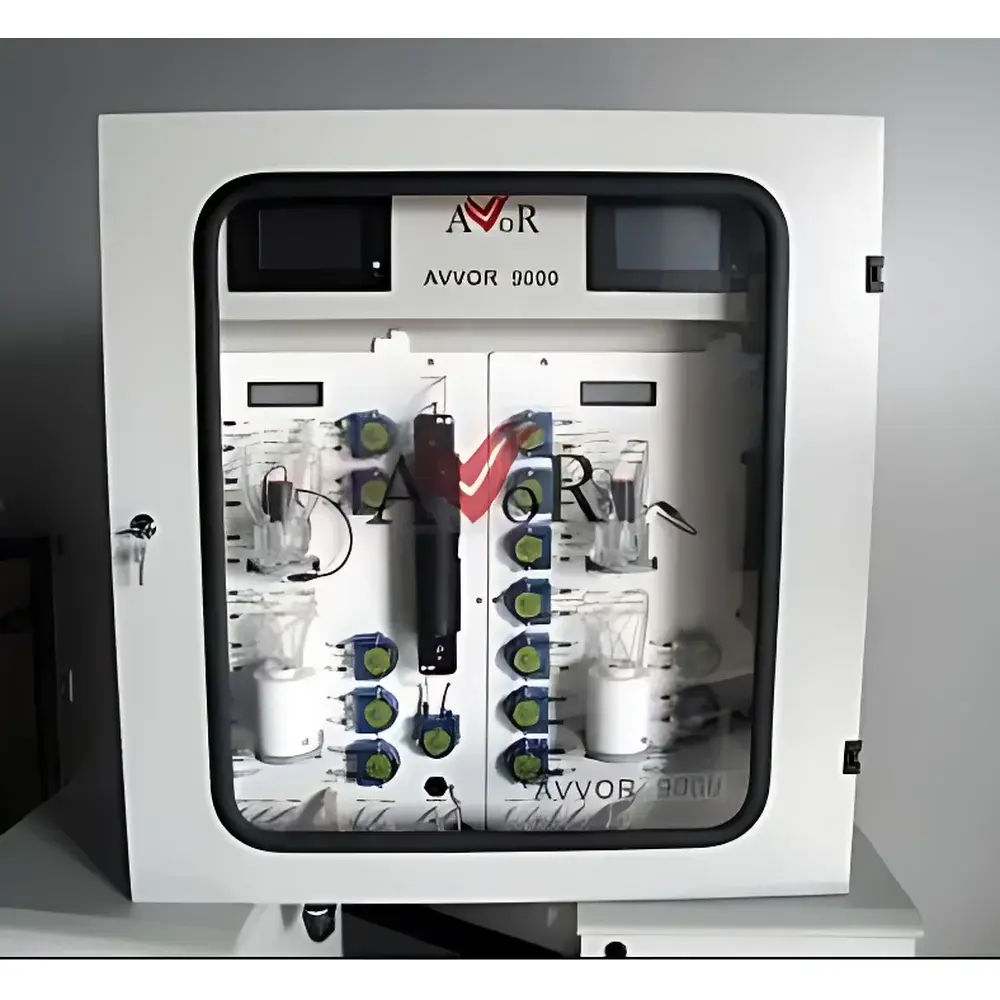
AVVOR 9000 Online Heavy Metal Analyzer
| Brand | AVVOR |
|---|---|
| Origin | Canada |
| Model | AVVOR 9000 |
| Measurement Principle | Anodic Stripping Voltammetry (ASV) |
| Detectable Elements | Cu, Pb, Zn, Cd, Mn, Sb, Tl, Fe, Ni, As, Hg, Se, Co, Mo, Au, Ag, Cr, Cr(VI), Sn, Pd, U |
| Electrode Options | Gold, Mercury-film, Bismuth-film, Bare Carbon |
| Max. Simultaneous Parameters per Module | 5 |
| Max. Modules per System | 2 |
| Analog Outputs | 8 × 4–20 mA |
| Digital Interfaces | RS-485, RS-232 |
| Compliance | Designed for EPA Method 7063, ISO 11969, and ASTM D3559-22 compatibility |
| Environmental Rating | IP65 Enclosure with Humidity Control |
Overview
The AVVOR 9000 Online Heavy Metal Analyzer is an industrial-grade electrochemical instrumentation system engineered for continuous, real-time quantification of dissolved heavy metal ions in aqueous matrices. It operates on the internationally standardized anodic stripping voltammetry (ASV) principle—a well-established electroanalytical technique recognized by regulatory frameworks including U.S. EPA Method 7063, ISO 11969, and ASTM D3559-22. In ASV, target metal ions are first preconcentrated onto a working electrode surface via controlled cathodic deposition under optimized electrolyte and potential conditions. Following a defined equilibration period, a linear or staircase anodic potential sweep is applied, causing oxidative dissolution (stripping) of the accumulated metals. The resulting current peaks—each uniquely associated with a specific redox potential—are measured and correlated to analyte concentration using calibration curves derived from traceable standard solutions. This method delivers sub-ppb detection sensitivity for most target elements while maintaining high selectivity in complex environmental matrices.
Key Features
- Modular architecture supporting up to two independent measurement modules per instrument chassis—enabling flexible configuration for site-specific monitoring needs.
- Dedicated electrode compatibility: gold, mercury-film, bismuth-film, and bare carbon electrodes—each selected based on target element chemistry, interferences, and regulatory acceptance.
- Multi-parameter capability: each module supports simultaneous quantification of up to five heavy metals, with predefined module configurations covering As/Hg/Se; Zn/Cd/Pb/Cu/Mn/Sb/Tl/Fe/Ni/Sn; Cr/Ni/Co/Mo; and Au/Ag/Cr/Cr(VI)/Pd.
- Robust analog and digital I/O: eight programmable 4–20 mA outputs assignable to any measured parameter, plus dual serial interfaces (RS-485 and RS-232) for SCADA integration and remote diagnostics.
- Automated operational integrity: scheduled self-calibration, fault detection with event logging, power/water interruption recovery, and time-stamped audit trails compliant with GLP data governance requirements.
- IP65-rated enclosure with internal humidity control and sealed optical/electrochemical compartments—designed for unattended deployment in outdoor wastewater outfalls, industrial effluent channels, and drinking water distribution nodes.
Sample Compatibility & Compliance
The AVVOR 9000 is validated for direct analysis of raw and pretreated water samples across diverse environmental and industrial contexts—including municipal wastewater effluents, surface and groundwater, potable water, seawater, and process liquors. Integrated sample conditioning includes filtration (optional 5 µm inline filter), pH stabilization, and optional UV digestion for organic interference mitigation. All measurement protocols adhere to principles outlined in ISO/IEC 17025 for analytical competence, and system validation reports support compliance with national discharge permits (e.g., U.S. NPDES), EU Water Framework Directive (WFD) monitoring obligations, and ISO 5667-3 sampling standards. Data integrity meets FDA 21 CFR Part 11 requirements through electronic signature-capable software with immutable audit logs.
Software & Data Management
The embedded firmware and companion PC-based software suite provide full lifecycle data management—from real-time trend visualization and alarm thresholding to automated report generation in PDF/CSV formats. Calibration history, maintenance logs, and raw voltammograms are stored with ISO 8601 timestamps and user attribution. Remote access via secure TCP/IP enables firmware updates, method reconfiguration, and diagnostic telemetry without on-site intervention. All data exports include metadata required for regulatory submission: instrument ID, electrode lot number, calibration date, analyst ID, and uncertainty estimates per ISO/IEC Guide 98-3 (GUM).
Applications
- Continuous compliance monitoring at wastewater treatment plant discharge points for regulated metals (e.g., Pb, Cd, Cr(VI), Hg).
- Early-warning detection in source water intakes for drinking water utilities—particularly for arsenic and lead in groundwater systems.
- Process control in electroplating, mining leachate, and battery manufacturing facilities where metal speciation and concentration stability are critical.
- Research-grade temporal profiling in limnological and marine studies requiring high-frequency metal flux quantification.
- Support for environmental impact assessments (EIAs) and post-remediation verification in brownfield sites.
FAQ
What electrochemical technique does the AVVOR 9000 employ?
Anodic stripping voltammetry (ASV), a reference method specified in EPA Method 7063 and ISO 11969.
Can the instrument measure hexavalent chromium (Cr(VI)) independently from total chromium?
Yes—via dedicated Cr(VI)-specific module (Module 4) using selective complexation and differential pulse ASV protocols.
Is electrode replacement performed by the user or requires service technician?
Electrodes are field-replaceable consumables with tool-free installation; full replacement kits include calibration verification standards.
How often is recalibration required under continuous operation?
Factory-recommended interval is every 7 days; automated daily bracketing checks ensure drift correction between formal calibrations.
Does the system support integration with existing PLC or DCS networks?
Yes—via Modbus RTU over RS-485 or 4–20 mA analog signals mapped to user-defined process variables.
Related Products







