
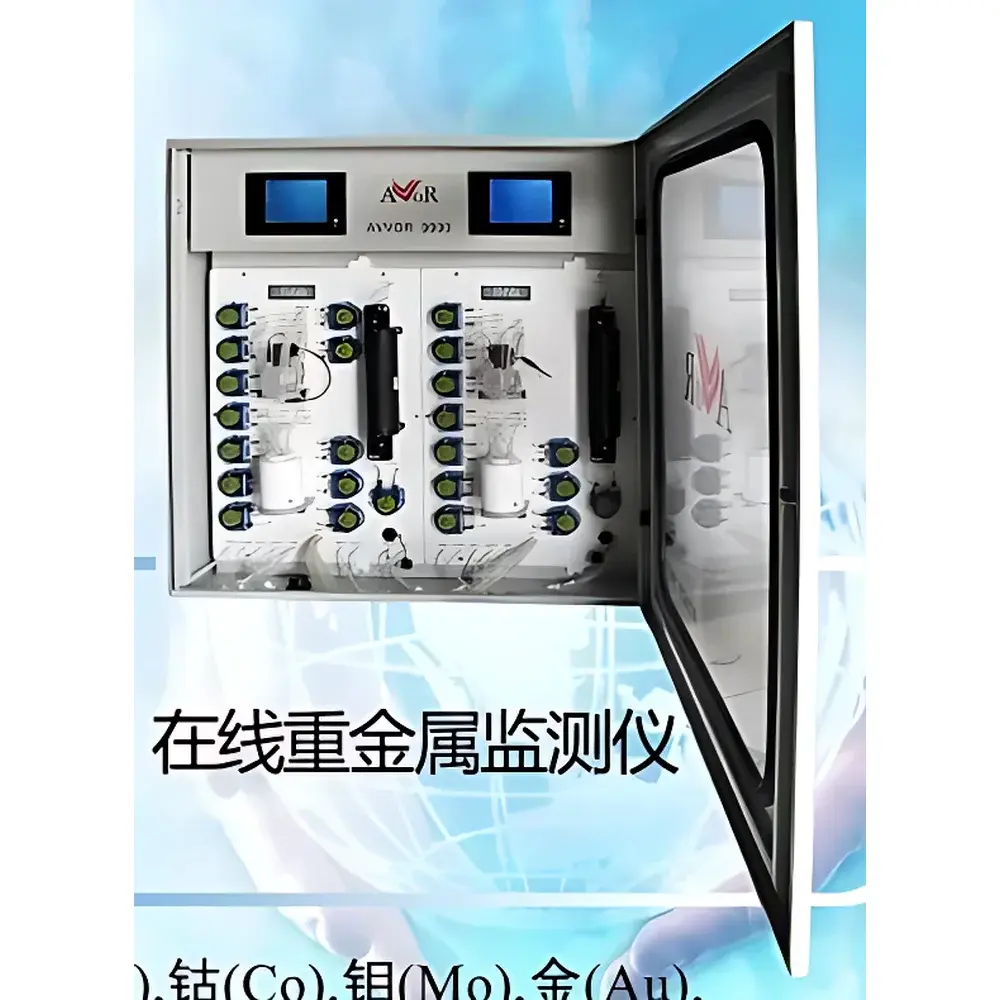
AVVOR 9000 Online Heavy Metal Analyzer
| Brand | AVVOR |
|---|---|
| Origin | Canada |
| Model | AVVOR 9000 |
| Detection Principle | Anodic Stripping Voltammetry (ASV) |
| Measurable Elements | Cu, Pb, Zn, Cd, Mn, Sb, Tl, Fe, Ni, As, Hg, Se, Co, Mo, Au, Ag, Cr, Cr(VI), Sn, Pd, U |
| Electrode Options | Gold, Mercury-film, Bismuth-film, Bare Carbon |
| Max. Simultaneous Channels | 2 modules × 5 metals each |
| Output Interfaces | 8 × 4–20 mA analog outputs, RS-485, RS-232 |
| Compliance | Designed for ISO 17294-2, ASTM D3559, EPA Method 7000B, and GLP/GMP-aligned data integrity |
| Environmental Rating | IP65 enclosure with humidity-resistant internal architecture |
| Power Supply | 100–240 VAC, 50/60 Hz |
| Operating Temperature | 5–40 °C |
| Sample Inlet | 6–8 mm tubing, pressure-rated for continuous flow |
Overview
The AVVOR 9000 Online Heavy Metal Analyzer is an industrial-grade electrochemical instrumentation platform engineered for continuous, real-time quantification of trace heavy metal ions in aqueous matrices. It operates on the internationally standardized principle of Anodic Stripping Voltammetry (ASV), a highly sensitive and selective voltammetric technique widely endorsed by regulatory bodies including the U.S. EPA (Method 7000B), ISO (ISO 17294-2), and ASTM (D3559). In ASV, target metal ions are first preconcentrated onto a working electrode via controlled cathodic deposition under optimized electrolyte and potential conditions. Following a defined equilibration period, a linear or staircase anodic potential sweep is applied, inducing oxidative dissolution of the deposited metals. The resulting current peaks—each uniquely associated with a specific metal’s standard reduction potential—are measured, integrated, and correlated to concentration via calibrated calibration curves. This method delivers sub-ppb detection limits for most target analytes while maintaining robustness against common interferences such as organic matter, chloride, and variable ionic strength—particularly when coupled with integrated sample conditioning (e.g., UV digestion, pH adjustment, and filtration).
Key Features
- Modular dual-channel architecture supporting up to two independent ASV test modules—enabling concurrent monitoring of up to ten distinct heavy metals without cross-contamination.
- Electrode flexibility: Interchangeable working electrodes—including gold, mercury-film, bismuth-film, and bare carbon—optimized for specific elemental groups (e.g., Hg/As/Se on gold; Zn/Cd/Pb/Cu on mercury-film; Cr(VI)/Ni/Co on carbon).
- Integrated sample pretreatment capability: Onboard reagent dosing, UV oxidation, and membrane filtration reduce organic fouling and matrix effects, enhancing long-term measurement stability and reproducibility.
- Eight programmable 4–20 mA analog outputs, individually assignable to any measured parameter or diagnostic signal—fully configurable via embedded web interface or Modbus RTU over RS-485.
- Comprehensive system autonomy: Scheduled auto-calibration using certified standard solutions, self-diagnostic routines for electrode health and fluidic integrity, and fail-safe shutdown during power loss, low flow, or temperature excursion.
- IP65-rated NEMA 4X enclosure with internal desiccant management and condensation-resistant PCB layout—designed for unattended operation in harsh outdoor or industrial environments.
Sample Compatibility & Compliance
The AVVOR 9000 is validated for direct analysis of raw and treated water streams across diverse applications: municipal wastewater effluents, industrial process liquors (e.g., electroplating rinse waters, mining leachates), surface and groundwater, drinking water distribution systems, and coastal seawater (with salinity compensation). It meets functional requirements for regulatory compliance monitoring under national discharge permits and aligns with data integrity expectations for GLP and GMP environments. While not a standalone certifiable instrument per FDA 21 CFR Part 11, its firmware supports audit-trail logging of all configuration changes, calibration events, and measurement records—exportable in CSV or XML format with timestamped digital signatures. All electrochemical protocols adhere to ISO 17294-2 Annex A for multi-element ASV in environmental waters.
Software & Data Management
The embedded Linux-based controller hosts a secure, browser-accessible interface (HTTPS/TLS 1.2) for remote configuration, real-time trend visualization, and event-based alerting (email/SMS via optional gateway). Data logging occurs at user-defined intervals (1 min to 24 h) with local storage (8 GB eMMC) and automatic synchronization to FTP/SFTP servers or MQTT brokers. Firmware updates are delivered via signed package verification. Optional cloud integration enables centralized fleet monitoring across distributed sites—supporting SCADA-level interoperability through OPC UA and Modbus TCP. Calibration history, electrode usage logs, and QC check results are retained for ≥12 months and exportable for third-party LIMS ingestion.
Applications
- Real-time compliance monitoring of effluent discharges from electroplating, metal finishing, battery recycling, and semiconductor fabrication facilities.
- Early-warning surveillance of heavy metal contamination in river basins downstream of mining operations or legacy industrial zones.
- Process control in water reclamation plants where residual Cu, Ni, or Cr(VI) must remain below reuse thresholds.
- Drinking water safety assurance in distribution networks vulnerable to lead service line corrosion or arsenic mobilization.
- Research-grade longitudinal studies of metal speciation dynamics in estuarine and marine ecosystems.
FAQ
What electrochemical method does the AVVOR 9000 use, and why is it suitable for online monitoring?
It employs Anodic Stripping Voltammetry (ASV), selected for its high sensitivity (sub-ppb LODs), multi-element capacity, and tolerance to complex matrices—making it ideal for unattended, long-interval field deployment.
Can the instrument measure hexavalent chromium (Cr(VI)) separately from total chromium?
Yes—Cr(VI) is selectively detected using a carbon-based working electrode under acidic conditions and differential pulse ASV, with no interference from Cr(III) or other trivalent metals.
How often is manual maintenance required?
Electrode cleaning is recommended every 7–14 days depending on sample turbidity; full calibration verification is performed automatically every 24 hours, with manual standard addition checks advised weekly.
Is the system compatible with existing SCADA infrastructure?
Yes—via native Modbus RTU (RS-485), Modbus TCP (Ethernet), or OPC UA (optional add-on), enabling seamless integration into plant-wide automation systems.
Does the analyzer support remote firmware updates and diagnostics?
Yes—secure over-the-air (OTA) updates are supported with cryptographic signature validation; remote diagnostics include impedance spectroscopy of electrode interfaces and fluidic pressure profiling.







