
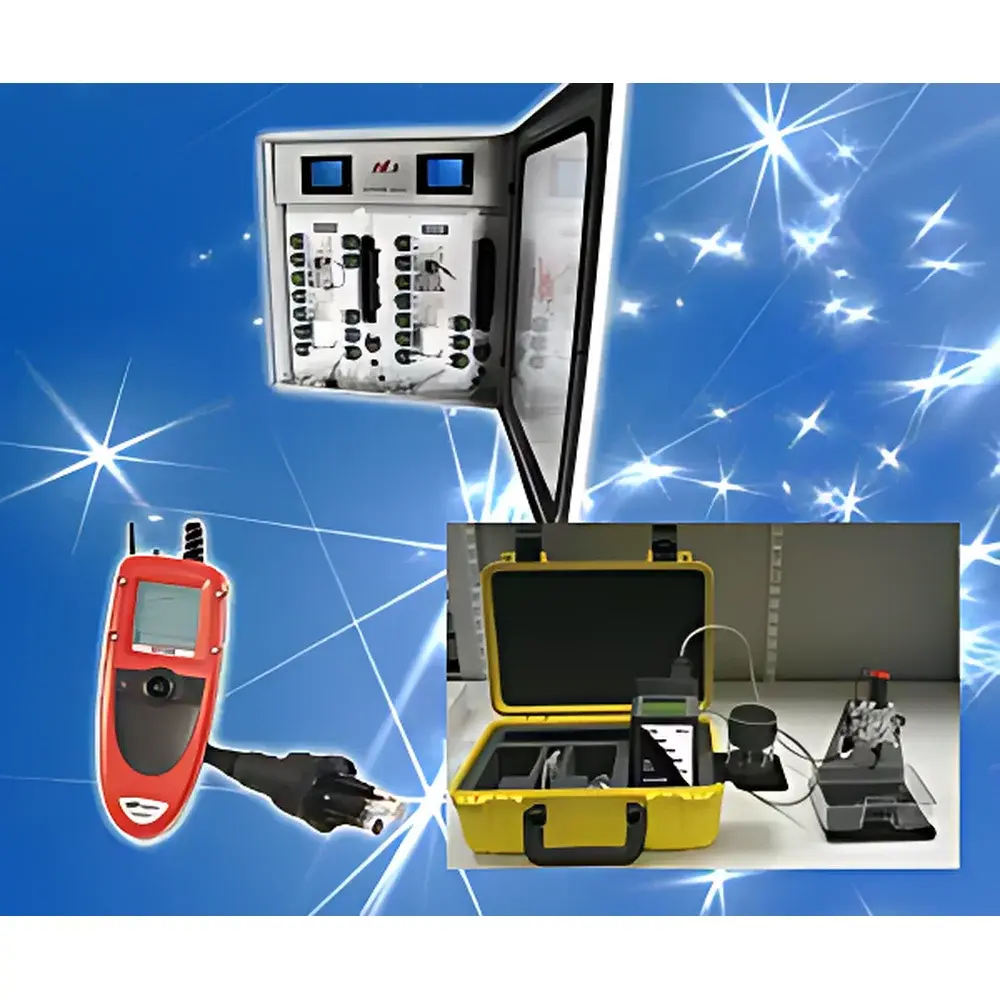
AVVOR 9000 Online Heavy Metal Analyzer | Wagtech Metalyser HM1000 Portable Heavy Metal Analyzer | AVVOR 8000 Laboratory-Based Heavy Metal Analyzer
| Origin | Canada |
|---|---|
| Manufacturer Type | Authorized Distributor |
| Origin Category | Imported |
| Models | HM-1000, AVVOR-8000, AVVOR-9000 |
| Pricing | Available Upon Request |
Overview
The AVVOR and Wagtech heavy metal analyzers represent a family of electrochemical and field-deployable instrumentation engineered for quantitative determination of toxic and regulated metals in environmental matrices. The AVVOR-9000 operates on the principle of anodic stripping voltammetry (ASV), a well-established electroanalytical technique standardized under ASTM D3559, ISO 11969, and EPA Method 7000B. It enables trace-level quantification (sub-ppb to low-ppb) of redox-active metals—including As(III), Cd, Pb, Cu, Zn, Hg, Sb, Tl, Se, Ni, Cr(VI), and others—by controlled pre-concentration onto a working electrode followed by potential-sweep–induced oxidation and current measurement. The Wagtech Metalyser HM-1000 implements a simplified, reagent-free variant of ASV optimized for rapid screening in resource-limited settings, while the AVVOR-8000 delivers laboratory-grade precision using dual-mode (ASV and cathodic stripping voltammetry, CSV) capability for broader speciation support (e.g., As(III)/As(V), Hg(II)/methylmercury). All systems comply with GLP data integrity requirements and support audit-ready electronic records per FDA 21 CFR Part 11 when integrated with validated software platforms.
Key Features
- AVVOR-9000: Modular architecture supporting up to two independent test modules; each module accommodates one working electrode (Au, Hg-film, Bi-film, or bare carbon) and enables concurrent multi-element analysis (up to 5 metals per module)
- HM-1000: Handheld, battery-powered design (operating time >8 h); no liquid reagents required; sample-to-result time <90 seconds; detection limits ≤0.1 µg/L for As, Cd, Cu, Hg, Pb
- AVVOR-8000: Benchtop configuration with automated liquid handling, temperature-controlled cell, and integrated digestion module for solid samples (soil, sludge, food digests)
- All models feature RS-485, Ethernet, and optional LoRaWAN/Wi-Fi connectivity for remote monitoring and SCADA integration
- Calibration traceability to NIST-traceable standard solutions; built-in QC checks including spike recovery, blank verification, and electrode surface renewal protocols
Sample Compatibility & Compliance
These analyzers are validated for use across diverse environmental and regulatory sample types: raw and treated drinking water (US EPA Safe Drinking Water Act compliance), wastewater effluents (EU Urban Wastewater Treatment Directive Annex I), surface water (ISO 5667-3), soil leachates (EPA Method 1311 TCLP), and food extractates (AOAC 2015.03). Electrode selection is matrix-dependent—gold electrodes for mercury and arsenic in chloride-rich waters; bismuth-film electrodes for cadmium and lead in low-conductivity samples; mercury-film electrodes for ultra-trace copper and zinc. Each instrument supports method validation per ISO/IEC 17025 and provides full documentation packages for laboratory accreditation submissions.
Software & Data Management
The proprietary Analytix Suite (v5.2+) provides instrument control, real-time voltammogram visualization, peak deconvolution, and calibration curve generation. Raw data files (.axd) are stored in open-format HDF5 containers with embedded metadata (sample ID, operator, timestamp, electrode history, ambient temperature). Audit trails log all user actions—including method edits, calibration overrides, and result deletions—with immutable timestamps and digital signatures. Export options include CSV, PDF analytical reports (with ISO 14253-1–compliant uncertainty statements), and direct upload to LIMS via HL7 or ASTM E1384 interfaces. Optional 21 CFR Part 11 compliance package includes role-based access control, electronic signatures, and periodic system integrity verification.
Applications
- Real-time monitoring of industrial discharge points for compliance with local effluent limits (e.g., China’s GB 8978–1996, India’s CPCB standards)
- Field screening of groundwater wells near mining sites or landfill leachate plumes
- Verification of adsorbent media performance (e.g., activated carbon, ion-exchange resins) in point-of-use treatment systems
- Research applications including bioavailability assessment (e.g., DGT-labile metal fraction correlation), redox speciation kinetics, and ligand competition modeling
- Emergency response deployment during chemical spills or flood-related contamination events
FAQ
What regulatory methods are supported by the AVVOR-9000?
It complies with ASTM D3559 (lead in water), ISO 11969 (cadmium), EPA Method 7000B (anodic stripping), and supports in-house validated methods aligned with EU WFD EQS requirements.
Can the HM-1000 measure hexavalent chromium (Cr(VI)) directly?
No—Cr(VI) requires pre-reduction to Cr(III) or separation prior to ASV detection; however, the AVVOR-9000 supports Cr(VI) quantification using differential pulse voltammetry with a gold electrode and acidic medium.
Is electrode cleaning automated?
Yes—the AVVOR-8000 and AVVOR-9000 include programmable electrochemical polishing cycles; HM-1000 uses disposable electrode cartridges to eliminate manual cleaning.
How often must calibration standards be renewed?
NIST-traceable stock standards (1000 mg/L) are stable for 24 months unopened; working standards (1–100 µg/L) should be prepared daily and verified against certified reference materials (e.g., NIST SRM 1640a) before analysis.
Does the system support multi-point calibration with internal standard correction?
Yes—Analytix Suite supports bracketing calibrations with internal standard addition (e.g., In(III) for Cd/Pb/Cu) to correct for matrix-induced signal suppression or enhancement.







