
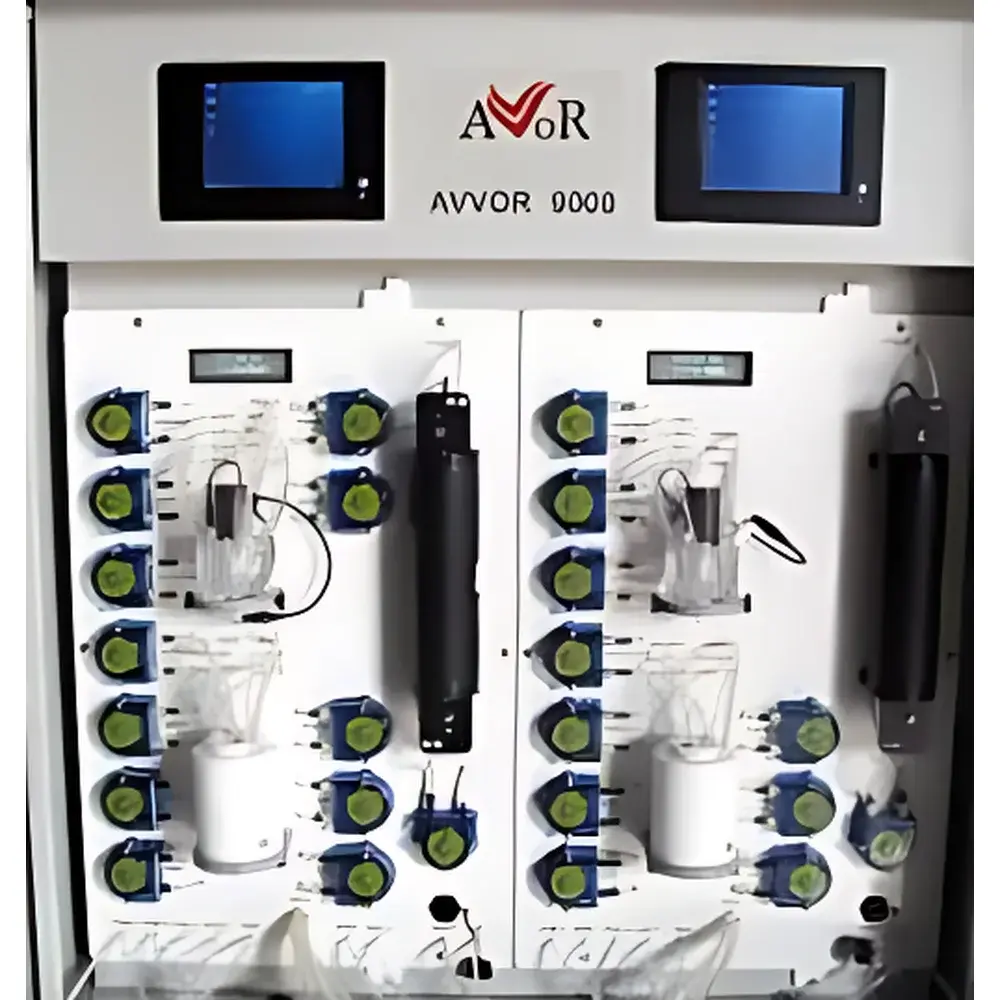
AVVOR 9000 Online Heavy Metals Analyzer with Anodic Stripping Voltammetry
| Brand | AVVOR |
|---|---|
| Origin | Canada |
| Model | AVVOR 9000 |
| Detection Principle | Anodic Stripping Voltammetry (ASV) |
| Measurable Elements | Cu, Pb, Zn, Cd, Mn, Sb, Tl, Fe, Ni, As, Hg, Se, Co, Mo, Au, Ag, Cr, Cr(VI), Sn, Pd, U |
| Electrode Options | Gold, Mercury-Film, Bismuth-Film, Bare Carbon |
| Max Modules | 2 |
| Simultaneous Parameters per Module | Up to 5 |
| Analog Outputs | 8 × 4–20 mA |
| Digital Interfaces | RS-485, RS-232 |
| Compliance | Designed for EPA Method 7063, ISO 11969, ASTM D3559, and GLP/GMP-aligned data integrity protocols |
Overview
The AVVOR 9000 Online Heavy Metals Analyzer is an industrial-grade electrochemical instrument engineered for continuous, real-time quantification of trace heavy metal ions in aqueous matrices. It employs validated anodic stripping voltammetry (ASV)—a standardized potentiostatic technique recognized by the U.S. Environmental Protection Agency (EPA Method 7063), ISO 11969, and ASTM D3559—as its core measurement principle. In ASV, target metal ions are first preconcentrated onto a working electrode via controlled cathodic deposition (electrolysis), followed by a rest period to stabilize the electrode-solution interface. A subsequent linear or staircase anodic potential sweep then oxidizes the deposited metals, generating current peaks whose magnitude and position correspond directly to concentration and elemental identity. This two-step electrochemical process delivers sub-ppb detection limits for most transition and post-transition metals, with inherent selectivity derived from characteristic peak potentials and optimized deposition parameters.
Key Features
- Modular architecture supporting up to two independent ASV test modules per analyzer chassis—enabling flexible deployment across multi-parameter monitoring requirements.
- Dedicated electrode compatibility: gold for As/Hg/Se; mercury-film for Zn/Cd/Pb/Cu/Mn/Sb/Tl/Fe/Ni/Sn; bismuth-film as a non-toxic alternative for Cd/Pb/Zn; bare carbon for Cr/Co/Mo/Au/Ag/Pd/Cr(VI).
- Each module accommodates one working electrode and delivers simultaneous quantification of up to five elements within a single analysis cycle (typical cycle time: 12–25 minutes, depending on configuration).
- Integrated sample conditioning system—including filtration, pH adjustment, and optional UV digestion—to minimize organic interference and enhance matrix robustness in complex wastewater or surface water samples.
- Eight configurable 4–20 mA analog outputs, each assignable to any measured parameter or diagnostic variable via embedded firmware; dual serial interfaces (RS-485 and RS-232) support Modbus RTU and ASCII protocols for SCADA integration.
- Automated maintenance routines: scheduled calibration verification using certified standard solutions, self-diagnostic fault logging, power-loss recovery with parameter retention, and sealed NEMA 4X enclosure with internal humidity control.
Sample Compatibility & Compliance
The AVVOR 9000 is validated for direct online analysis of liquid samples with conductivity between 50 µS/cm and 20 mS/cm and suspended solids content ≤ 25 mg/L. It operates reliably across municipal effluents, industrial process streams (e.g., plating rinse waters, mining leachates), drinking water distribution systems, groundwater wells, and coastal seawater (with salinity compensation). All firmware and data handling workflows adhere to principles of ALCOA+ (Attributable, Legible, Contemporaneous, Original, Accurate, Complete, Consistent, Enduring, Available) and support audit-ready electronic records. Optional software packages provide 21 CFR Part 11-compliant user access control, electronic signatures, and immutable audit trails—meeting GLP and GMP environmental monitoring requirements.
Software & Data Management
Embedded firmware includes real-time signal processing algorithms for baseline correction, peak deconvolution, and drift compensation. The web-accessible configuration interface allows remote setup of measurement sequences, calibration schedules, alarm thresholds (high/low, rate-of-change), and output mapping. Raw voltammograms and processed concentration logs are timestamped and stored locally (SD card, ≥1 year at 1-min intervals) while streaming via TCP/IP or MQTT to centralized LIMS or cloud-based dashboards. Export formats include CSV, PDF reports, and XML for regulatory submission. Firmware updates are delivered via secure HTTPS with cryptographic signature validation.
Applications
- Continuous compliance monitoring at NPDES outfalls and industrial discharge points for regulated metals under Clean Water Act Section 402.
- Early-warning detection in source water intakes for municipal treatment plants—particularly for Hg, As, and Cr(VI) where rapid response is critical.
- In-process control of electroplating baths, etching solutions, and semiconductor rinse waters to maintain bath chemistry and reduce chemical consumption.
- Long-term trend analysis in watershed studies, including seasonal mobilization of Pb/Cd from sediments or As release from reducing aquifers.
- Supporting ISO 14001-certified environmental management systems through automated, auditable heavy metal data collection.
FAQ
What electrochemical method does the AVVOR 9000 use, and why is it suitable for regulatory applications?
It uses anodic stripping voltammetry (ASV), a reference method cited in EPA 7063 and ISO 11969 for trace metal analysis in water. Its reproducibility, low detection limits, and ability to resolve overlapping elements via peak potential separation make it appropriate for compliance-grade monitoring.
Can the instrument measure hexavalent chromium (Cr(VI)) separately from total chromium?
Yes—using a dedicated gold or modified carbon electrode with selective complexation chemistry, the AVVOR 9000 quantifies Cr(VI) independently without requiring speciation pretreatment.
How often does the system require calibration or maintenance?
Automatic daily verification against a primary standard is configurable; full calibration is recommended every 7–14 days depending on matrix fouling risk. Electrodes are field-replaceable with <5-minute swap time and no recalibration needed.
Is remote diagnostics and firmware update supported?
Yes—via secure HTTPS connection, authorized users can perform health checks, download diagnostic logs, and install signed firmware updates without on-site technician intervention.
Does the analyzer meet cybersecurity standards for industrial IoT deployment?
It implements TLS 1.2 encryption for web interface and MQTT communication, role-based authentication, disabled default credentials, and configurable firewall rules—aligning with IEC 62443-3-3 SL2 recommendations.







