
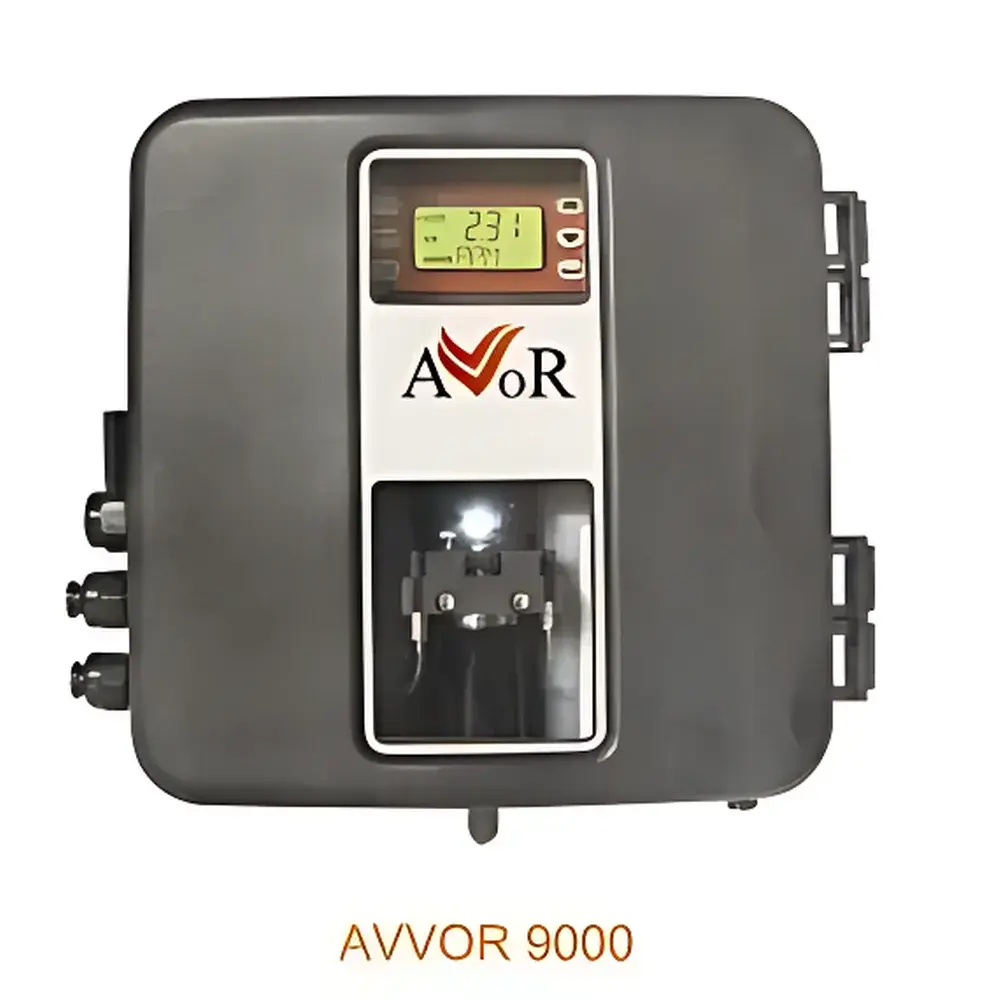
AVVOR 9000 Residual Chlorine and Total Chlorine Analyzer (DPD-Based Online Water Quality Monitor)
| Brand | AVVOR |
|---|---|
| Origin | Canada |
| Model | AVVOR 9000 |
| Measurement Range | 0–10 mg/L Cl₂ |
| Cycle Time | 110 s – 10 min (user-selectable) |
| Accuracy | ±5% or ±0.03 mg/L Cl₂ (whichever is greater) for 0–6 mg/L |
| Resolution | 0.01 mg/L |
| Method | EPA-Approved DPD Colorimetric Analysis |
| Output | 4–20 mA analog + RS-485 with Modbus RTU protocol |
| Alarms | Two user-configurable concentration-based digital alarms |
| Operating Temperature | 5–40 °C |
| Inlet Pressure | 5–150 psi |
| Enclosure Rating | NEMA 4X / IP66 |
| Housing Material | ABS plastic |
| Power Supply | 100–240 V AC, auto-ranging, 47–63 Hz |
| Certifications | CE, UL, CSA, ETL, ETLc |
| Dimensions (L×W×H) | 41 × 41 × 26 cm |
| Weight | 3.6 kg |
Overview
The AVVOR 9000 Residual Chlorine and Total Chlorine Analyzer is a fully automated, online water quality monitoring instrument engineered for continuous, unattended measurement of free chlorine, combined chlorine, and total chlorine in potable water distribution systems, municipal drinking water plants, and industrial process streams. It implements the U.S. Environmental Protection Agency (EPA)-approved DPD (N,N-diethyl-p-phenylenediamine) colorimetric method — a standardized wet-chemistry technique in which chlorine oxidizes DPD to form a stable pink-colored compound, quantified photometrically at 515 nm. The analyzer performs sequential reagent dosing, mixing, reaction incubation, optical detection, and waste disposal within a sealed fluidic path, ensuring high reproducibility and minimal interference from turbidity or background color. Designed for deployment in chlorination control loops, it delivers real-time data with cycle times configurable between 110 seconds and 10 minutes — enabling flexible integration into SCADA systems while maintaining compliance with regulatory monitoring frequency requirements under EPA Method 334.1 and ISO 7393-2.
Key Features
- True unattended operation for up to 30 days on a single reagent cartridge set, minimizing labor and service intervals
- User-selectable measurement cycle time (110 s to 10 min) to match system dynamics and regulatory reporting needs
- Dual independent alarm outputs — programmable as high/low concentration thresholds or maintenance alerts — supporting manual override or PLC-driven chlorine dosing control
- NEMA 4X / IP66-rated ABS enclosure suitable for indoor and outdoor installation in humid, dusty, or splash-prone environments
- Integrated dual-output interface: isolated 4–20 mA analog signal (HART-compatible) and RS-485 serial port with Modbus RTU protocol for seamless integration into industrial automation networks
- Low reagent consumption design reduces operational cost and hazardous waste generation per measurement cycle
- Self-diagnostic routines monitor optical path integrity, pump performance, and reagent expiration, logging events for audit-ready traceability
Sample Compatibility & Compliance
The AVVOR 9000 is validated for use with clarified, low-turbidity water samples typical of finished drinking water (<5 NTU), filtered surface water, and pre-disinfected groundwater. It meets performance criteria specified in EPA Method 334.1 for residual chlorine determination and aligns with ISO 7393-2 for total chlorine analysis. While not intended for raw wastewater or highly colored industrial effluents without pretreatment, it supports optional inline filtration and air-gap sampling for applications requiring particulate removal. All electrical components are certified to UL 61010-1, CSA C22.2 No. 61010-1, and CE marking under the EU Low Voltage and EMC Directives. ETL and ETLc listings confirm conformance with North American safety and electromagnetic compatibility standards. The device operates within GLP/GMP-aligned data integrity frameworks when paired with compliant SCADA or LIMS software that supports audit trails and electronic signatures.
Software & Data Management
The analyzer includes embedded firmware with non-volatile memory for storing calibration history, alarm logs, diagnostic records, and daily measurement summaries. Configuration and diagnostics are accessible via local LCD interface or remotely through Modbus register mapping. When integrated with third-party supervisory systems, all measurements and status flags are timestamped with millisecond precision and retain full traceability per FDA 21 CFR Part 11 requirements — provided the host system implements appropriate access controls, electronic signature workflows, and audit trail retention policies. Optional firmware updates are delivered via secure USB or Modbus file transfer, with version-controlled change logs stored internally.
Applications
- Real-time monitoring and feedback control of chlorine injection points in municipal water treatment plants
- Compliance verification at distribution system entry points and critical nodes (e.g., reservoirs, booster stations)
- Process optimization in food & beverage production where chlorine residuals must remain within strict regulatory limits
- Validation support for disinfection validation studies under USP and WHO Guidelines for Drinking-water Quality
- Remote telemetry for rural or decentralized water systems using cellular or LoRaWAN gateways connected to the RS-485 interface
FAQ
What chlorine species does the AVVOR 9000 measure?
It measures free residual chlorine, combined chlorine (chloramines), and total chlorine — selectable via reagent configuration and measurement protocol.
Is field calibration required?
Yes — initial calibration using NIST-traceable chlorine standards is mandatory; subsequent verification is recommended every 7 days or after reagent replacement.
Can the instrument operate under variable inlet pressure?
Yes — it accepts inlet pressures from 5 to 150 psi and includes an internal pressure regulator to maintain consistent sample flow during measurement cycles.
Does it support remote firmware updates?
Firmware updates are supported via USB drive or Modbus file transfer, with checksum validation and rollback capability in case of interruption.
How is reagent consumption managed?
Reagent cartridges are pre-filled and barcoded; the system tracks usage in real time and triggers visual and digital alerts when remaining capacity falls below 10% of nominal volume.
Related Products







