
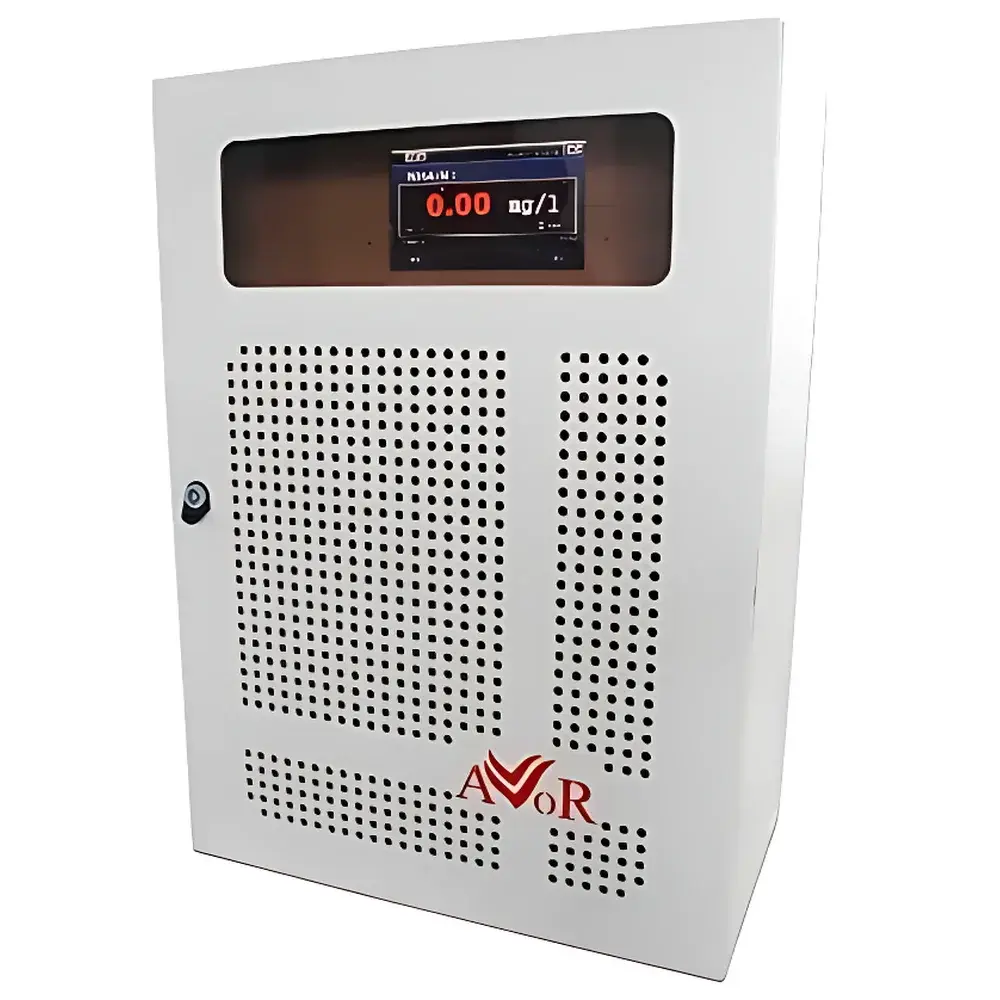
AVVOR AVVOR 9000 NH4-N Online Ammonia Nitrogen Analyzer
| Brand | AVVOR |
|---|---|
| Origin | Fujian, China |
| Manufacturer Type | Authorized Distributor |
| Product Origin | Domestic (China) |
| Model | AVVOR 9000 NH4-N |
| Instrument Type | Online Analyzer |
| Measurement Principle | Ammonia Gas-Sensing Electrode Method |
| Measurement Range | 0.05–1000 mg/L (multi-range configurable) |
| Accuracy | ±3% FS |
| Detection Limit | 0.01 mg/L |
| Measurement Cycle | 5 min per sample |
| Batch Capacity | 10 samples |
| Compliance | HJ/T 101–2003 (China EPA Standard) |
Overview
The AVVOR AVVOR 9000 NH4-N Online Ammonia Nitrogen Analyzer is an industrial-grade, continuous-monitoring instrument engineered for reliable, real-time quantification of total ammonia nitrogen (NH₄⁺–N) in aqueous environmental and process streams. It operates on the well-established ammonia gas-sensing electrode principle — a potentiometric method recognized for its selectivity, stability, and minimal sample pretreatment requirements. Upon alkalization of the water sample with sodium hydroxide (NaOH), ammonium ions (NH₄⁺) are converted to gaseous ammonia (NH₃), which diffuses selectively through a hydrophobic, gas-permeable membrane mounted at the tip of the sensing electrode. The permeated NH₃ dissolves into an internal electrolyte buffer, inducing a measurable pH shift detected by an integrated solid-state pH sensor. This voltage response exhibits a Nernstian logarithmic relationship with the logarithm of NH₄⁺–N concentration across six user-selectable ranges (0.05–1, 1–10, 5–50, 10–100, 50–500, and 500–1000 mg/L), enabling high-resolution measurement across trace to high-concentration applications without manual dilution.
Key Features
- Ammonia-specific gas-sensing electrode with hydrophobic Teflon®-based selective membrane, ensuring long-term stability and resistance to fouling and ionic interference.
- Automated two-point calibration using certified reference standards (e.g., 1 mg/L and 10 mg/L NH₄⁺–N), supported by built-in calibration validation logic and drift monitoring.
- Integrated thermal regulation module and flow-through cell design, maintaining optimal electrode temperature (typically 25 ± 1 °C) and consistent hydraulic residence time for reproducible diffusion kinetics.
- Programmable auto-cleaning cycle utilizing compressed air or low-pressure water jet, reducing maintenance frequency and mitigating biofilm accumulation on the membrane surface.
- 5-inch capacitive color touchscreen interface with intuitive navigation, real-time trend visualization, alarm thresholds, and event logging (including calibration history, error codes, and system diagnostics).
- Open communication architecture compliant with Modbus RTU/TCP and ASCII protocols; full source code for data acquisition provided to system integrators for seamless SCADA/DCS integration.
Sample Compatibility & Compliance
The AVVOR 9000 NH4-N is validated for direct analysis of raw and treated waters including surface water (rivers, lakes, reservoirs), drinking water distribution systems, municipal wastewater effluents, and industrial discharge streams. It meets the performance criteria specified in China’s Ministry of Ecology and Environment standard HJ/T 101–2003 for online ammonia nitrogen analyzers. While not certified to ISO 15681-1:2018 or ASTM D1426–15, its operational methodology aligns with the electrochemical principles referenced therein. For regulated environments operating under GLP or GMP frameworks, the analyzer supports audit-ready data integrity features including time-stamped, non-erasable event logs and optional password-protected configuration access — compatible with 21 CFR Part 11-compliant data management platforms when deployed with appropriate LIMS or historian systems.
Software & Data Management
The embedded firmware provides local data storage for ≥30 days of 5-minute interval measurements (concentration, temperature, electrode mV, calibration status). Data export is supported via USB flash drive (CSV format) or Ethernet (Modbus TCP). Remote access and centralized monitoring are enabled through optional OPC UA or MQTT gateways. All calibration events, maintenance alerts, and system faults are timestamped and retained with operator ID tagging where authentication is enabled. The open API facilitates custom dashboard development and integration into enterprise environmental monitoring platforms, supporting automated report generation aligned with regulatory submission templates (e.g., China MEP monthly discharge reports).
Applications
- Real-time compliance monitoring at municipal wastewater treatment plant (WWTP) discharge outfalls per GB 18918–2002 Class I A/B limits.
- Process control in biological nutrient removal (BNR) systems, including nitrification/denitrification loop feedback.
- Early-warning detection of ammonia breakthrough in drinking water treatment plants following chloramination or breakpoint chlorination.
- Effluent surveillance for chemical, pharmaceutical, and food processing facilities subject to local discharge permits.
- Long-term ecological monitoring in sensitive aquatic ecosystems where sub-0.1 mg/L resolution is critical for eutrophication assessment.
FAQ
Does the analyzer require reagent addition during routine operation?
Yes — standardized NaOH solution (typically 1–2 mol/L) is consumed during each measurement cycle to convert NH₄⁺ to NH₃. Reagent volume is precisely metered via peristaltic pump; typical consumption is ≤5 mL per analysis.
Can the instrument operate unattended for extended periods?
Yes — designed for 7×24 operation with automatic calibration every 6–24 hours (user-configurable), self-diagnostic routines, and low-reagent/low-pressure alarms. Mean time between unscheduled service intervals exceeds 180 days under typical municipal wastewater conditions.
Is the electrode replaceable in the field?
Yes — the ammonia gas-sensing electrode is a modular, plug-and-play component with quick-connect fittings; replacement takes <10 minutes and requires no recalibration beyond standard two-point verification.
What is the recommended maintenance schedule?
Daily visual inspection; weekly membrane cleaning (if ambient suspended solids >50 mg/L); quarterly electrode performance verification using traceable standards; annual full system validation per HJ/T 101–2003 Annex B procedures.
How does the analyzer handle high-turbidity or high-salinity samples?
A pre-filtration module (5–10 µm) is recommended upstream for turbidities >100 NTU. Salinity up to 35 g/L (seawater strength) is tolerated, though accuracy may degrade >±5% above 20 g/L without salinity compensation — optional conductivity-based correction is available via firmware update.
Related Products







