
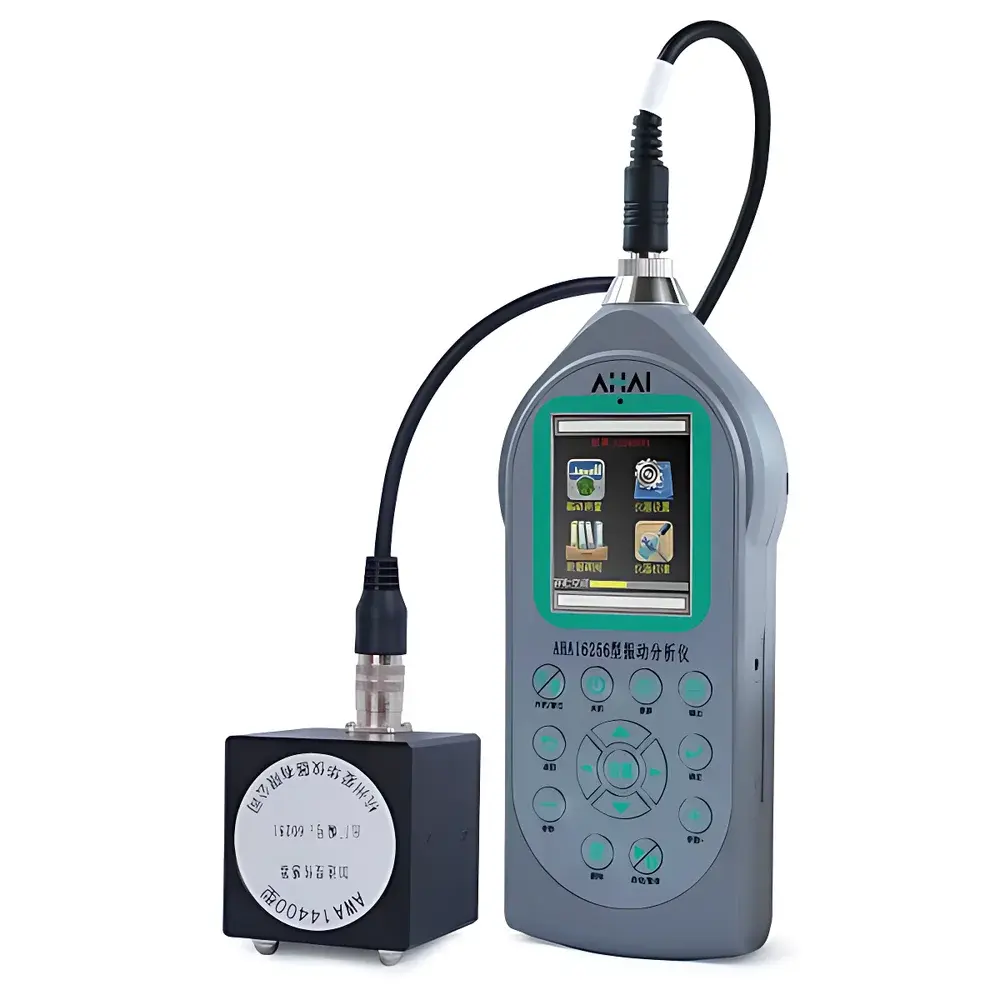
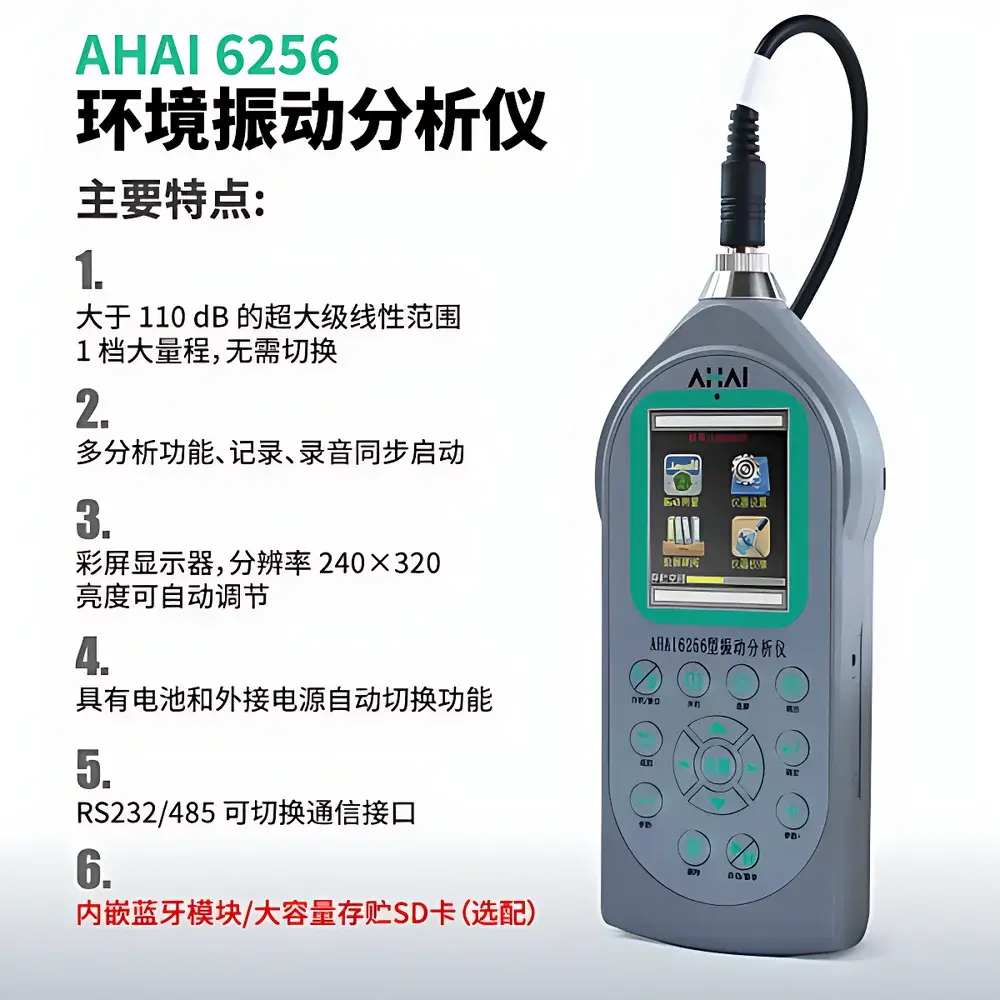
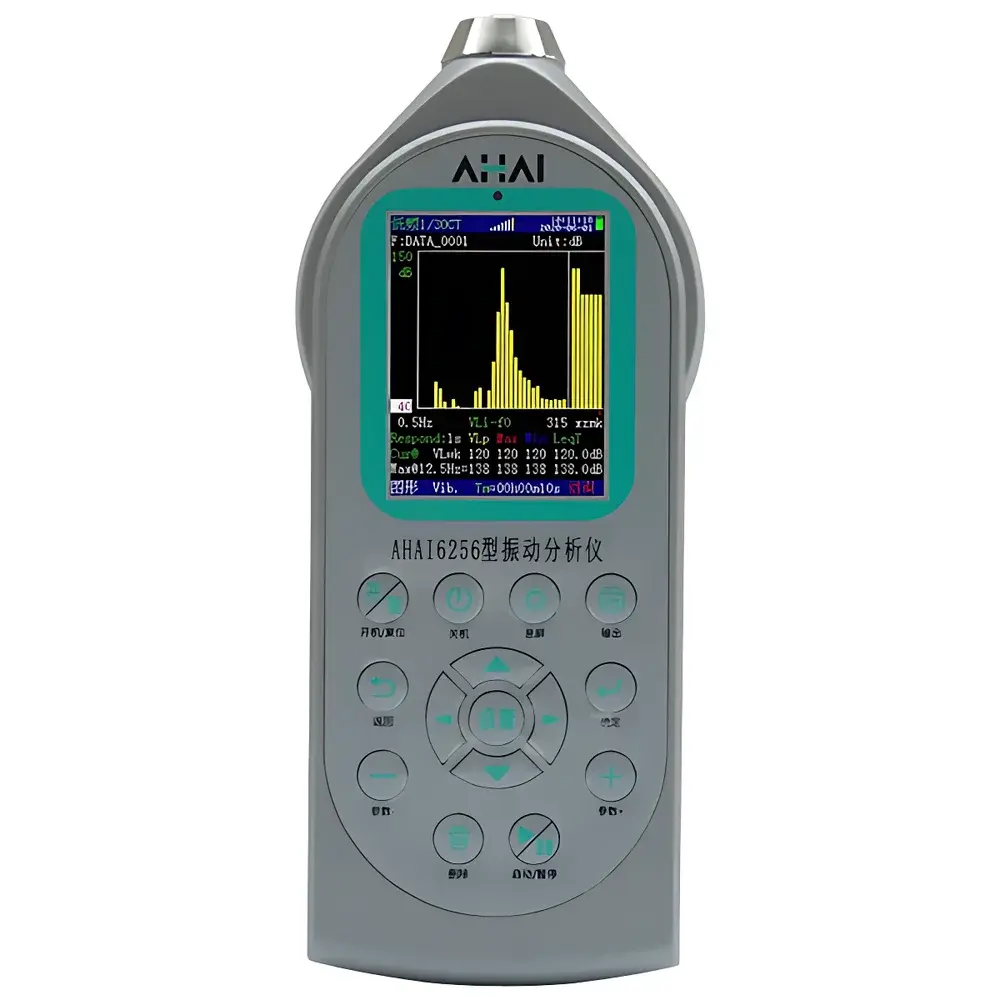
AWA AHAI6256 Hand-Arm and Whole-Body Vibration Analyzer
| Brand | AWA |
|---|---|
| Model | AHAI6256 |
| Type | Portable Vibration Analyzer |
| Compliance | ISO 8041:2005, ISO 5349-1:2001, GB/T 23716–2009, IEC 61260:1995 |
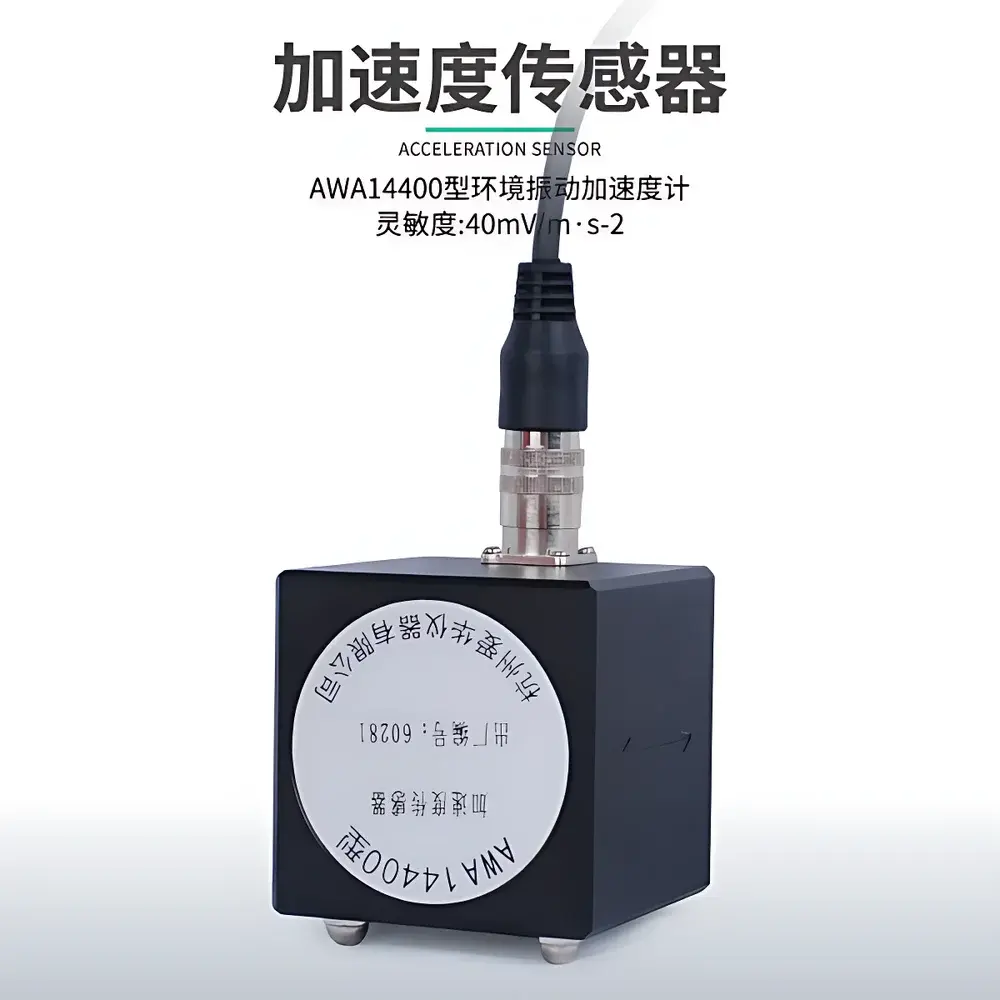
| Sensor | AWA14400 Environmental Accelerometer (Sensitivity: 40 mV/m·s⁻², Mass: 550 g) |
| Frequency Range | 0.315 Hz–250 Hz (±2 dB), with weighted bands Wb/Wc/Wd/We/Wj/Wk/Wm/Wz/Wu |
| Measurement Parameters | Acceleration (m/s²), Velocity (mm/s), Displacement (µm), 1/3-Octave Band Analysis, FFT Spectrum (up to 256 lines), Time History Recording |
| Dynamic Range | 48 dB–158 dB (re 10⁻⁶ m/s²) |
| Linear Range | >90 dB |
| Sampling Rate | 750 Hz |
| A/D Resolution | 24-bit |
| Memory | 64 kB Flash (128 measurement sets) |
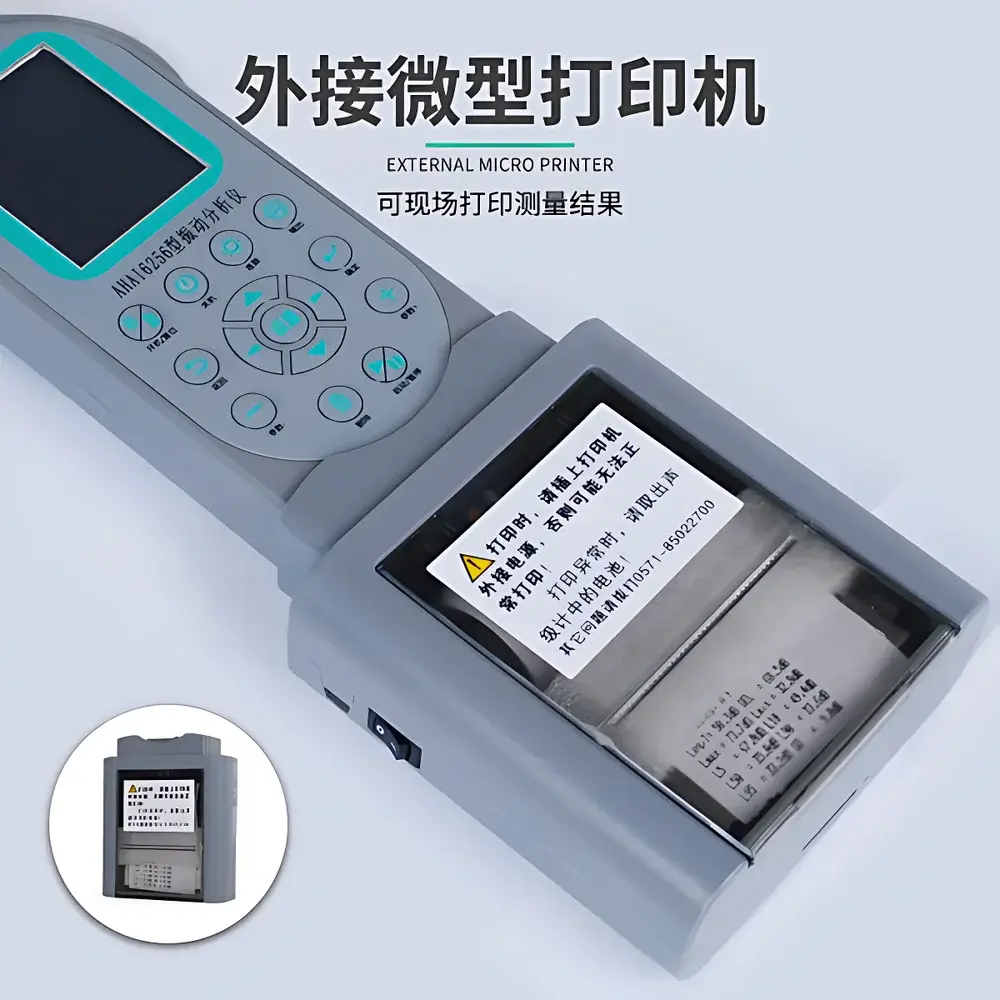
| Interface | RS232 (printer & PC data export) |
| Power | 6×LR6 alkaline or rechargeable batteries (≥16 h operation) or 5 V external supply |
| Operating Temp | –10 °C to +50 °C |
| Storage Temp | –20 °C to +70 °C |
| RH | 25 %–90 % |
Overview
The AWA AHAI6256 Hand-Arm and Whole-Body Vibration Analyzer is a portable, microprocessor-based instrumentation system engineered for precision assessment of mechanical vibration exposure in occupational and environmental settings. It implements digital signal processing (DSP) architecture to simultaneously acquire, condition, weight, and analyze vibration signals across multiple biodynamic and physical domains. The instrument conforms to the core transduction and metrological requirements defined in ISO 8041:2005 (Human response to vibration — Measurement instrumentation) and supports all major frequency weightings specified for hand-transmitted (Wh, Wk), whole-body vertical (Wb/Wz) and horizontal (Wb/Wx-y) vibration evaluation per ISO 5349-1:2001 and GB/T 23716–2009. Its integrated triaxial acceleration sensing—via the calibrated AWA14400 environmental accelerometer—enables direct acquisition of raw time-series data at 750 Hz with 24-bit resolution, ensuring high reproducibility for both short-term spot measurements and extended monitoring campaigns.
Key Features
- Single-instrument capability covering hand-arm vibration (HAV), whole-body vibration (WBV), environmental vibration (ENV), and machinery vibration diagnostics
- Simultaneous parallel application of up to eight standardized frequency weightings (Wb, Wc, Wd, We, Wj, Wk, Wm, Wz) plus user-defined weighting (Wu)
- Real-time 1/3-octave band analysis compliant with IEC 61260:1995 Class 2 specifications
- FFT spectral analysis with configurable line resolution (up to 256 lines), enabling identification of dominant vibration sources and resonance frequencies
- Full parametric output: RMS, peak, crest factor, vibration dose value (VDV), daily exposure A(8), and equivalent continuous acceleration (aeq)
- Onboard 64 kB Flash memory stores up to 128 complete measurement sessions—including time-history waveforms, spectra, and metadata—with timestamping and operator ID tagging
- RS232 serial interface for direct printing via compatible thermal printers or secure data transfer to laboratory PCs for post-processing in Excel, MATLAB, or validated vibration analysis software
Sample Compatibility & Compliance
The AHAI6256 is designed for field deployment on diverse vibration sources including power tools (grinders, chipping hammers), industrial vehicles (forklifts, earthmovers), building structures (floors, foundations), and transportation infrastructure (railway platforms, bridges). Its sensor mounting options support rigid coupling to handles (per ISO 5349-1), seat surfaces (per ISO 2631-1), and structural elements using magnetic bases or adhesive mounts. All measurement modes satisfy traceability requirements under ISO/IEC 17025-accredited calibration protocols. The device supports audit-ready reporting aligned with EU Directive 2002/44/EC on occupational exposure limits and facilitates generation of records suitable for GLP-compliant health surveillance programs.
Software & Data Management
Raw and processed data exported via RS232 are structured in ASCII-delimited format, enabling seamless ingestion into laboratory information management systems (LIMS) or statistical analysis platforms. While no proprietary PC software is bundled, the instrument’s output schema is fully documented and interoperable with common vibration analysis toolsets. Each stored record includes instrument serial number, date/time stamp, operator ID, sensor configuration, applied weightings, and full spectral or time-history datasets. For regulated environments, users may implement external validation protocols to meet FDA 21 CFR Part 11 requirements for electronic records and signatures when integrating AHAI6256 data into quality management systems.
Applications
- Occupational health & safety assessments of hand-arm vibration syndrome (HAVS) risk in construction, metalworking, and forestry sectors
- Whole-body vibration exposure evaluation for drivers and operators of off-road vehicles, agricultural machinery, and marine vessels
- Environmental impact studies assessing ground-borne vibration from rail transit, pile driving, or quarry blasting
- Predictive maintenance screening of rotating equipment (pumps, compressors, gearboxes) via acceleration envelope analysis
- Building vibration diagnostics during retrofitting, demolition proximity monitoring, or seismic resilience verification
- Educational use in university laboratories for teaching human biodynamics, signal processing, and metrology principles
FAQ
Does the AHAI6256 support real-time FFT analysis with adjustable windowing and overlap?
Yes—it performs live FFT computation with Hanning windowing and configurable 50 % or 75 % spectral overlap, delivering stable amplitude estimates for transient and periodic vibration events.
Can the instrument store time-history waveforms for post-event forensic analysis?
Yes—each measurement session retains the full 750 Hz sampled waveform (up to 60 seconds per set), allowing retrospective spectral reprocessing and event-triggered review.
Is calibration certificate included with delivery?
No—calibration is performed per ISO 16063-21 by accredited third-party labs; users must arrange initial and periodic recalibration (recommended annually) to maintain traceability to national standards.
What is the maximum duration of continuous logging on internal battery?
With six fresh LR6 alkaline cells, the unit operates continuously for ≥16 hours in standard measurement mode (excluding printer use or backlight max intensity).
Are the frequency weightings implemented in hardware or digitally post-processed?
All weightings are applied in real time using embedded FIR filters derived directly from ISO 5349-1 and ISO 2631-1 digital filter coefficients, ensuring phase-linear response and metrological fidelity.
Related Products







