
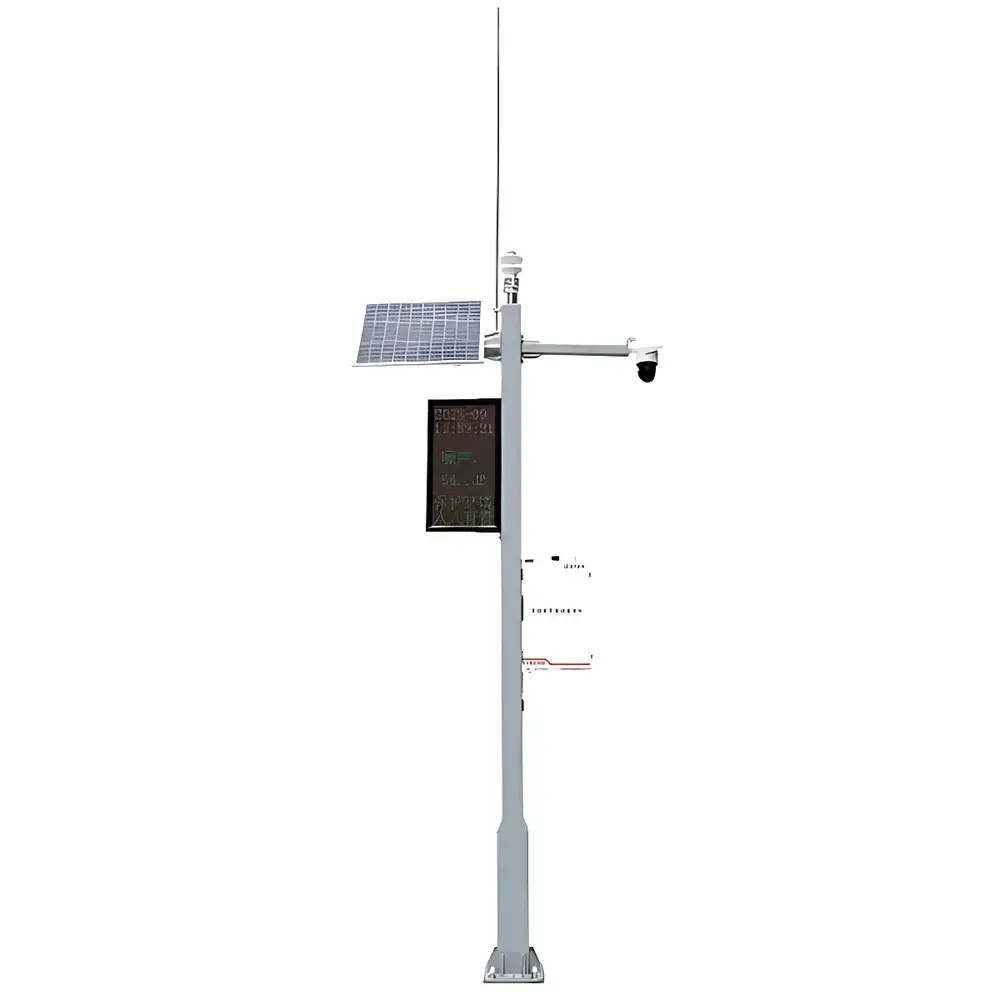
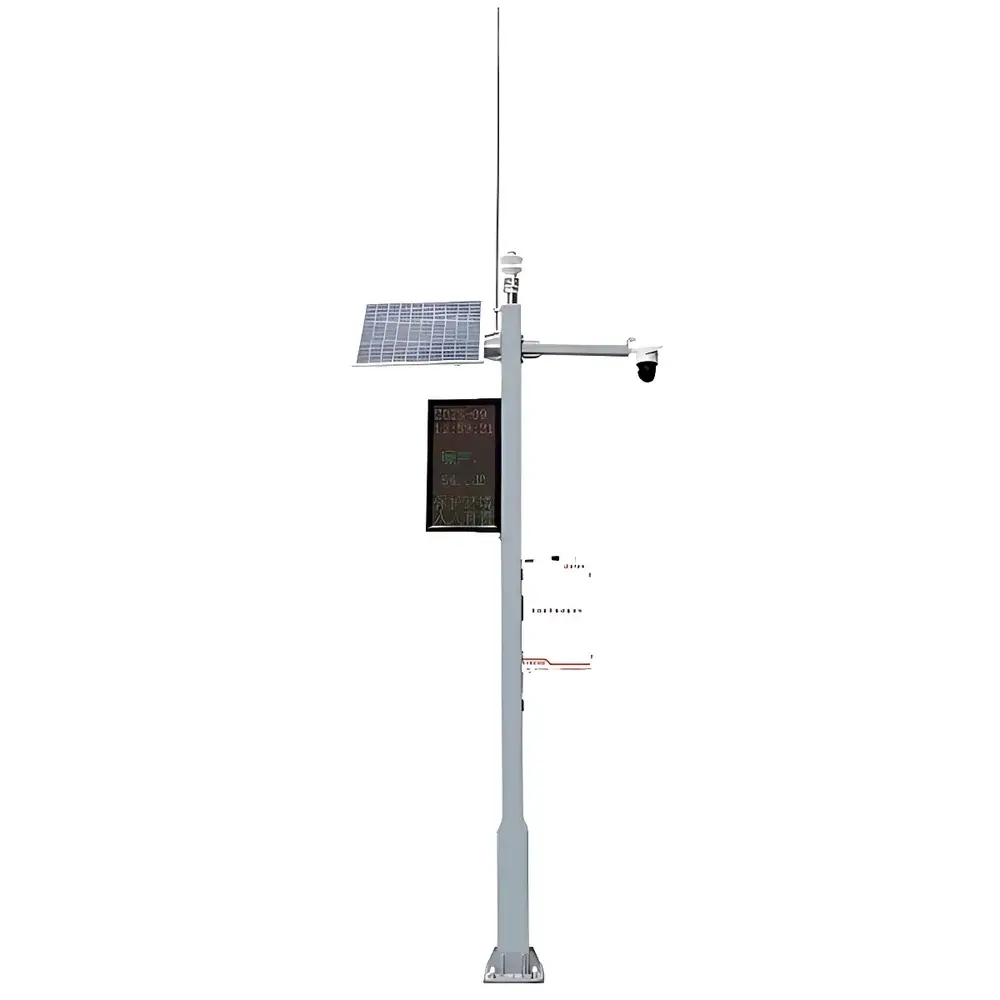
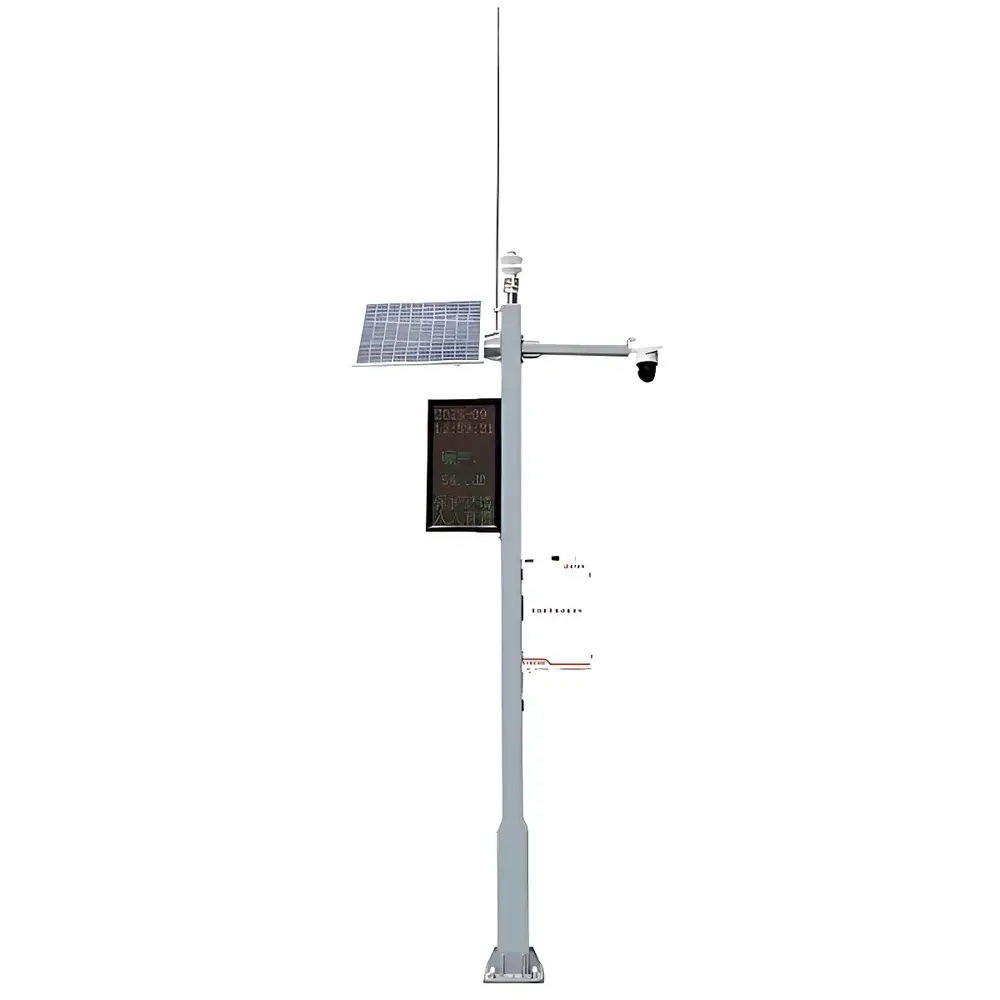
AWA AWA5000 Environmental Noise Automatic Monitoring Station
| Brand | AWA |
|---|---|
| Model | AWA5000 |
| Compliance | GB/T 3785.1–2023 / IEC 61672-1:2013 Class 1 |
| Standard Conformance | HJ 907–2017 |
| Dynamic Range | 123 dB |
| Display | 4.3-inch capacitive touchscreen |
| Internal Storage | 16 GB (expandable to 64 GB via microSD) |
| Communication | Wi-Fi, 4G LTE, Bluetooth |
| Positioning | Integrated GPS + network-assisted positioning |
| Audio Recording | High-fidelity time-stamped PCM recording |
| Frequency Analysis | Real-time 1/1 and 1/3-octave band analysis |
| Power Supply | Integrated outdoor-rated power management system |
| Optional Modules | Meteorological sensor suite, traffic flow counter, PTZ camera, LED display panel, acoustic source localization unit |
Overview
The AWA AWA5000 Environmental Noise Automatic Monitoring Station is a fully integrated, field-deployable noise monitoring system engineered for continuous, unattended operation in ambient environmental conditions. It operates on the principle of precision electret condenser microphone transduction coupled with real-time digital signal processing (DSP) for acoustic parameter computation. The system conforms to IEC 61672-1:2013 Class 1 performance requirements—ensuring traceable accuracy for sound pressure level (SPL), frequency-weighted (A-, C-, Z-) and time-weighted (Fast, Slow, Impulse) measurements—as mandated by international regulatory frameworks governing environmental acoustics. Designed specifically for long-term deployment at fixed urban, industrial, or transportation corridor sites, the AWA5000 delivers metrologically valid data suitable for regulatory reporting, noise mapping, and compliance verification under national environmental protection statutes.
Key Features
- 123 dB linear dynamic range—enables full-scale measurement from 20 dB(A) to 143 dB(A) without manual or automatic range switching, eliminating clipping risk during transient events such as construction impact or aircraft flyovers.
- Fully digital implementation of all weighting filters (frequency and time) and detection algorithms (RMS, peak, quasi-peak), ensuring repeatability and immunity to analog drift across temperature and humidity gradients.
- Integrated 4.3-inch capacitive touchscreen interface supporting multi-touch gesture navigation, real-time parallel display of LAF, LAEQ, LMAX, LMIN, and octave-band spectra—reducing need for external control hardware.
- Dual-layer data storage architecture: 16 GB embedded flash memory with journaling file system for fail-safe logging; expandable to 64 GB via industrial-grade microSD card rated for extended outdoor thermal cycling (-30 °C to +70 °C).
- Tri-modal communication stack: Simultaneous support for IEEE 802.11n Wi-Fi (2.4 GHz), LTE Cat-4 4G cellular (with dual-SIM failover), and Bluetooth 5.0 for local diagnostics and firmware updates—enabling adaptive telemetry under variable network availability.
- Embedded GNSS receiver compliant with GPS, GLONASS, and BeiDou constellations, delivering sub-5 m horizontal positional accuracy (CEP) with NMEA 0183 output; network-based geolocation fallback ensures continuity during satellite signal loss.
Sample Compatibility & Compliance
The AWA5000 is validated for continuous monitoring of broadband environmental noise in accordance with GB/T 3785.1–2023 (identical to IEC 61672-1:2013 Class 1) and meets the functional and architectural specifications outlined in HJ 907–2017, China’s technical standard for automated environmental noise monitoring systems. Its outdoor microphone unit features IP65-rated weatherproofing, UV-stabilized housing, and wind-noise suppression (including optional windscreen and turbulence-reducing sphere). All firmware and data handling routines are designed to support audit-ready operation—including timestamp synchronization via NTP or PTP, secure TLS 1.2 encrypted data transmission, and immutable event logging aligned with ISO/IEC 17025 documentation integrity requirements.
Software & Data Management
The system runs a Linux-based real-time operating environment with deterministic audio capture scheduling. Measurement data—including raw waveform snippets (16-bit/48 kHz PCM), statistical aggregates (L10, L50, L90, SEL, LDN), and octave-band spectra—is structured in UTF-8 encoded CSV and XML formats compliant with ISO 1996-2:2017 metadata conventions. Remote configuration and firmware updates are managed through HTTPS-secured web interface or RESTful API endpoints. Audit trails record all user-initiated actions (e.g., calibration initiation, module activation, storage format changes) with SHA-256 hashed log entries. Optional integration with centralized environmental data platforms supports automated ingestion into GIS layers and regulatory dashboards per national environmental information system (EIS) architectures.
Applications
- Regulatory compliance monitoring at municipal boundaries, near schools/hospitals, and along highway/railway corridors.
- Baseline noise characterization for EIA (Environmental Impact Assessment) studies and post-construction validation.
- Long-term trend analysis of urban noise climate using Lden and Lnight metrics per EU Directive 2002/49/EC methodology.
- Event-triggered acoustic surveillance—e.g., detecting and classifying anomalous noise sources (e.g., illegal dumping, nighttime construction) via programmable threshold logic and spectral signature matching.
- Multi-sensor environmental observatories when integrated with meteorological (wind speed/direction, temperature, humidity), traffic volume, and visual surveillance modules.
FAQ
Does the AWA5000 support remote calibration verification?
Yes—integrated electro-acoustic self-test routines verify microphone sensitivity and amplifier gain stability at scheduled intervals; optional external pistonphone coupling enables traceable field calibration per IEC 61260-1:2014.
Can measurement data be exported in formats compatible with third-party noise modeling software?
Yes—CSV exports include full timestamp resolution (ms), GPS coordinates, and standardized metric labels (e.g., “LAeq,T”), enabling direct import into SoundPLAN, CadnaA, and IMMI.
Is the system certified for use in GLP or ISO 17025-accredited laboratories?
While primarily deployed in field monitoring networks, its metrological traceability, audit logging, and firmware version control meet key prerequisites for ISO/IEC 17025 Clause 7.7 (measurement traceability) and Clause 8.9 (records retention).
What is the typical power consumption and recommended backup solution for off-grid installations?
Average power draw is 3.2 W (standby) to 5.8 W (full operation); solar-charged 24 V DC battery banks with charge controllers are routinely deployed for autonomous operation exceeding 72 hours during grid outage.
How is time synchronization maintained across distributed AWA5000 nodes?
Primary sync via NTP over cellular/Wi-Fi; secondary fallback to GNSS PPS (pulse-per-second) signal; internal RTC maintains ±0.5 s/day accuracy during network outages.



