AWT 2800 Series Fire Detector Test Chamber (Combined Smoke & Heat Detector Calibration and Certification Chamber)
| Brand | AWT |
|---|---|
| Origin | United Kingdom |
| Manufacturer Type | Authorized Distributor |
| Origin Category | Imported Equipment |
| Model | 2800 Series |
| Pricing | Available Upon Request |
Overview
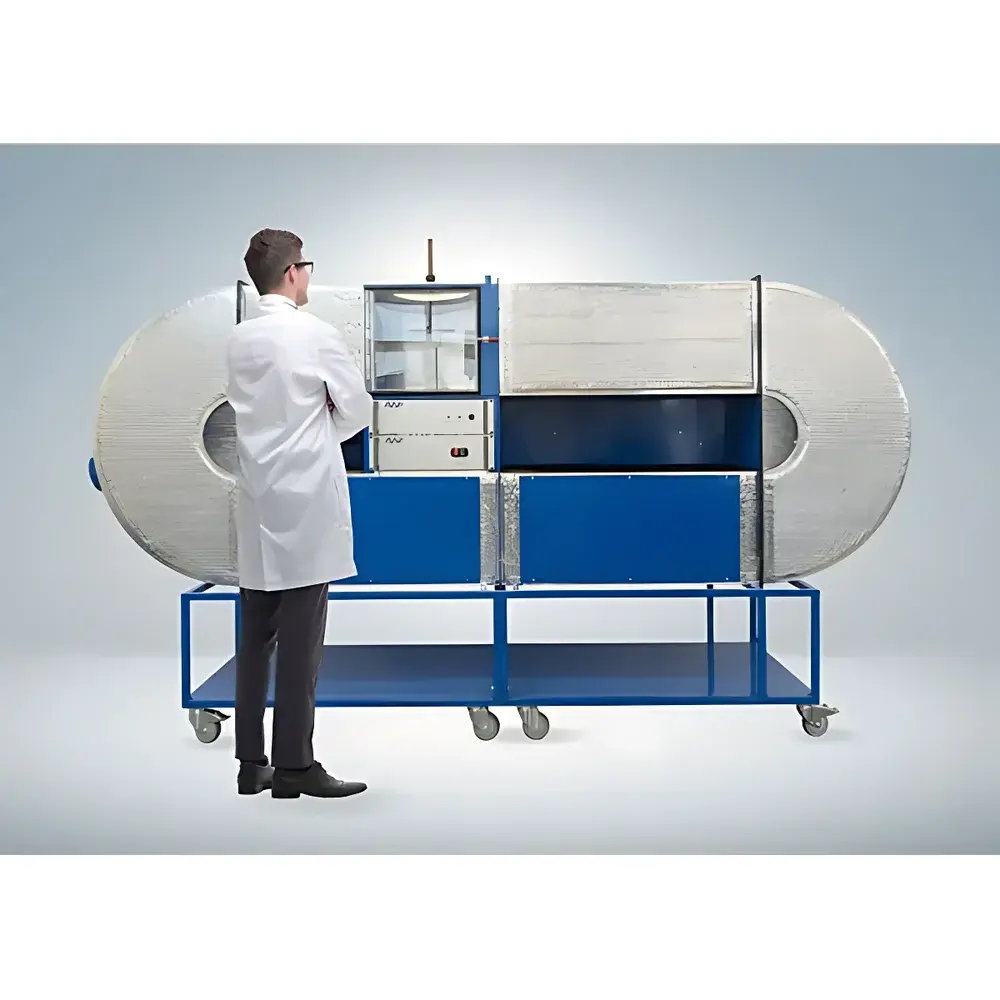
The AWT 2800 Series Fire Detector Test Chamber is a full-height, floor-standing laboratory instrument engineered for the precise, repeatable, and standards-compliant evaluation of point-type smoke and heat fire detectors. It operates on dual-path test methodology: controlled aerosol generation and thermal ramping within a geometrically defined, optically characterized test volume. The chamber integrates calibrated air flow control, temperature gradient management via integrated cooling systems, and traceable optical density monitoring — enabling simultaneous or sequential assessment of optical scattering (photoelectric), ionization, and thermally activated detection elements. Designed explicitly for conformity assessment against EN 54-7 (smoke detectors), EN 54-5 (heat detectors), EN 14604 (residential smoke alarms), and BS 5446-2, the system supports both type approval testing in notified bodies and iterative R&D validation in detector manufacturing laboratories.
Key Features
- Integrated dual-mode test environment: configurable for standalone smoke sensitivity calibration, heat response time measurement, or combined smoke-and-heat exposure protocols.
- Active cooling system enabling stable sub-ambient temperature control (down to 10 °C) and precise thermal ramp rates (0.1–10 °C/min) compliant with EN 54-5 Annex B and GB 4716-2024 Clause 5.3.
- Modular ductwork interface (optional accessory) supporting high-velocity airflow simulation (up to 5 m/s) for gust-effect testing of ionization detectors per EN 54-7 Clause 4.3.3.2.
- Adjustable high-intensity light source (300–10,000 lux, 550 nm ±20 nm) for glare resistance evaluation of optical smoke detectors, aligned with EN 54-7 Clause 4.3.4.3.
- Traceable optical path length (1.2 m nominal) with NIST-traceable photometric calibration; integrated laser scattering monitor for real-time obscuration (0.05–15.0% obs/m) measurement.
- Robust stainless-steel construction with ESD-safe interior finish, ISO Class 8 cleanroom-compatible airflow filtration, and integrated exhaust handling for safe aerosol containment.
Sample Compatibility & Compliance
The 2800 Series accommodates standard commercial point detectors (DIN 4102-10 / EN 54 mounting footprint), including photoelectric, ionization, multi-sensor, and fixed-rate/thermistor-based heat detectors. It supports physical mounting in both horizontal and vertical orientations, replicating field installation conditions. All operational modes are validated against the mandatory test sequences defined in EN 54-7:2020+A1:2023 (Clause 4.3), EN 54-5:2017 (Annexes A–C), EN 14604:2022, BS 5446-2:2022, and the latest Chinese national standards GB 4715-2024 and GB 4716-2024. The chamber’s metrological traceability framework complies with ISO/IEC 17025 requirements for testing laboratories, and its documented uncertainty budget meets the ≤±3% relative uncertainty threshold specified in EN 54-7 Annex D for obscuration measurement.
Software & Data Management
The embedded control software provides synchronized acquisition of temperature, obscuration, airflow velocity, and illumination intensity at 10 Hz sampling rate. Data export is available in CSV and XML formats compatible with LIMS integration. Audit trails record all parameter changes, operator logins, and calibration events in accordance with FDA 21 CFR Part 11 and EU Annex 11 requirements. Optional IQ/OQ documentation packages support GxP-aligned qualification, including sensor verification reports, chamber uniformity mapping, and repeatability studies across three independent test cycles.
Applications
- Type examination and certification testing for CE marking under EN 54 series and UKCA schemes.
- R&D validation of next-generation multi-criteria detectors under mixed-stimulus fire scenarios (e.g., smouldering + rapid temperature rise).
- Production line quality assurance with pass/fail decision logic based on EN 54-7 Table 2 and EN 54-5 Table 1 thresholds.
- Third-party laboratory accreditation preparation (UKAS, CNAS, TÜV) with full uncertainty analysis reporting.
- Fire safety engineering research into detector response under non-standard environmental conditions (e.g., high humidity, dust-laden air, low ambient light).
FAQ
Does the 2800 Series support automated test sequencing per EN 54-7 Annex F?
Yes — preconfigured test templates include full Annex F smoke sensitivity protocols with auto-triggered aerosol injection, dwell time enforcement, and pass/fail classification per Table 2.
Can the chamber be used for UL 217 or UL 268 listed product testing?
While primarily designed for EN/GB standards, its adjustable airflow, thermal ramp, and obscuration control parameters allow adaptation to UL 217 Section 22 and UL 268 Section 23 test conditions with appropriate method validation.
Is calibration certificate included with delivery?
A UKAS-accredited calibration certificate for temperature, obscuration, and airflow sensors is provided upon commissioning, with 12-month recalibration intervals recommended.
What maintenance is required for long-term compliance?
Quarterly optical path cleaning, annual photometric recalibration, and biannual verification of cooling system performance per ISO/IEC 17025 Clause 6.4.10.