
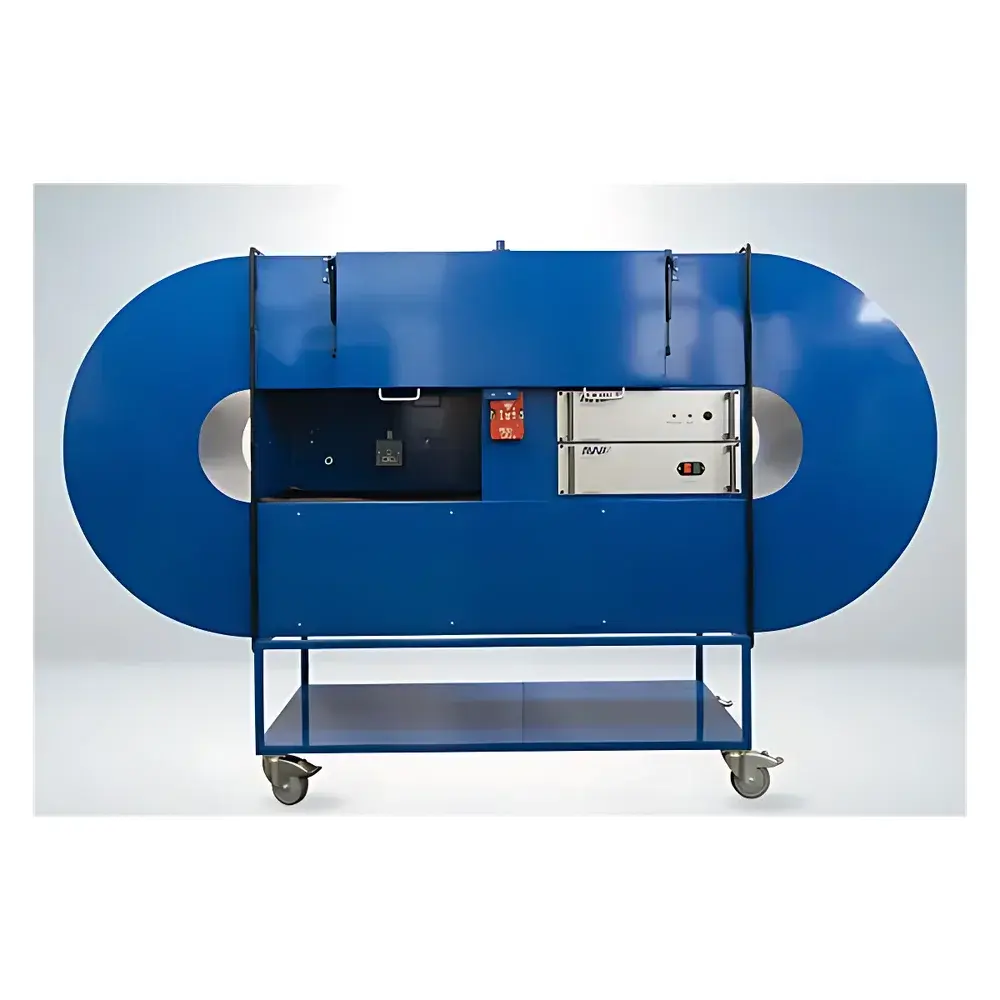
AWT 3000 Series Fire Detector Test Chamber
| Brand | AWT |
|---|---|
| Origin | United Kingdom |
| Model | 3000 Series |
| Compliance | EN 54-7, EN 54-5, EN 14604, BS 5446-2, GB 4715-2024, GB 4716-2024 |
| Configuration Options | 3100 (optical smoke only), 3400 (optical smoke + thermal verification), 3800 (optical smoke + thermal verification + refrigerated aerosol generation) |
Overview
The AWT 3000 Series Fire Detector Test Chamber is an engineered calibration and functional verification platform designed for precision testing of point-type fire detectors in industrial, certification, and high-volume manufacturing environments. Based on controlled aerosol generation and thermally regulated chamber dynamics, the system enables repeatable, traceable assessment of optical smoke detectors (scattered-light and transmitted-light types) and fixed-temperature/heat-rate-of-rise thermal detectors. Its architecture conforms to the physical test requirements defined in EN 54-7 (smoke detectors), EN 54-5 (heat detectors), and EN 14604 (domestic smoke alarms), ensuring alignment with CE marking pathways and third-party type-approval protocols. The chamber operates by introducing calibrated, ISO-standardized test aerosols—such as polydisperse ammonium chloride or titanium dioxide—into a sealed, temperature-stabilized volume while monitoring detector response time, alarm threshold, and hysteresis behavior under reproducible environmental conditions.
Key Features
- Modular configuration across three variants: 3100 (dedicated optical smoke calibration), 3400 (dual-mode smoke + thermal verification using integrated heater elements), and 3800 (full-spectrum capability including refrigerated aerosol generation for low-temperature smoke simulation)
- Temperature-controlled test volume (±0.5 °C stability) with independent HVAC management for thermal detector validation per EN 54-5 Annex B
- Automated aerosol concentration ramping and dwell control compliant with EN 54-7 §6.3.2 and GB 4715-2024 Clause 5.3.1
- Integrated photometric reference sensor for real-time smoke density ( obscuration per m) traceability to NPL-calibrated standards
- Rigid stainless-steel chamber construction with electrostatic-dissipative interior surfaces to prevent particle adhesion and ensure aerosol homogeneity
- Front-access sliding door with magnetic seal and interlocked safety cutoff for operator protection during active testing
Sample Compatibility & Compliance
The AWT 3000 Series supports all standard 110 mm–120 mm diameter ceiling-mounted point detectors, including ionization, photoelectric, and multi-sensor devices. It accommodates both single- and dual-technology units without mechanical adaptation. All configurations meet mandatory test sequence requirements outlined in EN 54-7 (smoke sensitivity, response to flaming/ smoldering fires), EN 54-5 (rate-of-rise and fixed-temperature thresholds), and BS 5446-2 (residential alarm reliability). For regulatory submissions, the system provides full audit trails—including timestamped aerosol concentration logs, chamber temperature profiles, and detector output signals—compatible with GLP-compliant documentation workflows. Test reports generated via optional software modules satisfy evidence requirements for UKAS-accredited laboratories and CNAS-certified facilities.
Software & Data Management
The optional AWT TestSuite v4.2 software enables automated execution of EN-defined test cycles, real-time visualization of detector output waveforms, and export of raw data in CSV and XML formats. It includes built-in compliance checkers that flag deviations from EN 54-7 Annex D tolerances or GB 4715-2024 alarm timing windows. Audit logging meets FDA 21 CFR Part 11 requirements for electronic records, with role-based user access, digital signatures, and immutable event history. Calibration certificates for internal sensors are issued annually and traceable to UK’s National Physical Laboratory (NPL) or equivalent NMIs. Data export supports integration with LIMS platforms via RESTful API endpoints.
Applications
- Factory acceptance testing (FAT) and final quality assurance for OEM detector production lines
- Periodic verification of installed base detectors in healthcare, data center, and transportation infrastructure
- Type examination and surveillance testing for notified bodies (e.g., VdS, UL, SGS, CQC)
- Research and development of next-generation multi-criteria fire detection algorithms
- Training and competency assessment for fire safety engineers and commissioning technicians
FAQ
Does the 3000 Series support testing of addressable detectors?
Yes—the chamber interfaces with common addressable protocols (e.g., EST, Honeywell Gent, Siemens Desigo) via optional RS-485 or CAN bus modules.
Can test parameters be customized beyond EN standards?
Absolutely—users may define custom aerosol concentration ramps, temperature gradients, and dwell durations through the TestSuite scripting interface.
Is refrigerant handling certification required for the 3800 model?
No—the 3800 uses sealed, self-contained R134a cooling circuits; no field refrigerant servicing is permitted or necessary.
What is the recommended calibration interval for chamber sensors?
Annual calibration is advised, with interim verification checks performed before each daily test session using certified reference aerosols and NIST-traceable thermistors.
Are replacement aerosol generators field-serviceable?
Yes—both heated and refrigerated aerosol modules are modular and swappable without tools; spare parts carry 24-month shelf life when stored per AWT Technical Bulletin TB-3007.



