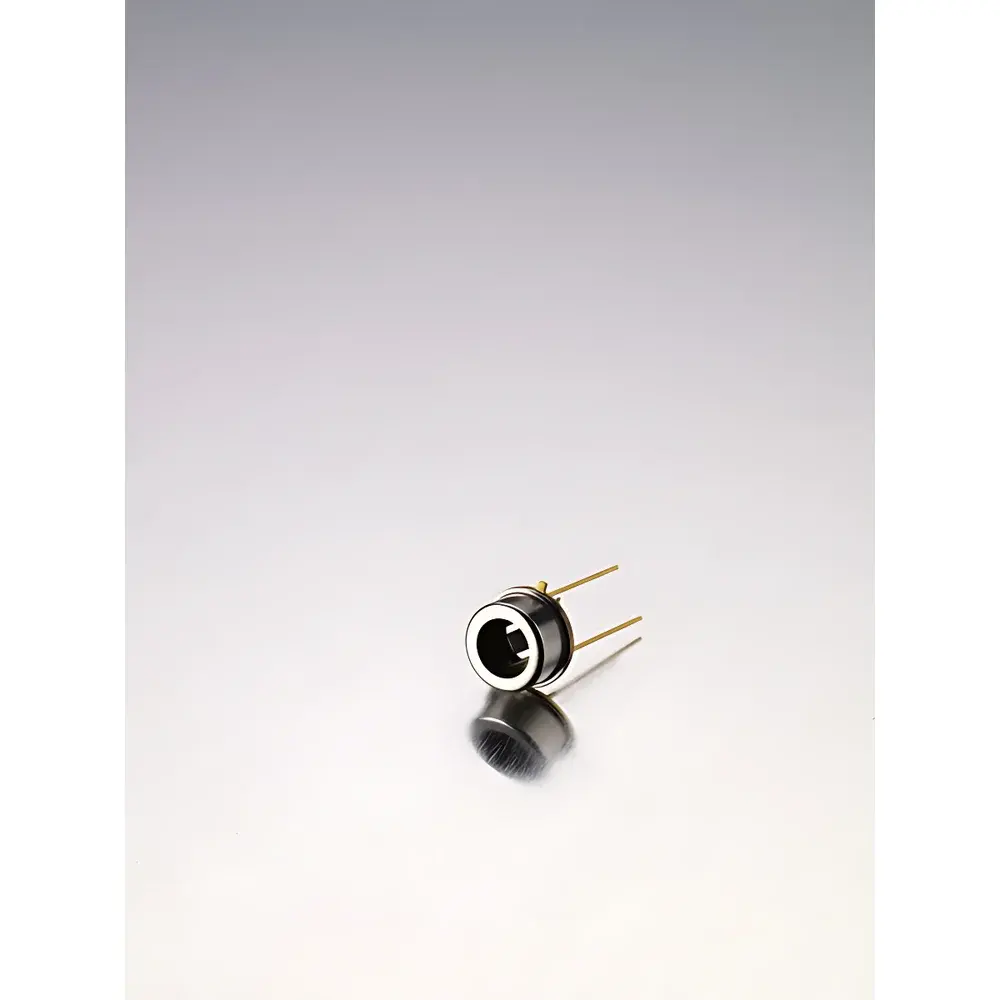
Axetris EMIRS Series Infrared Thermal Source
| Brand | Axetris |
|---|---|
| Origin | Switzerland |
| Housing | TO-39 metal can |
| Spectral Range | 2–16 µm |
| Emissivity | >0.95 (blackbody-like) |
| Modulation Speed | Up to 100 Hz (electrical, chopper-free) |
| Power Consumption | <150 mW (typ.) |
| Lifetime | >50,000 h (at rated operating conditions) |
| MEMS Qualification | IEC 60749-21 / IEC 61340-5-1 / IEC 60068-2 series compliant |
| Optional Windows | Sapphire, CaF₂, BaF₂, Ge |
| Mounting | Standard TO-39 footprint with solderable leads |
Overview
The Axetris EMIRS Series is a family of micro-electro-mechanical systems (MEMS)-based thermal infrared sources engineered for high-stability, low-power, and spectrally broad emission in gas sensing applications. Unlike conventional filament-based or ceramic IR emitters, the EMIRS leverages a thin-film resistive heater patterned on a single-crystal silicon membrane, coated with a dielectric layer to enhance spectral emissivity across the mid-infrared (MIR) range (2–16 µm). This architecture enables true blackbody-like radiation characteristics—emissivity exceeding 0.95—with exceptional spatial uniformity and temporal stability. Its monolithic silicon substrate ensures mechanical robustness and thermal inertia low enough to support rapid electrical modulation (up to 100 Hz), eliminating the need for external mechanical choppers in NDIR, PAS, or ATR-FTIR configurations. Designed specifically for integration into compact, battery-operated, and field-deployable analyzers, the EMIRS operates at sub-150 mW power draw while maintaining long-term radiometric consistency—critical for regulatory-compliant medical, automotive, and industrial gas monitoring systems.
Key Features
- Blackbody-equivalent spectral emission (2–16 µm) with emissivity >0.95 across operational temperature range
- Chopper-free amplitude modulation via direct current drive—supports synchronous detection without moving parts
- Ultra-low power consumption (<150 mW typical at 500 K emitter temperature)
- Proven lifetime >50,000 hours under continuous operation at nominal bias conditions
- TO-39 hermetic metal-can package with industry-standard pinout and solder-reflow compatibility
- Optional optical windows: sapphire (broadband transmission, high durability), germanium (optimized for >2 µm), calcium fluoride (CaF₂), and barium fluoride (BaF₂) for deep-UV-to-MIR transmission (note: CaF₂/BaF₂ variants excluded from Class 7M3 qualification)
- MEMS structure qualified per IEC 60749-21 (ESD robustness), IEC 61340-5-1 (electrostatic control), and IEC 60068-2 environmental stress test standards; full Class 7M3 qualification per IEC 60749-21 achieved for standard sapphire/Ge-window versions
Sample Compatibility & Compliance
The EMIRS is compatible with all standard infrared detection modalities requiring stable, broadband MIR excitation—including non-dispersive infrared (NDIR), photoacoustic spectroscopy (PAS), and attenuated total reflection Fourier-transform infrared (ATR-FTIR) platforms. Its spectral output aligns with fundamental vibrational absorption bands of key target gases: CO (2143 cm⁻¹), CO₂ (2349 cm⁻¹), CH₄ (3017 cm⁻¹), NH₃ (10.4 µm), NOₓ species (5.3–6.3 µm), SF₆ (10.6 µm), refrigerants (e.g., R134a at 11.9 µm), ethanol (9.5 µm), and water vapor (6.3 µm). Device-level compliance supports integration into systems meeting ISO 13485 (medical devices), ISO 26262 ASIL-B (automotive functional safety), and EN 50194 (gas detection equipment). While the EMIRS itself is not a finished analyzer, its design facilitates traceable calibration workflows aligned with ASTM E1421 (FTIR quantitative analysis) and USP (analytical instrument qualification).
Software & Data Management
As a passive optical component, the EMIRS requires no embedded firmware or driver software. However, its electrical modulation interface (two-terminal DC or pulsed bias) is fully compatible with standard analog/digital control circuits used in OEM gas analyzer platforms—including those implementing FDA 21 CFR Part 11-compliant audit trails for medical device data acquisition. When integrated with closed-loop temperature-controlled drivers, the EMIRS supports real-time radiometric feedback protocols using thermistor or pyroelectric reference sensors—enabling GLP/GMP-aligned drift compensation and performance verification logs. Axetris provides comprehensive electrical characterization datasets (I-V curves, spectral radiance vs. drive current, thermal time constants) in CSV and MATLAB formats for system-level modeling and uncertainty budgeting per GUM (JCGM 100:2008).
Applications
- Medical Diagnostics: Capnography (CO₂ monitoring), anesthetic gas analysis (sevoflurane, isoflurane), breath ethanol screening, and pulmonary function testing
- Automotive & Transportation: Onboard exhaust gas monitoring (OBD-II compliant NOₓ/CO detection), ignition interlock devices (IID), and cabin air quality control
- HVAC & Building Automation: Demand-controlled ventilation (DCV) via CO₂ setpoint regulation, refrigerant leak detection in chillers and heat pumps
- Industrial Safety & Process Control: Fixed and portable combustible gas detectors (LEL monitoring), semiconductor fab ambient purity verification, and incubator atmosphere control
- Environmental Monitoring: Ambient air quality stations measuring VOCs, SO₂, and greenhouse gases (CO₂, CH₄, N₂O) under EPA Method 205 or EN 15267-3 frameworks
FAQ
What is the maximum recommended operating temperature for the EMIRS emitter membrane?
The silicon membrane is rated for continuous operation up to 550 K surface temperature; sustained operation above this threshold accelerates oxidation and degrades long-term emissivity stability.
Can the EMIRS be driven with AC voltage instead of DC?
Yes—provided the RMS voltage remains within the specified current limits and frequency does not exceed 1 kHz to avoid parasitic inductive coupling effects in the TO-39 leadframe.
Is there a calibrated spectral radiance dataset available for each production lot?
Axetris provides batch-level spectral calibration certificates (traceable to PTB or NIST standards) upon request, including measured radiance at 300 K, 400 K, and 500 K blackbody-equivalent temperatures.
How does the EMIRS compare to traditional wire-filament IR sources in terms of modulation fidelity?
Due to its low thermal mass (<10 µJ thermal capacitance), the EMIRS achieves rise/fall times <5 ms—over 10× faster than coiled-wire emitters—enabling higher signal-to-noise ratios in lock-in amplifier-based detection schemes.
Are custom window materials or hermetic sealing options available beyond the standard catalog?
Yes—Axetris offers engineering collaboration for application-specific variants, including ZnSe windows for CO₂ laser line rejection filtering and dual-window configurations for differential reference-path architectures.