
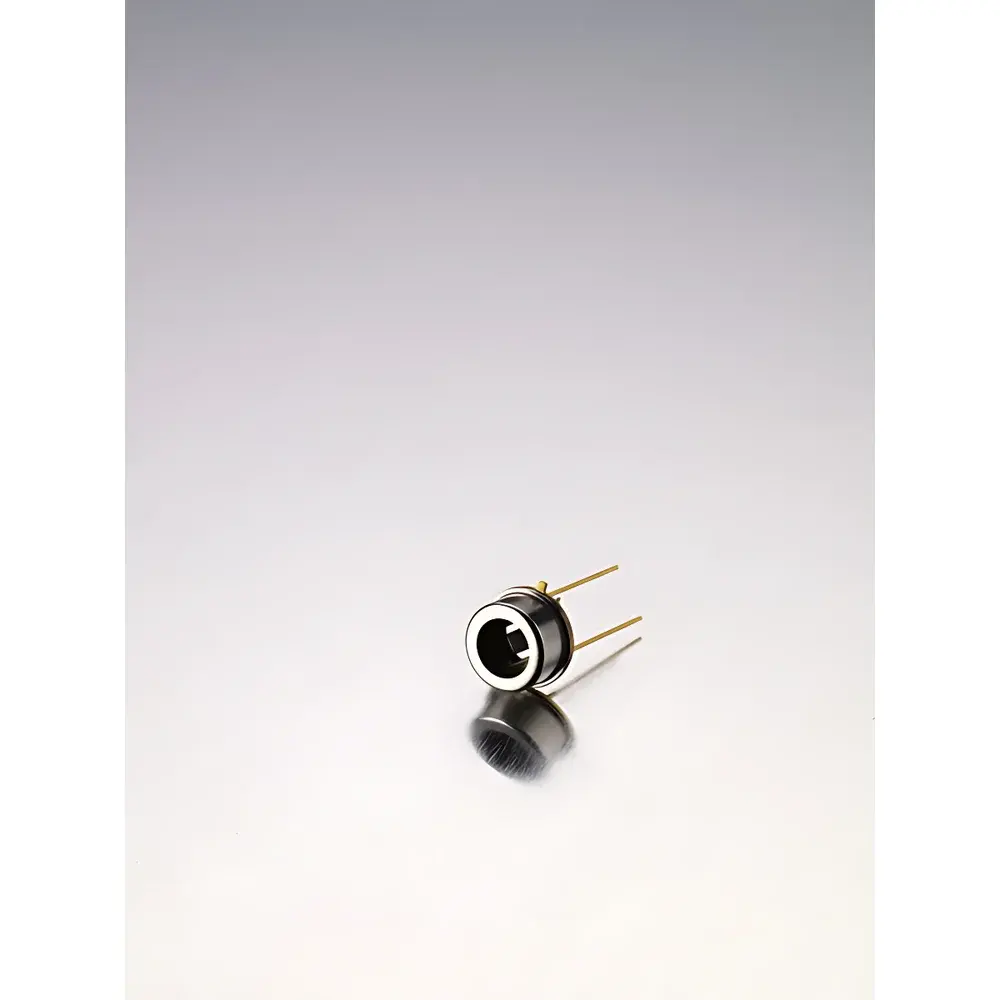
Axetris EMIRS200 and EMIRS50 MEMS-Based Infrared Thermal Sources
| Brand | Axetris |
|---|---|
| Origin | Switzerland |
| Model | EMIRS200, EMIRS50 |
| Housing | TO-39 metal can |
| Emitter Type | MEMS micro-hotplate with dielectric thin-film coating |
| Spectral Range | 2–16 µm (blackbody-like emission) |
| Modulation Capability | Direct electrical square-wave modulation (chopper-free) |
| Typical Power Consumption | <150 mW (EMIRS200), <300 mW (EMIRS50) |
| Radiant Efficiency | >30% (relative to ideal blackbody at same temperature) |
| Lifetime | >100,000 hours (at nominal drive conditions) |
| Environmental Certification | IEC 60747-17 / IEC 62047-21 compliant |
| Window Options | Sapphire (Al₂O₃), CaF₂, BaF₂, Ge |
| Mounting | Standard TO-39 header with optional reflective cup or protective cap |
Overview
The Axetris EMIRS200 and EMIRS50 are high-performance, surface-micromachined infrared thermal sources engineered for integration into compact, low-power, and highly stable NDIR (Non-Dispersive Infrared), PAS (Photoacoustic Spectroscopy), and ATR-FTIR (Attenuated Total Reflection Fourier Transform Infrared) gas sensing platforms. Based on a silicon micro-hotplate architecture, each emitter integrates a resistive heating element coated with a proprietary dielectric thin film—optimized to deliver near-blackbody spectral radiance across the 2–16 µm mid-infrared range. Unlike traditional wire-filament or ceramic IR sources, the EMIRS series eliminates mechanical choppers by supporting direct electrical square-wave modulation up to 10 Hz, enabling precise temporal control of radiant output without moving parts. This design delivers exceptional long-term stability (0.95 across operational band), and rapid thermal response (trise < 10 ms), making it suitable for demanding real-time gas concentration monitoring in regulated environments.
Key Features
- MEMS-based micro-hotplate structure fabricated on single-crystal silicon substrate, ensuring batch-to-batch consistency and scalability
- Dielectric thin-film coating engineered for broadband emissivity enhancement and oxidation resistance
- TO-39 hermetic metal-can packaging with standardized pinout, compatible with automated SMT assembly
- Optional integrated reflective cup (Al-coated Si) to increase directional radiant intensity by up to 3×
- Choice of optical windows—including sapphire (transmission: 0.15–5.5 µm), CaF₂ (0.13–9 µm), BaF₂ (0.15–12 µm), and Ge (2–16 µm)—to match detector spectral response and target gas absorption bands
- Low steady-state power consumption: ≤150 mW (EMIRS200), ≤300 mW (EMIRS50) at typical operating temperatures (≈600–800 K)
- Qualified to IEC 60747-17 Class 7M3 for mechanical shock and vibration (excluding CaF₂/BaF₂ variants due to material brittleness)
Sample Compatibility & Compliance
The EMIRS series is designed for use in certified gas analyzers requiring traceable performance under international regulatory frameworks. Its spectral output aligns with fundamental vibrational absorption lines of CO, CO₂, CH₄, NH₃, NO, NO₂, SO₂, SF₆, refrigerants (e.g., R134a, R410a), volatile organic compounds (VOCs), anesthetic agents (e.g., sevoflurane, isoflurane), ethanol, and water vapor. Devices incorporating EMIRS emitters have been validated in systems complying with EN 50194 (gas detectors), ISO 8573-1 (compressed air purity), ASTM D6245 (CO₂ in indoor air), and USP (pharmaceutical environmental monitoring). For medical applications—including capnography, anesthetic gas analysis, and breath alcohol testing—the source supports design verification per IEC 62304 (software lifecycle) and IEC 60601-1 (electrical safety), while its modulation fidelity enables compliance with FDA 21 CFR Part 11 data integrity requirements when paired with appropriate firmware logging.
Software & Data Management
While the EMIRS itself is a passive emitter requiring external drive electronics, its compatibility with industry-standard analog/digital control interfaces (e.g., PWM input, 0–5 V analog bias) allows seamless integration into embedded systems running deterministic real-time OSes (e.g., FreeRTOS, VxWorks). When deployed in analyzers with onboard microcontrollers or FPGA-based signal processors, the source’s fast modulation enables phase-sensitive detection schemes—critical for noise rejection in PAS and lock-in amplified NDIR architectures. Firmware implementations must include calibrated current/voltage lookup tables for stable radiant flux control, and audit trails for drive parameter changes are recommended to satisfy GLP/GMP traceability mandates. Axetris provides full electrical characterization datasets (I-V curves, thermal time constants, spectral radiance maps) in CSV and MATLAB formats to support system-level calibration and uncertainty budgeting per ISO/IEC 17025.
Applications
- Environmental Monitoring: Continuous emissions monitoring systems (CEMS) for stack gas analysis (CO, NOₓ, SOₓ); ambient air quality sensors for urban and industrial zones
- Medical Diagnostics: Benchtop and portable capnographs; multi-gas anesthesia monitors; respiratory function analyzers compliant with ISO 80601-2-55
- Automotive Safety: Integrated breath alcohol interlocks (BAIs) meeting SAE J2716; cabin air quality modules for HVAC demand-controlled ventilation
- Industrial Process Control: Refrigerant leak detection in HVAC/R service tools; fermentation off-gas analysis in bioreactors; inert gas purity verification in semiconductor fabrication
- Security & Safety: Portable combustible gas detectors (LEL sensors); confined-space entry monitors for H₂S, CH₄, and CO; incubator atmosphere controllers
FAQ
What is the maximum recommended modulation frequency for stable operation?
The EMIRS200 and EMIRS50 support square-wave electrical modulation up to 10 Hz with minimal thermal lag and amplitude decay; higher frequencies may be used with reduced radiant contrast due to thermal inertia.
Can the EMIRS be operated in pulsed mode to extend lifetime?
Yes—duty-cycle reduction below 50% significantly lowers average junction temperature and improves longevity; lifetime extrapolation models are provided in Axetris Application Note AN-EMIRS-002.
Are CaF₂ or BaF₂ window variants suitable for humid environments?
No—CaF₂ and BaF₂ are hygroscopic and degrade under prolonged exposure to RH >60%; sapphire or Ge windows are recommended for field-deployed instruments operating in variable humidity.
Does Axetris provide calibration certificates traceable to NIST or PTB?
Axetris supplies factory-measured spectral radiance data referenced to SI-traceable blackbody standards; full NIST/PTB calibration services are available through authorized metrology partners upon request.
How does the EMIRS compare to traditional globar or wire-filament sources in terms of spectral stability?
Unlike filament-based sources subject to oxidation and hot-spot formation, the MEMS architecture ensures uniform temperature distribution and negligible spectral drift over time—validated by accelerated life testing per IEC 60747-17 Annex D.
Related Products







