
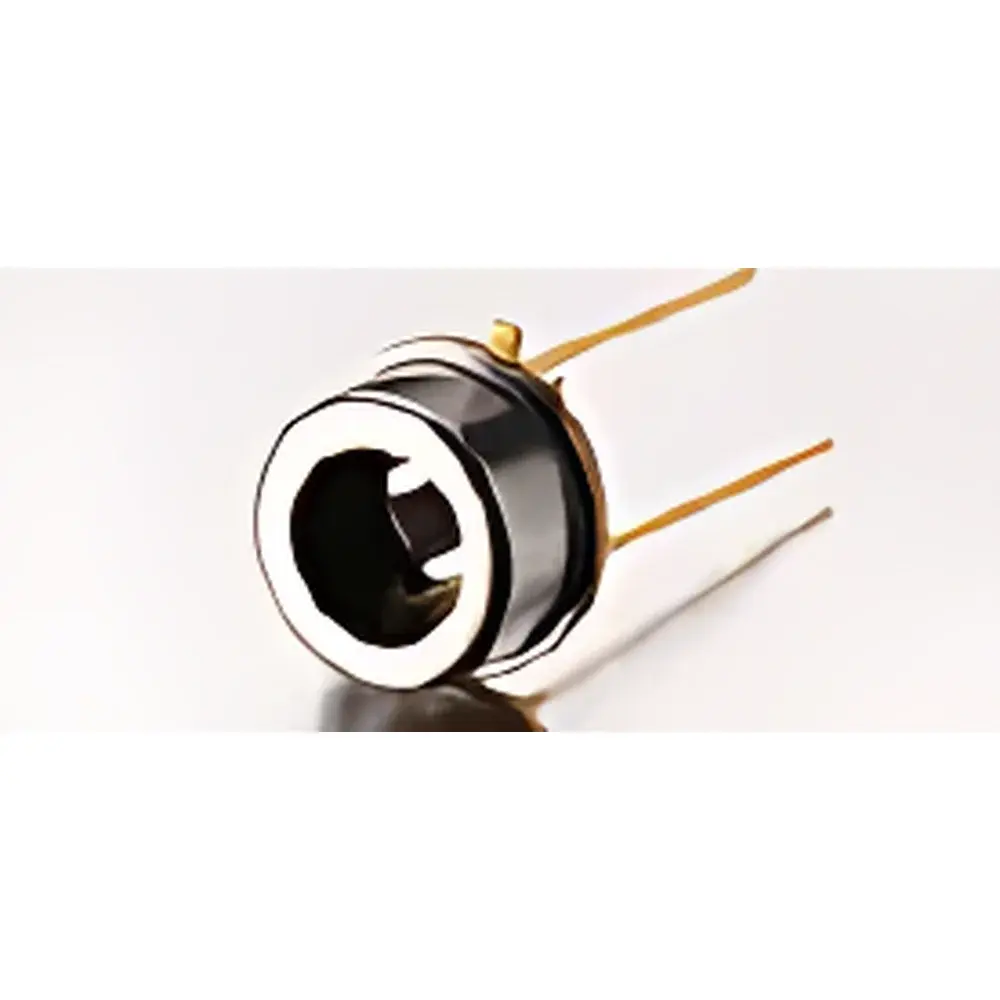
Axetris EMIRS200_AT01T_BT130 Infrared Blackbody Source with Protective Cap
| Brand | Axetris |
|---|---|
| Origin | Switzerland |
| Model | EMIRS200_AT01T_BT130 |
| Housing | TO-39 metal can with protective cap |
| Emitter Type | MEMS-based micro-hotplate thermal IR source |
| Spectral Range | 2–16 µm (blackbody-like emission) |
| Modulation Capability | Electrical AC modulation up to several hundred Hz (chopper-free) |
| Window Options | Sapphire, CaF₂, BaF₂, Ge |
| Compliance | IEC 60747-17 / IEC 62047-18 / IEC 6721-3-7 Class 7M3 (except CaF₂/BaF₂ window variants) |
| Power Consumption | <150 mW typical operating power |
| Lifetime | >50,000 hours (L₅₀ at rated drive conditions) |
| Radiation Efficiency | >90% emissivity across 3–12 µm band |
Overview
The Axetris EMIRS200_AT01T_BT130 is a MEMS-engineered infrared blackbody source designed for high-stability, low-power, and compact gas sensing systems. Based on a micro-hotplate architecture, the device integrates a thin-film resistive heater suspended on a silicon membrane, coated with a dielectric layer to enhance spectral emissivity and thermal uniformity. Encapsulated in a hermetically sealed TO-39 metal package with an integrated protective cap, this source delivers near-ideal blackbody radiation across the mid- to long-wave infrared spectrum (2–16 µm), making it especially suitable for non-dispersive infrared (NDIR), photoacoustic spectroscopy (PAS), and attenuated total reflection Fourier-transform infrared (ATR-FTIR) configurations. Its solid-state electrical modulation eliminates mechanical choppers, reducing system complexity, vibration sensitivity, and long-term drift—critical for field-deployable and battery-operated analyzers.
Key Features
- MEMS-based thermal emitter with silicon substrate and optimized dielectric coating for high emissivity (>0.90) and spectral stability from 3 to 12 µm
- Chopper-free AC modulation capability up to 300 Hz, enabling synchronous detection without moving parts or optical interruption
- Ultra-low power consumption: typical drive power below 150 mW at operational radiance levels, supporting energy-constrained portable and IoT-enabled platforms
- Hermetic TO-39 metal housing with optional protective cap and reflective cavity geometry for directional beam control
- Interchangeable infrared-transmissive windows: sapphire (broadband, robust), CaF₂ (deep UV to mid-IR), BaF₂ (extended IR), and Ge (long-wave IR up to 16 µm)
- Qualified per IEC 6721-3-7 Class 7M3 for mechanical shock and vibration resistance; compliant with IEC 60747-17 (MEMS devices) and IEC 62047-18 (micro-hotplate specifications)
- Proven lifetime exceeding 50,000 hours under continuous operation at nominal drive current, validated via accelerated life testing per JEDEC JESD22-A108
Sample Compatibility & Compliance
The EMIRS200_AT01T_BT130 is engineered for integration into certified gas analysis instrumentation requiring traceable, repeatable, and stable IR emission. It supports calibration protocols aligned with ISO 12099 (optical gas analyzers), ASTM D6348 (NDIR hydrocarbon measurement), and EN 14687 (medical respiratory gas monitors). When configured with sapphire or germanium windows, the source meets stringent environmental sealing requirements for medical (IEC 60601-1), automotive (ISO 16750-4), and industrial safety (IEC 60079-0/28) applications. Devices equipped with CaF₂ or BaF₂ windows are intended for controlled lab environments due to hygroscopic sensitivity and are excluded from Class 7M3 mechanical qualification. All variants support GLP/GMP-compliant calibration workflows when paired with NIST-traceable reference detectors.
Software & Data Management
While the EMIRS200_AT01T_BT130 is a passive analog emitter, its performance is fully characterized and documented in Axetris’ Device Characterization Database (DCDB), accessible via secure customer portal. Each unit ships with individual spectral radiance curves (measured at multiple drive currents and ambient temperatures), thermal time constants, and modulation transfer function (MTF) data. For system integrators, Axetris provides SPICE-compatible thermal-electrical models and Python-based calibration utilities compatible with common DAQ platforms (NI PXI, Keysight U1282A, Dewesoft X). Firmware-agnostic modulation timing guidelines ensure seamless integration with microcontroller-based drivers (e.g., ARM Cortex-M4/M7) and support audit-ready logging for FDA 21 CFR Part 11–compliant instruments.
Applications
- Medical Diagnostics: CO₂ capnography modules, anesthetic agent monitoring (sevoflurane, isoflurane), breath ethanol screening, and pulmonary function testing
- Automotive Safety: On-board alcohol interlock systems (ECE R110), exhaust gas recirculation (EGR) monitoring, cabin air quality sensors
- HVAC & Building Automation: Demand-controlled ventilation (DCV) using CO₂ feedback, refrigerant leak detection (R-134a, R-1234yf, R-32)
- Industrial Safety: Fixed and portable combustible gas detectors (CH₄, C₃H₈), toxic gas monitors (NH₃, SO₂, NO₂), and SF₆ purity analyzers for switchgear
- Environmental Monitoring: Ambient VOC profiling, landfill gas analysis, and indoor air quality (IAQ) networks
FAQ
What is the typical spectral responsivity range of the EMIRS200 series?
The emitter exhibits blackbody-like radiance from 2 µm to 16 µm, with peak emissivity (>0.90) between 3 µm and 12 µm depending on operating temperature and window material.
Can this source be driven with pulsed DC or sinusoidal AC signals?
Yes—electrical modulation is supported using either square-wave or sine-wave drive signals up to 300 Hz; optimal signal-to-noise ratio is achieved with 1–10 Hz fundamental frequencies for NDIR applications.
Is window material selection critical for gas absorption band matching?
Yes—sapphire is recommended for CO₂ (4.26 µm) and CO (4.67 µm); Ge is preferred for SF₆ (10.6 µm) and refrigerants beyond 8 µm; CaF₂ enables extended use down to 0.15 µm but requires dry environment handling.
Does Axetris provide calibration certificates with NIST traceability?
Each batch undergoes factory spectral radiance calibration against a NIST-traceable blackbody standard (model SR8000); full calibration reports are available upon request and comply with ISO/IEC 17025 requirements.
How does the MEMS architecture improve long-term stability compared to wire-filament sources?
The monolithic silicon micro-hotplate eliminates filament sag, oxidation, and thermal creep—resulting in 3% typical for traditional coil-based emitters.




