
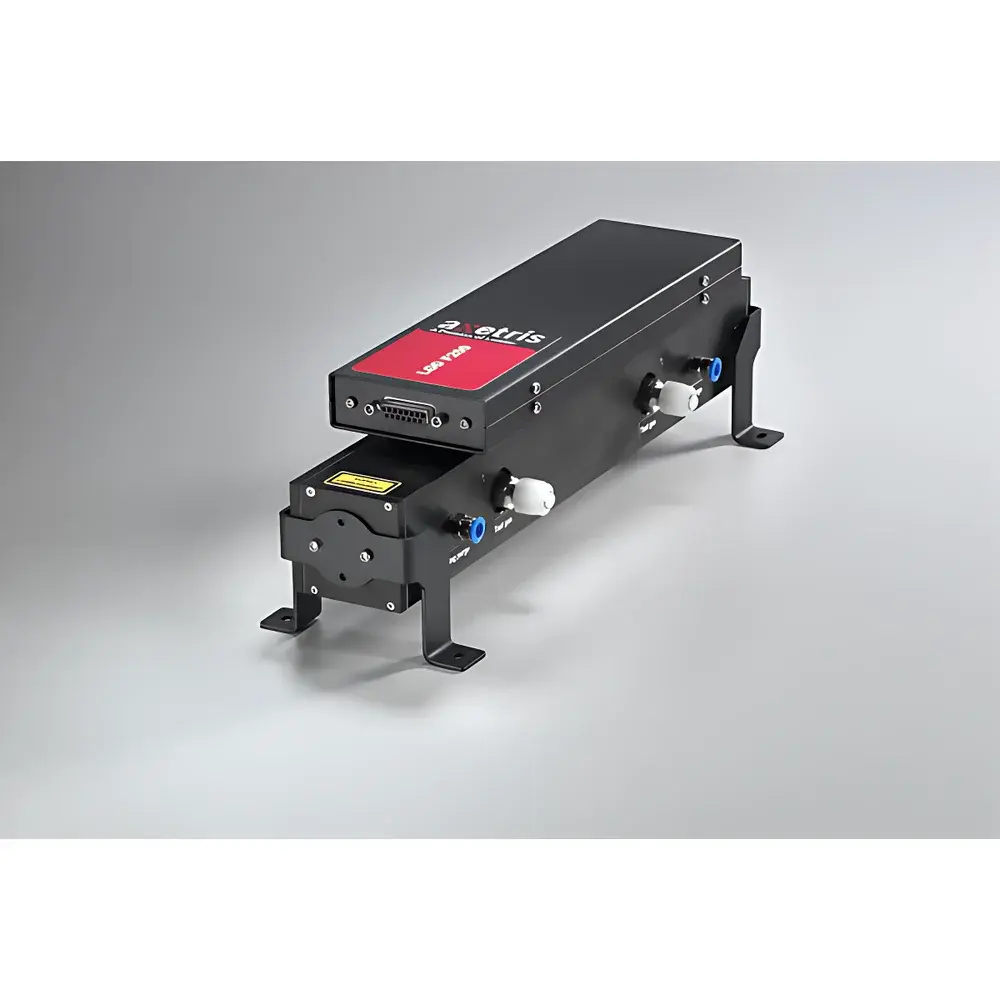
Axetris LGD Series Tunable Diode Laser Gas Detection Module
| Brand | Axetris |
|---|---|
| Origin | Switzerland |
| Model Series | LGD |
| Detection Principle | Tunable Diode Laser Absorption Spectroscopy (TDLAS) |
| Target Gases | NH₃, CH₄, H₂O, CO₂, HCl, HF, O₂ |
| Design | OEM-optimized modular optical sensor platform |
| Operating Temperature Range (heated variant) | up to 190 °C |
| Measurement Type | Non-contact, in-situ, continuous |
| Cross-Interference | Negligible due to narrow-linewidth laser scanning and species-specific absorption lines |
| Calibration | Factory-calibrated |
| Compliance | Designed for integration into systems compliant with IEC 61508 (SIL2-capable architecture), EN 61000-6-2/6-4 (EMC), and ATEX/IECEx Zone 2 / Class I Div 2 ready (with appropriate host system certification) |
Overview
The Axetris LGD Series is a high-performance, OEM-grade tunable diode laser (TDL) gas detection module engineered for precision, reliability, and seamless integration into industrial gas monitoring systems. Based on the fundamental principle of Tunable Diode Laser Absorption Spectroscopy (TDLAS), the module emits narrow-band infrared laser light tuned to specific ro-vibrational absorption lines of target gas molecules—such as NH₃ at 1531 nm, CH₄ at 1653 nm, or CO₂ at 2004 nm. Absorption depth is quantified via second-harmonic wavelength modulation spectroscopy (WMS-2f), delivering parts-per-trillion (ppt) to percent-level sensitivity with sub-second response times. Unlike electrochemical or NDIR sensors, TDLAS eliminates cross-sensitivity from background gases (e.g., H₂O vapor interference on CO₂ measurement) by exploiting spectrally isolated transitions. The absence of reference cells or consumable components reduces long-term maintenance and supports true “fit-and-forget” deployment in harsh environments.
Key Features
- Modular optical architecture optimized for embedded integration—compact footprint (≤120 × 80 × 45 mm), low power consumption (<5 W typical), and industry-standard digital interfaces (RS-485, UART, optional analog 4–20 mA output)
- Heated optical path option enabling stable operation at process temperatures up to 190 °C, critical for hot-stack monitoring in combustion and waste incineration applications
- Optical path length configurable from 0.1 m to 10 m via external retroreflector or multipass cell integration—supporting both extractive and in-situ measurement configurations
- Factory calibration traceable to NIST standards; built-in temperature and pressure compensation algorithms ensure accuracy across ambient variations (−20 °C to +60 °C operating range)
- Robust mechanical design rated IP65 (housing), compliant with vibration and shock requirements per IEC 60068-2 for industrial control cabinet mounting
- No consumables, no moving parts, and no zero-gas requirement—enabling >5 years MTBF under continuous operation
Sample Compatibility & Compliance
The LGD module is designed for direct in-line or extractive sampling of clean, dry, or moderately particulate-laden gas streams. For high-dust or corrosive environments (e.g., flue gas post-SCR), integration with heated sample probes and particle filtration (e.g., sintered metal filters, cyclonic separators) is recommended. The module itself does not require hazardous area certification; however, its electrical interface and thermal management are compatible with host systems certified to ATEX Directive 2014/34/EU (Zone 2), IECEx (Ex nA IIC T4 Ga), and UL Class I, Division 2, Groups A–D. Software-level data handling supports audit trails and electronic signatures per FDA 21 CFR Part 11 when deployed within validated GxP-compliant platforms.
Software & Data Management
Axetris provides the LGD Control Suite—a Windows-based configuration and diagnostics tool supporting real-time spectrum visualization, baseline correction, multi-gas fitting (for co-detection scenarios), and firmware updates via USB or serial interface. For OEM integration, a comprehensive ASCII command protocol (LGD-CLI) enables full remote control—including laser current/temperature setpoint adjustment, gain scaling, alarm threshold definition, and diagnostic register polling. All measurement data (concentration, signal-to-noise ratio, laser temperature, photodiode voltage) are timestamped and exportable in CSV or Modbus TCP format. Optional SDKs for C/C++, Python, and LabVIEW facilitate custom SCADA/HMI development and support deterministic data acquisition at up to 10 Hz sampling rate.
Applications
- Process Control: Real-time NH₃ slip monitoring in selective catalytic reduction (SCR) systems; CH₄ concentration feedback in anaerobic digesters; O₂ trim control in industrial burners
- Emissions Monitoring: Continuous emission monitoring systems (CEMS) for CO₂, NOₓ precursors, and acid gases (HCl, HF) in coal-fired power plants, cement kilns, and municipal waste incinerators
- Environmental Surveillance: Fugitive methane detection at landfill sites; CO₂ and NH₃ flux quantification in agricultural biogas facilities and livestock housing ventilation ducts
- Safety & Leak Detection: Toxic gas (HF, HCl) monitoring in semiconductor fab tool exhaust lines; refrigerant (CH₄, CO₂) leak detection in cold storage facilities
- Indoor Air Quality (IAQ): Demand-controlled ventilation (DCV) based on CO₂ and H₂O vapor concentration in smart HVAC systems for hospitals, laboratories, and data centers
FAQ
Is the LGD module suitable for measuring gases in high-humidity environments?
Yes—the TDLAS technique inherently corrects for water vapor spectral interference through multi-line fitting and built-in H₂O concentration compensation. Optional heated optical windows prevent condensation in saturated streams.
Can multiple LGD modules be synchronized for multi-point or multi-gas analysis?
Yes—via external trigger input (TTL) and time-stamped data output, enabling phase-aligned measurements across distributed sensor networks.
Does the module require periodic recalibration in the field?
No—factory calibration remains stable over time due to laser wavelength stabilization and temperature-compensated photodetector electronics. Field verification using certified span gas is recommended annually for regulatory compliance.
What is the minimum detectable concentration for NH₃ using the standard LGD-261 configuration?
Typical limit of detection (LoD) is 0.2 ppm·m (pathlength-normalized) for NH₃ at 1531 nm, translating to ~0.5 ppm in a 2.5 m multipass cell.
Is firmware update capability available remotely?
Yes—firmware can be updated via serial interface using LGD Control Suite or integrated OEM host software implementing the LGD-CLI protocol.
Related Products







