
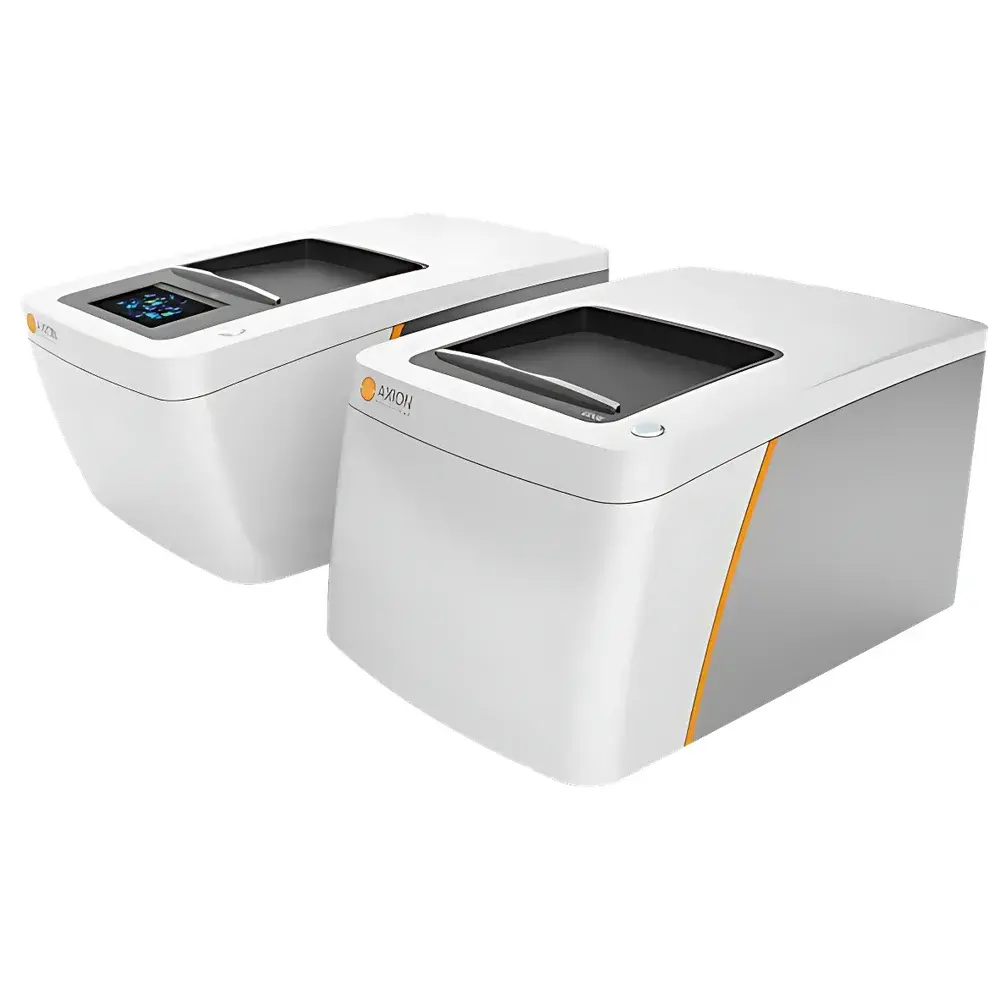
Axion BioSystems Maestro Edge/Pro High-Throughput Microelectrode Array (MEA) Electrophysiology System with Integrated Lumos Optogenetics Platform
| Brand | Axion BioSystems |
|---|---|
| Origin | USA |
| Manufacturer Type | Original Equipment Manufacturer (OEM) |
| Product Category | Imported Instrument |
| Model | Maestro Edge / Maestro Pro |
| Throughput Format | Multiwell (96-well or 384-well compatible) |
| Application Scope | In Vitro |
| Electrode Count per Well | 384 or 768 |
| Stimulus Modalities | Electrical Stimulation + Optical Stimulation (405 nm, 470 nm, 530 nm, 630 nm LEDs) |
| Compliance | Designed for GLP/GMP-aligned workflows |
Overview
The Axion BioSystems Maestro Edge/Pro is a fully integrated, label-free, high-throughput microelectrode array (MEA) platform engineered for real-time, noninvasive electrophysiological interrogation of functional neural networks in vitro. At its core, the system leverages extracellular field potential (FP) recording—based on the principles of bioelectric signal transduction across cultured excitable cells—to capture millisecond-resolution spontaneous and evoked activity from neurons, cardiomyocytes, or co-cultures. Unlike indirect proxies such as calcium imaging or gene expression profiling, Maestro directly measures action potential–driven extracellular voltage fluctuations across spatially resolved electrode grids embedded in standard multiwell plates. Each well contains either 384 or 768 titanium-nitride microelectrodes arranged in a dense, low-impedance grid, enabling simultaneous recording from hundreds of discrete sites within a single biological sample. When coupled with the Lumos optogenetic stimulation module, the platform adds precise, wavelength-selective, sub-100-ms optical control over genetically targeted cell populations—enabling causal perturbation experiments that bridge structure, function, and dynamics in human iPSC-derived neural models.
Key Features
- True high-throughput electrophysiology: Simultaneous recording from up to 96 wells (Maestro Pro) or 384 wells (Maestro Edge), each with 384 or 768 electrodes—no multiplexing or time-sharing required.
- Integrated optogenetic stimulation: Lumos module delivers calibrated, programmable light pulses (1–100% intensity, 100 ms minimum duration) across four independently controllable LED wavelengths (405 nm, 470 nm, 530 nm, 630 nm) per well.
- Label-free, noninvasive long-term monitoring: No dyes, reporters, or physical tethering—supports chronic recordings over days to weeks without compromising network integrity or cellular morphology.
- Native in situ architecture: Records from intact, adherent, synaptically connected neural cultures—including organoids, brain slices, and co-cultures—preserving native network topology and intercellular connectivity.
- Comprehensive parameter quantification: AxIS Navigator software computes >25 secondary metrics—including spike rate, burst frequency, synchrony index (cross-correlation coefficient), oscillatory power (FFT-based band analysis), and network burst duration—aligned to ISO/IEC 17025–informed validation protocols.
- FDA 21 CFR Part 11–ready data management: Role-based user access, electronic signatures, full audit trail logging, and immutable raw-data archiving compliant with GLP and GMP preclinical study requirements.
Sample Compatibility & Compliance
The Maestro platform accommodates a broad spectrum of excitable in vitro models without enzymatic dissociation or mechanical disruption: primary rodent/human neurons, iPSC-derived neuronal subtypes (e.g., sympathetic, parasympathetic, cortical, dopaminergic), 2D monolayers, 3D neurospheres, cerebral organoids (“mini-brains”), acute brain slices (up to 400 µm thickness), and heterotypic co-cultures (e.g., neuron–cardiomyocyte, neuron–astrocyte). All MEA plates are sterile, tissue-culture treated, and certified endotoxin-free (≤0.03 EU/mL). The system meets IEC 61000-6-3 (EMC emissions) and IEC 61000-6-2 (immunity) standards. Hardware and software are validated per ASTM E3148–20 (Standard Guide for Validation of In Vitro Assays Using Human Stem Cell–Derived Neurons) and align with USP <1033> and ISO 13485 design controls for regulated neurotoxicity and safety pharmacology applications.
Software & Data Management
AxIS Navigator serves as the central acquisition, visualization, and analytical engine—built on a deterministic real-time operating layer for sub-millisecond timestamp accuracy. Raw data are stored in HDF5 format with embedded metadata (well ID, stimulation protocol, environmental log, user annotations). Batch processing pipelines support automated spike detection (adaptive thresholding), burst identification (minimum inter-spike interval and intra-burst spike count), and network-level synchrony mapping (pairwise cross-correlation matrices). Export options include CSV, MATLAB (.mat), and Python-compatible NumPy arrays. For regulatory submissions, the software generates PDF reports with traceable parameters, version-controlled analysis scripts, and full provenance tracking—including calibration logs, hardware diagnostics, and user session records.
Applications
- Human disease modeling: Functional phenotyping of iPSC-derived neurons from patients with Parkinson’s, epilepsy, autism spectrum disorder, schizophrenia, or Fragile X syndrome.
- Neurotoxicity screening: Quantitative assessment of compound-induced changes in network excitability, synchrony collapse, or oscillatory power loss—aligned with OECD TG 426 and ICH S7B guidelines.
- Optogenetic circuit mapping: Spatiotemporal dissection of synaptic connectivity in defined neuronal subpopulations within heterogeneous co-cultures or organoids.
- Cardiac-neural interface studies: Real-time modulation of hiPSC-cardiomyocyte beating rate via optogenetically controlled sympathetic/parasympathetic neurons—modeling autonomic regulation in arrhythmia pathophysiology.
- Stem cell quality control: Objective, functional benchmarking of neuronal differentiation efficiency and maturation kinetics across batches or bioreactor runs.
- Drug mechanism-of-action studies: Discrimination between sodium channel blockers, GABAergic modulators, or NMDA receptor antagonists based on distinct network-level electrophysiological fingerprints.
FAQ
Can Maestro distinguish between excitatory and inhibitory neuronal activity?
Yes—through spectral decomposition of network oscillations (e.g., gamma vs. delta band power) and differential response profiles to pharmacological probes (e.g., bicuculline vs. CNQX), supported by validated reference datasets.
Is the system compatible with existing incubators or environmental control units?
Maestro Edge/Pro includes an integrated CO2/temperature/humidity chamber with PID-controlled stabilization; external incubator integration is not required but possible via analog I/O triggers.
How is electrode impedance managed during long-term recordings?
Titanium-nitride electrodes maintain stable impedance (<200 kΩ at 1 kHz) over weeks due to electrochemical inertness and proprietary surface passivation—verified per ASTM F2519–19.
Does Axion provide application support for assay development?
Yes—Axion’s Scientific Applications Team offers protocol optimization, validation consulting, and custom analysis script development under service-level agreements.
Are MEA plates reusable?
No—plates are single-use, sterilized, and qualified for consistent electrode performance; reuse compromises signal fidelity and introduces contamination risk.




