
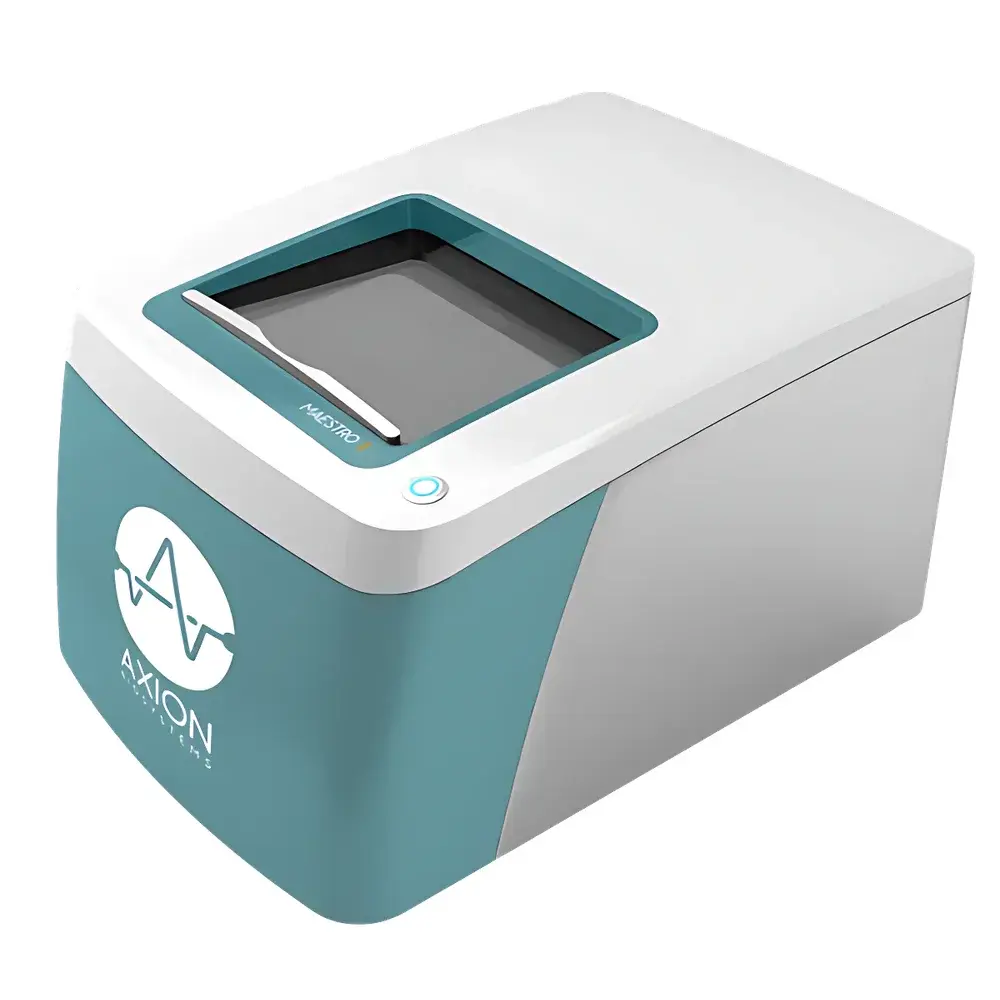
Axion BioSystems Maestro Z Real-Time, Label-Free Impedance-Based Cell Analysis System
| Brand | Axion BioSystems |
|---|---|
| Origin | USA |
| Manufacturer Type | Original Equipment Manufacturer (OEM) |
| Product Category | Imported Instrument |
| Model | Maestro Z |
| Pricing | Available Upon Request |
Overview
The Axion BioSystems Maestro Z is a next-generation, real-time, label-free cell analysis system engineered for non-invasive, long-term monitoring of cellular physiology using impedance-based biosensing. Unlike endpoint assays or fluorescent labeling techniques, the Maestro Z measures dynamic changes in electrical impedance across microelectrode arrays integrated into standard 96-well plates—enabling continuous, quantitative assessment of cell behavior without perturbing native function. The system operates on the principle of multi-frequency electric cell-substrate impedance sensing (ECIS), where alternating current (AC) signals across a physiologically relevant frequency spectrum (10 Hz to 50 kHz) resolve distinct biophysical contributions: low frequencies reflect paracellular barrier integrity and tight junction formation, while higher frequencies report on cell morphology, adhesion strength, and membrane capacitance. This dual-domain impedance profiling allows simultaneous interrogation of proliferation, cytotoxicity, migration, barrier function (e.g., TEER), and GPCR-mediated signaling—all within a single, unmodified assay format.
Key Features
- Integrated Environmental Control: Built-in temperature regulation (37 °C ± 0.3 °C) and humidity management enable stable, incubator-free operation—eliminating dependency on external CO₂ incubators and reducing workflow complexity and contamination risk.
- True Multi-Frequency Impedance Sensing: Simultaneous acquisition across 12 discrete AC frequencies per well provides high-resolution kinetic profiles of both resistive (barrier integrity) and capacitive (cell morphology/adhesion) components.
- Standalone Operation & Data Integrity: Onboard computing unit with redundant SSD storage and optional GxP-compliant software version supports full audit trails, electronic signatures, and 21 CFR Part 11–aligned data security protocols for regulated environments.
- Optical Accessibility: All Maestro Z-compatible plates feature optically clear polymer bottoms compatible with phase-contrast and fluorescence microscopy—enabling concurrent morphological validation and impedance-derived functional readouts.
- Mobile Monitoring & Cloud-Ready Workflow: Secure iOS/Android application enables real-time remote viewing of impedance traces, plate heatmaps, and alarm notifications; raw data export supports FAIR principles (Findable, Accessible, Interoperable, Reusable).
Sample Compatibility & Compliance
The Maestro Z accommodates a broad range of biological models—including adherent monolayers (e.g., MDCK, Caco-2, HUVEC), suspension cells (e.g., Jurkat, primary T cells), 3D spheroids, organoids, and co-culture systems. Its open-plate architecture supports integration with pharmacological agents, cytokines, antibodies, and viral vectors without hardware modification. The system complies with ISO 13485:2016 for medical device quality management and meets essential requirements for GLP/GMP-aligned workflows. Software validation packages—including IQ/OQ/PQ documentation, change control logs, and system suitability testing templates—are available for regulatory submissions under FDA, EMA, and PMDA guidelines.
Software & Data Management
Maestro Z is powered by Axion’s proprietary Maestro Software Suite, a Windows-based platform offering intuitive experiment design, automated baseline correction, and kinetic parameter extraction (e.g., doubling time, IC₅₀, TEER slope, wound closure rate). The software includes built-in statistical modules for dose-response modeling (logistic regression, four-parameter fit), time-series clustering, and multi-plate normalization. All datasets are stored in vendor-neutral HDF5 format with embedded metadata (timestamp, user ID, environmental logs, protocol version), ensuring traceability and interoperability with LIMS and ELN systems. For enterprise deployments, API access enables direct integration with Python/R analytics pipelines and institutional data lakes.
Applications
- Real-time quantification of cell proliferation and cytostatic/cytotoxic responses to small molecules, biologics, or nanomaterials
- Dynamic assessment of epithelial/endothelial barrier integrity via transepithelial electrical resistance (TEER) in drug permeability and inflammation studies
- Label-free monitoring of immune cell activation, cytotoxic T-cell killing kinetics, and CAR-T efficacy in co-culture assays
- Functional profiling of GPCR ligands using impedance-based “impedance fingerprinting” to distinguish biased agonism and pathway selectivity
- Quantitative analysis of cell migration and invasion through extracellular matrix-coated electrodes in wound-healing and metastasis models
- Longitudinal phenotyping of patient-derived organoids and iPSC-differentiated lineages for disease modeling and personalized therapy screening
FAQ
Can the Maestro Z be used outside a CO₂ incubator?
Yes—the system incorporates active temperature and humidity control, enabling fully autonomous operation in ambient lab environments without external gas supply or incubation infrastructure.
Is optical imaging possible during impedance recording?
Yes—standard Maestro Z plates feature optically transparent polymer bottoms compatible with inverted microscopes, allowing concurrent live-cell imaging and impedance measurement.
Does the system support Good Laboratory Practice (GLP) compliance?
The optional GxP software version provides full 21 CFR Part 11 compliance, including role-based access control, electronic signatures, and immutable audit trails for regulated preclinical research.
What data formats are supported for downstream analysis?
Raw impedance data exports as HDF5 files with embedded metadata; processed results are available in CSV, Excel, and JSON formats for integration with statistical and machine learning platforms.
How does Maestro Z differentiate between cell number and cell morphology effects?
By analyzing frequency-dependent impedance spectra, the system deconvolves contributions from intercellular resistance (cell density/barrier) and membrane capacitance (cell spreading, cytoskeletal remodeling), enabling mechanistic interpretation beyond simple confluence metrics.




