
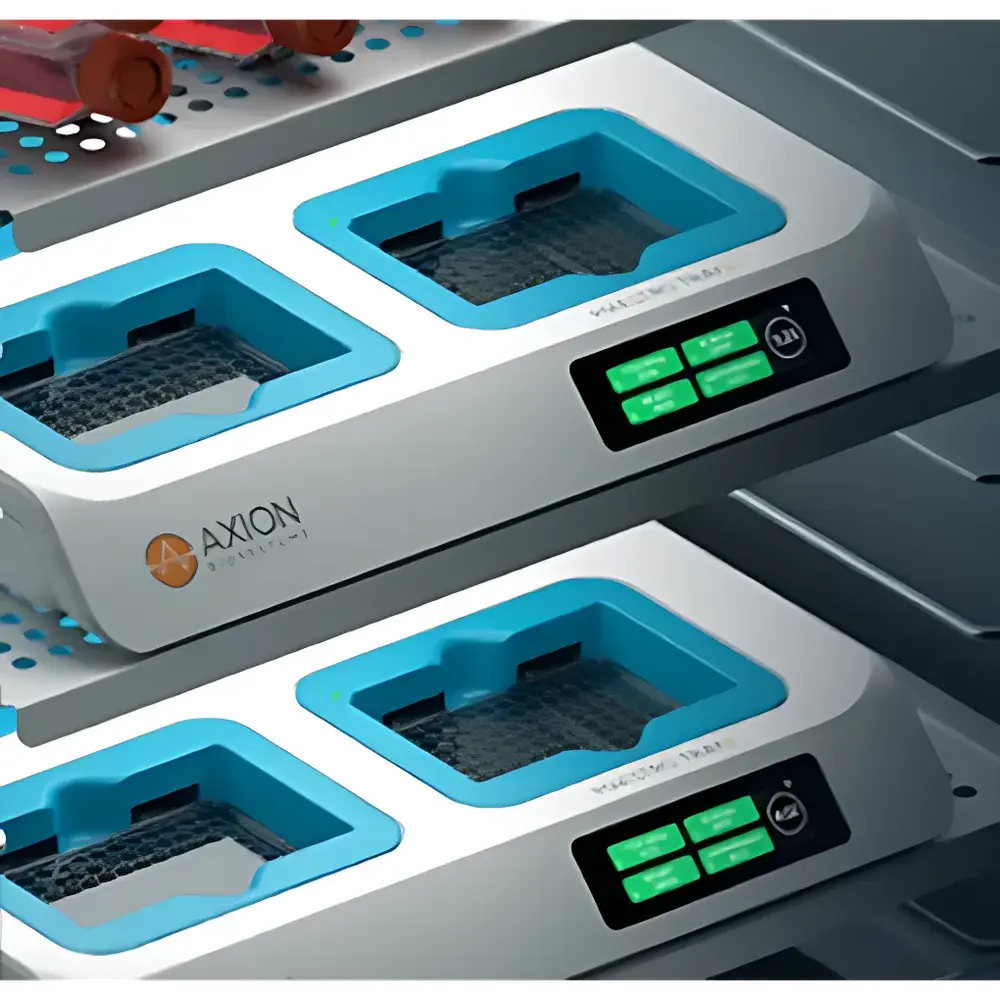
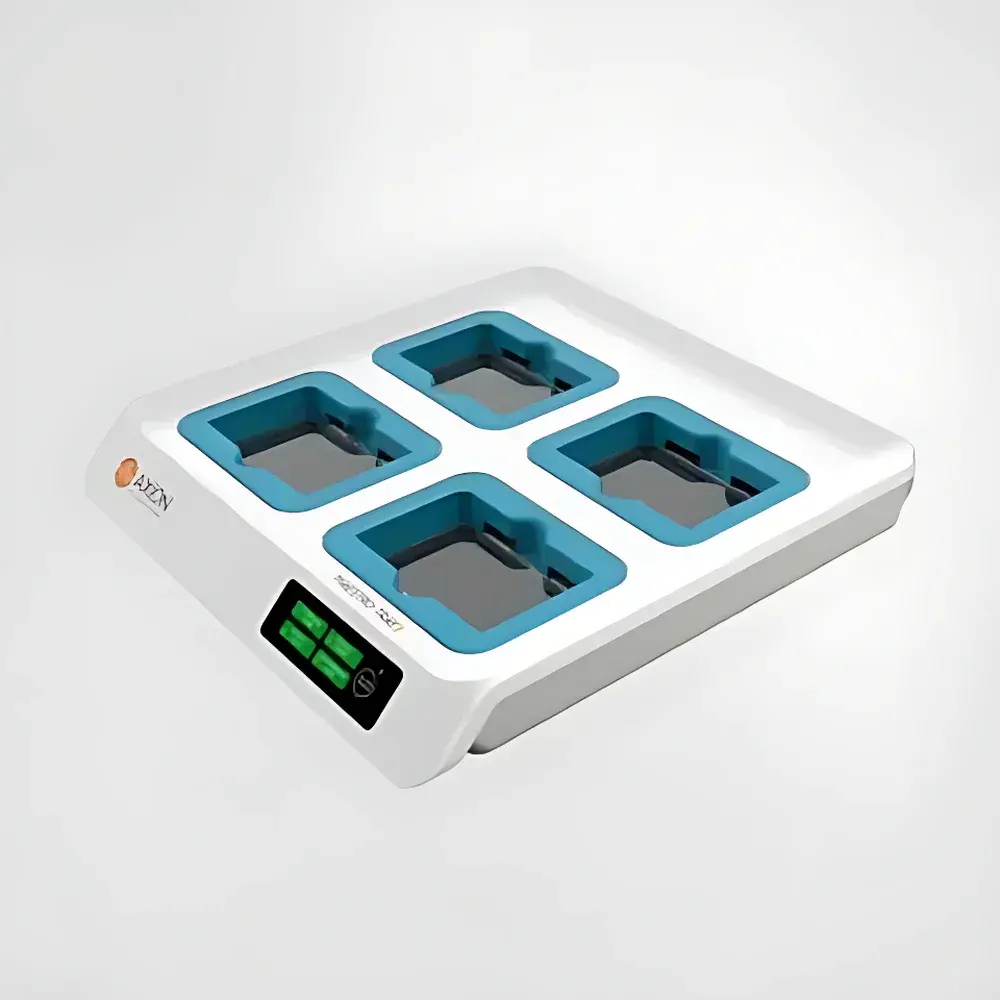
Axion BioSystems Maestro TrayZ Label-Free Real-Time Impedance-Based Cell Analysis System
| Brand | Axion BioSystems |
|---|---|
| Origin | USA |
| Manufacturer Type | Original Equipment Manufacturer (OEM) |
| Product Category | Imported Instrument |
| Model | Maestro TrayZ |
| Pricing | Available Upon Request |
Overview
The Axion BioSystems Maestro TrayZ is a modular, label-free, real-time impedance-based cell analysis system engineered for continuous, non-invasive monitoring of living cells inside standard CO2 incubators. Leveraging extracellular electrical impedance spectroscopy (EIS), the platform detects subtle changes in cell morphology, adhesion, proliferation, and barrier integrity without requiring fluorescent dyes, genetic reporters, or enzymatic substrates. Each assay relies on microelectrode-integrated culture plates (e.g., 96-well E-Plates), where alternating current (AC) signals at multiple frequencies are applied across electrode arrays; resulting impedance shifts correlate directly with biological events—including cell attachment, spreading, cytotoxicity, migration, and monolayer disruption. Unlike endpoint assays or optical methods susceptible to phototoxicity or autofluorescence interference, Maestro TrayZ delivers kinetic resolution over hours to weeks, preserving native cell physiology and enabling longitudinal studies under physiologically relevant conditions.
Key Features
- Variable-throughput architecture: A single Maestro TrayZ terminal supports up to eight independent 96-well impedance reader modules—each physically mounted within a standard incubator—scaling total capacity from 1 × 96 to 8 × 96 wells per system. Through synchronized networked operation, users maintain centralized control without compromising spatial or thermal uniformity.
- Automated consumable recognition: Integrated barcode scanners identify E-Plate lot numbers, well geometry, and calibration metadata upon plate insertion, ensuring traceability and auto-loading of historical assay parameters or initiation of new protocols via AxIS Z software.
- GxP-compliant data governance: Full audit trail functionality—including user logins, parameter modifications, environmental sensor logs (temperature, CO2, humidity), and timestamped event records—supports compliance with FDA 21 CFR Part 11, ISO 13485, and GLP/GMP documentation requirements.
- Remote experiment oversight: The Axion Mobile App provides secure, role-based access to real-time impedance traces, live status indicators, and alert notifications—enabling off-site monitoring across institutional or multi-site research environments.
- Incubator-native design: All hardware components—including reader modules, power distribution units, and communication interfaces—are rated for continuous operation at 37°C and 5% CO2, eliminating external cabling or chamber door interruptions during long-term assays.
Sample Compatibility & Compliance
Maestro TrayZ accommodates diverse cellular models including adherent monolayers (e.g., HEK293, MDCK, Caco-2), suspension cultures (e.g., Jurkat, THP-1), 3D spheroids, organoids, and co-cultures. Its impedance readout is insensitive to optical clarity, media composition, or phenol red presence—making it suitable for complex matrices such as serum-rich or lipid-supplemented media. The system complies with IEC 61000-6-3 (EMC emissions) and IEC 61010-1 (safety for laboratory equipment). All E-Plates are manufactured under ISO 13485-certified processes and validated for sterility (ISO 11137), endotoxin levels (<0.5 EU/mL), and dimensional consistency per ASTM F2971.
Software & Data Management
AxIS Z software serves as the unified interface for experimental design, acquisition, visualization, and export. It supports batch protocol creation, multi-parameter curve fitting (e.g., RTCA-derived metrics: Cell Index, Max Slope, Area Under Curve), and automated threshold-based event detection (e.g., IC50 calculation, TEER stabilization time). Raw impedance data (magnitude and phase at 10–32 kHz) are stored in HDF5 format with embedded metadata, ensuring FAIR (Findable, Accessible, Interoperable, Reusable) principles. Export options include CSV, Excel, and MATLAB-compatible .mat files. For regulated environments, electronic signatures, role-based permissions, and 21 CFR Part 11-compliant signature workflows are fully configurable.
Applications
- Real-time quantification of cell proliferation, cytostasis, and apoptosis kinetics
- Dynamic assessment of cytotoxicity and mechanism-of-action profiling for small molecules, biologics, and nanomaterials
- Transendothelial/epithelial electrical resistance (TEER) monitoring for barrier function modeling
- GPCR activation kinetics and biased signaling characterization via impedance waveform profiling
- Immune cell–target cell interactions in cancer immunotherapy and CAR-T functional assays
- 3D tumor spheroid invasion and migration dynamics using custom electrode geometries
- Wound healing and collective cell migration analysis (e.g., scratch assay alternatives)
- Viral cytopathic effect monitoring and antiviral compound screening
FAQ
What types of cell culture vessels are compatible with Maestro TrayZ?
Standard 96-well E-Plates (with integrated gold microelectrodes) are required; formats include flat-bottom, 3D spheroid, and vascular barrier plates—all optimized for specific biological endpoints.
Can Maestro TrayZ be used outside a CO2 incubator?
No—the system is designed exclusively for use inside humidified, temperature- and CO2-controlled incubators. Reader modules lack environmental regulation and must remain within specified operating conditions (35–37°C, 0–10% CO2).
Is calibration required before each experiment?
Each E-Plate undergoes factory calibration; no user-performed calibration is needed. AxIS Z automatically applies plate-specific correction factors during data acquisition.
How does Maestro TrayZ handle edge effects in 96-well plates?
The system employs frequency-dependent impedance compensation algorithms and excludes outer wells from primary analysis by default—though users may override this setting for specialized applications.
Does the system support integration with LIMS or ELN platforms?
Yes—AxIS Z provides RESTful API endpoints and configurable ODBC drivers for bidirectional data exchange with major Laboratory Information Management Systems (LIMS) and Electronic Lab Notebooks (ELN).
Related Products




