
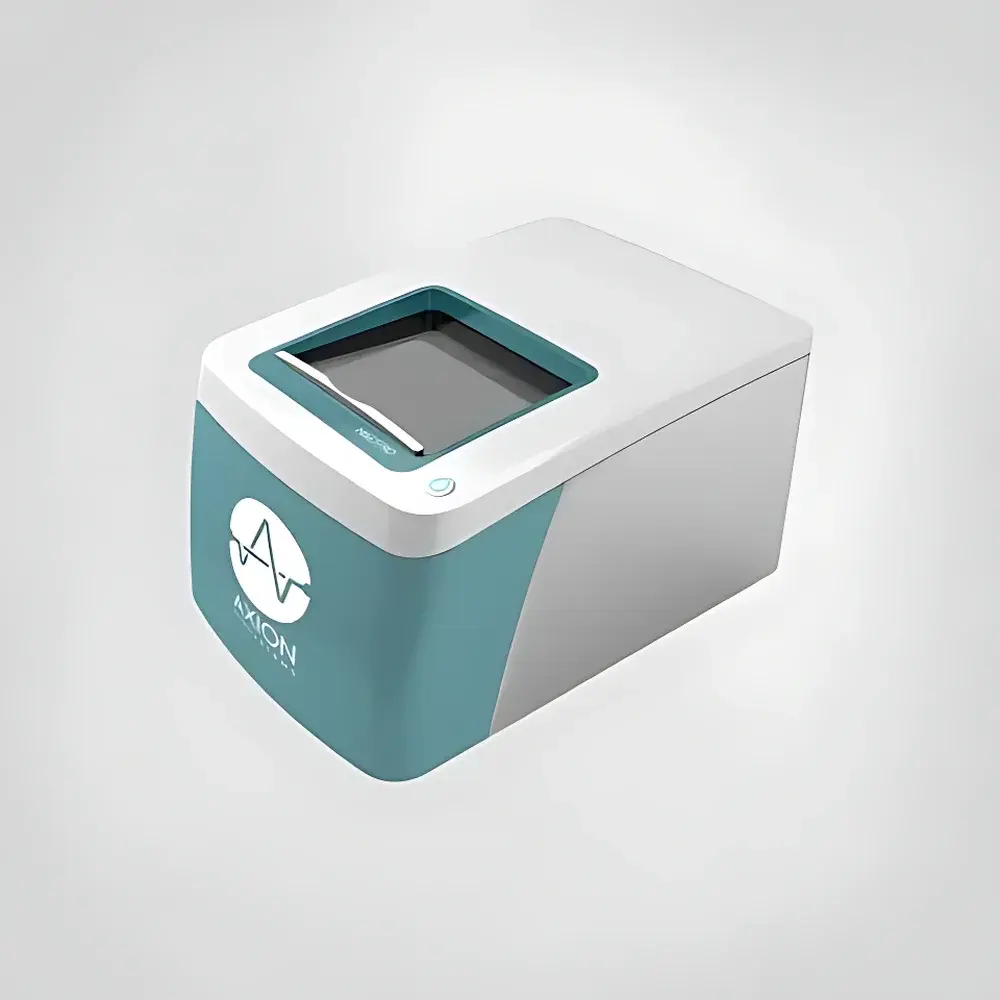
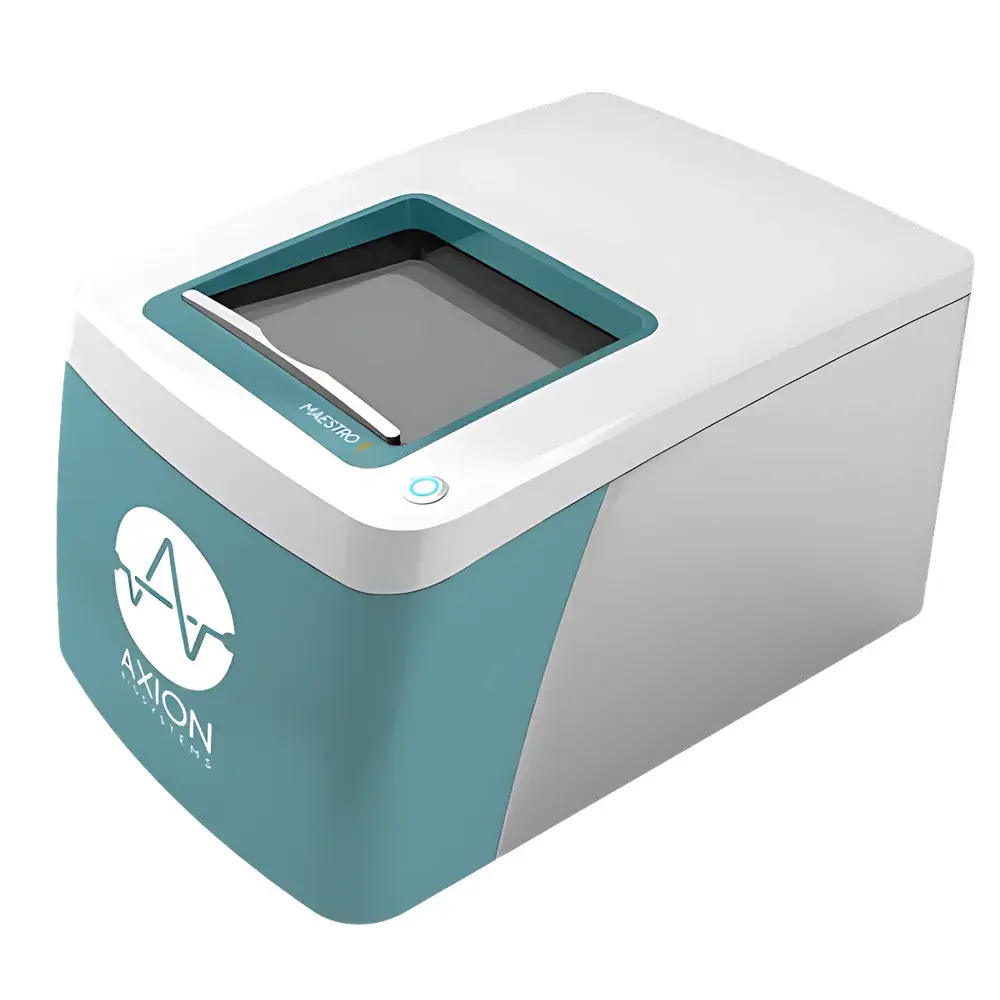
Axion BioSystems Maestro Z High-Throughput TEER and Impedance Monitoring System for 96- to 384-Well Plates
| Brand | Axion BioSystems |
|---|---|
| Origin | USA |
| Manufacturer Type | Original Equipment Manufacturer (OEM) |
| Product Category | Imported Instrument |
| Model | Maestro Z |
| Pricing | Available Upon Request |
Overview
The Axion BioSystems Maestro Z is a benchtop, label-free, high-throughput impedance monitoring system engineered for real-time, noninvasive assessment of barrier integrity, cell proliferation, cytotoxicity, and functional responses in adherent and suspension cultures. It operates on the principle of electric cell-substrate impedance sensing (ECIS), applying low-magnitude, multi-frequency alternating current across integrated microelectrode arrays embedded in standard 96-, 24-, or 384-well culture plates. By quantifying changes in complex impedance—specifically resistance (Rb, reflecting paracellular tight junction integrity) and capacitance (Cμ, reporting membrane coverage and morphology)—the Maestro Z delivers kinetic, quantitative readouts of cellular behavior without dyes, labels, or endpoint lysis. Its design centers on physiological relevance: measurements occur continuously inside standard CO2 incubators, eliminating perturbation from plate handling or environmental shifts. This enables longitudinal tracking of epithelial/endothelial barrier function via transepithelial/transendothelial electrical resistance (TEER), with sensitivity sufficient to resolve sub-hour dynamics in cytokine-induced permeability shifts—such as TNF-α–mediated junctional disruption and angiopoietin-1–driven recovery in human aortic and brain microvascular endothelial monolayers.
Key Features
- Integrated incubator-compatible hardware: Compact footprint with thermally stable, EMI-shielded sample chamber; no external incubator modification required.
- True multi-frequency impedance acquisition: Simultaneous measurement at 10 discrete frequencies (125 Hz – 2 MHz) to deconvolve resistive and capacitive components of cellular impedance.
- High-density electrode architecture: Each well contains 8 gold microelectrodes (100 µm × 100 µm) enabling robust signal-to-noise ratio (>60 dB) and reproducible baseline establishment.
- FDA 21 CFR Part 11–compliant software platform: Includes electronic signatures, audit trails, role-based access control, and secure data encryption for GLP/GMP-aligned workflows.
- On-device data storage: Internal solid-state memory retains all raw impedance time-series data during power interruption or host PC failure—ensuring zero data loss.
- Automated background subtraction and normalization: Built-in algorithms support well-level baseline correction, inter-plate normalization, and kinetic curve alignment across experimental replicates.
Sample Compatibility & Compliance
The Maestro Z supports a broad range of biologically relevant models: confluent monolayers of primary or immortalized epithelial/endothelial cells (e.g., Caco-2, MDCK, HUVEC, hBMEC), 3D spheroids, organoids, co-cultures, and suspension cells (via adherence-dependent or non-adherent assay configurations). All assays comply with ASTM F2971-15 (Standard Guide for Use of Electric Cell-Substrate Impedance Sensing in Biological Assays) and align with ISO/IEC 17025 requirements for measurement uncertainty estimation. TEER validation follows USP <788> guidance for barrier integrity verification in drug transport studies. The system meets IEC 61000-4-3 (EMC immunity) and UL 61010-1 safety standards for laboratory instrumentation.
Software & Data Management
Maestro Software v4.x provides a unified interface for instrument control, real-time visualization, and post-acquisition analysis. It natively exports impedance magnitude/phase data in CSV and HDF5 formats, with optional integration into LIMS or ELN platforms via RESTful API. Analytical modules include automatic peak detection for migration/invasion onset, slope-based cytotoxicity scoring (IC50 derivation), and TEER stability metrics (coefficient of variation over 24 h). Audit trails log every user action—including parameter edits, data exports, and report generation—with timestamps and operator IDs. Data retention policies support configurable auto-archiving and encrypted offsite backup.
Applications
- Dynamic TEER monitoring in BBB, intestinal, and alveolar barrier models under inflammatory challenge (e.g., IL-6, IFN-γ, LPS).
- Real-time quantification of GPCR-mediated signaling kinetics (e.g., histamine, thrombin, S1P) via impedance waveform profiling.
- Label-free cytotoxicity screening across compound libraries, including immunomodulators and nanotherapeutics.
- Longitudinal assessment of wound healing, cell migration, and collective invasion using scratch-free impedance mapping.
- Functional characterization of CAR-T or NK cell cytolytic activity against tumor spheroids.
- Validation of barrier-protective agents (e.g., angiopoietin-1, sphingosine-1-phosphate analogs) in preclinical vascular leak models.
FAQ
What electrode configurations are supported?
The Maestro Z uses 96-well plates with 8-electrode arrays per well (Axion’s proprietary CytoView-Z plates); 24- and 384-well formats require compatible plate adapters and are validated for TEER and proliferation assays.
Can the system operate outside a CO2 incubator?
Yes—though optimal performance requires temperature and humidity control; ambient operation is possible for short-term assays (<4 h) with external humidification.
Is calibration required before each experiment?
No routine recalibration is needed; factory calibration is traceable to NIST standards, and daily verification is performed automatically via internal reference impedance circuits.
How does Maestro Z differentiate TEER from baseline impedance drift?
By applying multi-frequency sweeps and modeling impedance spectra with the Cole-Cole equation, the system isolates the low-frequency resistive component (Rb)—which correlates directly with paracellular resistance—while rejecting capacitive artifacts from media evaporation or electrode fouling.
Does the software support automated reporting for regulatory submissions?
Yes—templates for FDA IND/CTA dossiers and EMA scientific advice packages are preconfigured, including metadata tagging, version-controlled SOP linkage, and PDF/A-2b export compliant with long-term archival standards.



