
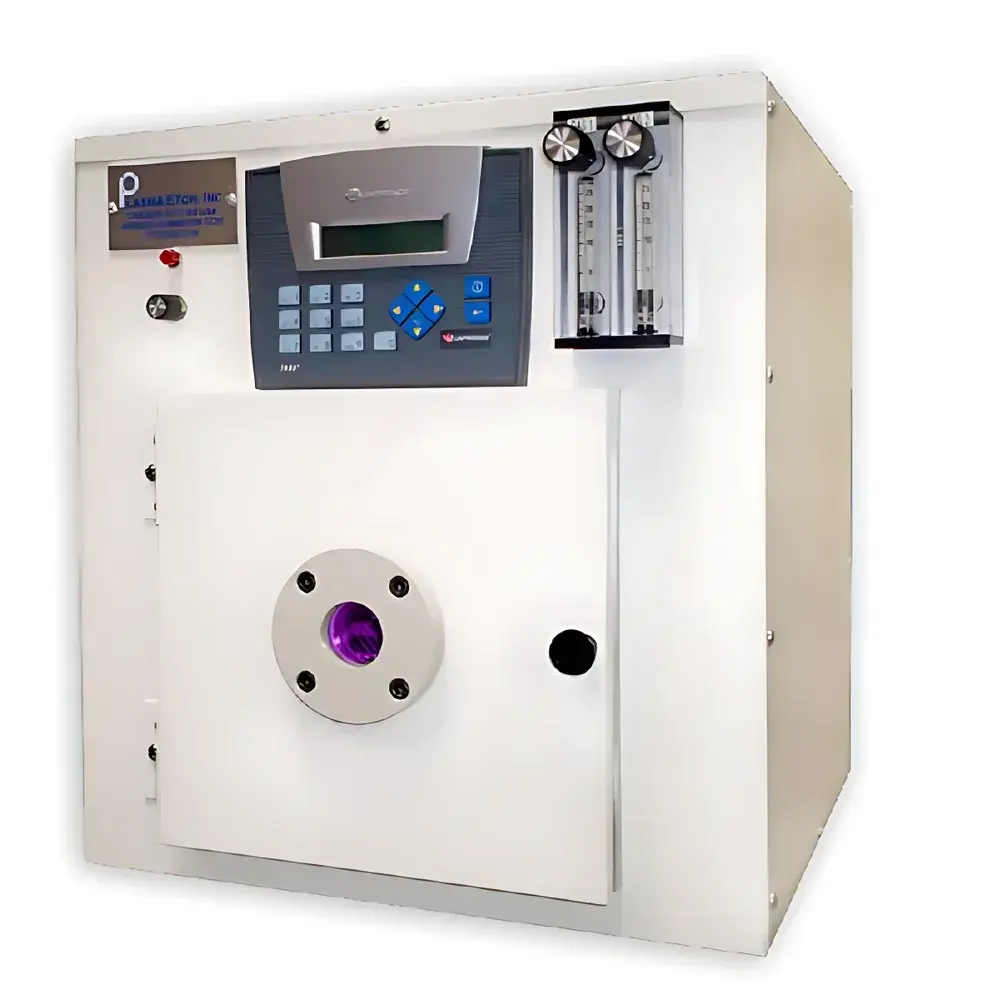
AXIS-TEC PE-100 Benchtop Reactive Ion Etcher (RIE) System
| Brand | AXIS-TEC |
|---|---|
| Origin | USA |
| Model | PE-100 |
| RF Frequency | 13.56 MHz |
| RF Power | 0–300 W (automatically adjustable) |
| Chamber Dimensions | 305 × 368 × 305 mm (L×D×H) |
| Chamber Volume | 34 L |
| Chamber Material | T6-aluminum monolithic construction |
| Operating Pressure Range | 1–2000 mTorr |
| Gas Flow Control | 0–50 sccm with precision needle valve |
| Vacuum Gauge | Pirani gauge (0–1 Torr) |
| Gas Inlet | Single or multi-channel configurable |
| Control System | PLC-based HMI automation |
| Configuration Options | Plasma cleaning, isotropic plasma etching, anisotropic RIE, and switchable mode architecture |
Overview
The AXIS-TEC PE-100 is a compact, benchtop reactive ion etcher (RIE) engineered for precision surface modification in academic research laboratories, materials science facilities, and pilot-scale microfabrication environments. Utilizing capacitively coupled radio-frequency (CCP) plasma generation at the industrial standard frequency of 13.56 MHz, the system enables controlled physical sputtering and chemically assisted etching through directional ion bombardment—core to RIE’s anisotropic profile control. Unlike generic plasma cleaners, the PE-100 integrates dual-mode operational architecture: users can select between isotropic (chemical-dominant) plasma processing for uniform surface activation or high-directionality RIE for sub-micron feature definition in thin-film patterning. Its monolithic T6-aluminum chamber ensures excellent thermal stability, RF shielding integrity, and vacuum compatibility down to 1 mTorr—critical for reproducible plasma impedance matching and process repeatability across wafer-level substrates, MEMS devices, and polymeric biomaterials.
Key Features
- Benchtop footprint with fully enclosed, EMI-shielded T6-aluminum chamber (305 × 368 × 305 mm), offering 34 L internal volume for scalable sample loading without compromising plasma uniformity.
- Digitally regulated 0–300 W RF power supply with real-time feedback control—enabling precise energy coupling for sensitive substrates such as photoresists, PDMS, and ALD-grown oxides.
- Configurable gas delivery system supporting single- or multi-gas inlet manifolds (e.g., O₂, CF₄, SF₆, Ar), each equipped with calibrated needle valves (0–50 sccm range) for stoichiometric process tuning.
- Integrated Pirani vacuum gauge (0–1 Torr) with analog output and digital readout, synchronized with chamber pressure regulation for stable glow discharge initiation and endpoint consistency.
- PLC-driven human-machine interface (HMI) with programmable recipe storage, stepwise process sequencing, and fault logging—designed for unattended operation under GLP-compliant lab protocols.
- Modular electrode configuration with removable sample tray and optional grounded/shielded electrode variants to support both parallel-plate RIE and downstream plasma configurations.
Sample Compatibility & Compliance
The PE-100 accommodates substrates up to 150 mm in diameter—including silicon wafers, glass slides, ceramic substrates, flexible polymer films, and metallized foils—without requiring custom fixtures. Chamber geometry and RF field distribution have been validated for uniform plasma density (±8% deviation across central 100 mm zone) per ASTM F2627-20 guidelines for plasma uniformity assessment. All wetted components comply with USP Class VI biocompatibility standards; aluminum surfaces are passivated per MIL-A-8625 Type II to prevent outgassing and metallic contamination. The system meets CE electromagnetic compatibility (EMC) Directive 2014/30/EU and operates within FCC Part 18 limits for industrial RF equipment. Optional documentation packages support ISO/IEC 17025 method validation and FDA 21 CFR Part 11 audit readiness for electronic record retention.
Software & Data Management
While the PE-100 operates via embedded PLC logic without external PC dependency, its HMI supports USB export of timestamped process logs—including RF forward/reflected power, chamber pressure, gas flow rates, and runtime duration—for traceability and statistical process control (SPC). Each saved recipe includes metadata fields for operator ID, material lot number, and calibration verification date. Audit trails are retained onboard for ≥12 months and may be archived externally in CSV or XML format. For integration into centralized laboratory information management systems (LIMS), the controller provides Modbus RTU over RS-485 for bidirectional communication with third-party SCADA platforms—facilitating automated workflow handoff in GMP-aligned cleanroom environments.
Applications
- Resist stripping and post-lithography residue removal from Si, GaAs, and quartz substrates prior to metrology or deposition steps.
- Anisotropic etching of SiO₂, Si₃N₄, and metal films using fluorocarbon chemistries (e.g., CHF₃/Ar) for MEMS release and NEMS device fabrication.
- Surface functionalization of PET, PTFE, and polyimide for improved adhesion in printed electronics and biomedical sensor assembly.
- Controlled hydrophilicity/hydrophobicity tuning of microfluidic channel walls via oxygen or hexamethyldisiloxane (HMDSO) plasma exposure.
- Pre-bonding surface activation of glass-to-silicon and polymer-to-metal interfaces in hermetic packaging processes.
FAQ
What vacuum level is required to initiate stable plasma discharge?
Stable ignition occurs between 10–100 mTorr depending on gas type and power setting; the system supports full operational range from 1–2000 mTorr for both low-pressure RIE and atmospheric-pressure-assisted modes.
Can the PE-100 perform both RIE and downstream plasma treatments?
Yes—the electrode configuration is mechanically reconfigurable to support either direct capacitive coupling (RIE mode) or remote plasma generation (downstream mode) via optional electrode shunting kits.
Is the chamber compatible with corrosive process gases such as Cl₂ or BCl₃?
Standard configuration supports O₂, Ar, CF₄, SF₆, and N₂; for halogen-based chemistries, optional anodized aluminum or quartz-lined chamber upgrades are available to mitigate erosion and particulate generation.
How is process repeatability ensured across multiple users or shifts?
Each recipe stores full parameter sets—including pressure ramp profiles, power ramp slopes, and gas sequence timing—with password-protected access levels and electronic signature requirements for critical process changes.
Does the system include calibration certificates for vacuum and flow sensors?
Factory calibration reports (traceable to NIST standards) are supplied with initial delivery; annual recalibration services are available through AXIS-TEC certified service centers in North America and EU member states.
Related Products



