AY1000 Low-Noise Low-Frequency Micro-Vibration Analyzer
| Brand | Aiyao Instruments |
|---|---|
| Origin | Shanghai, China |
| Model | AY1000 |
| Output Interface | RS422 Digital Output |
| Operating Frequency Range | ≥0.01 Hz |
| Noise Floor | Ultra-Low (Typ. <10 ng/√Hz below 1 Hz) |
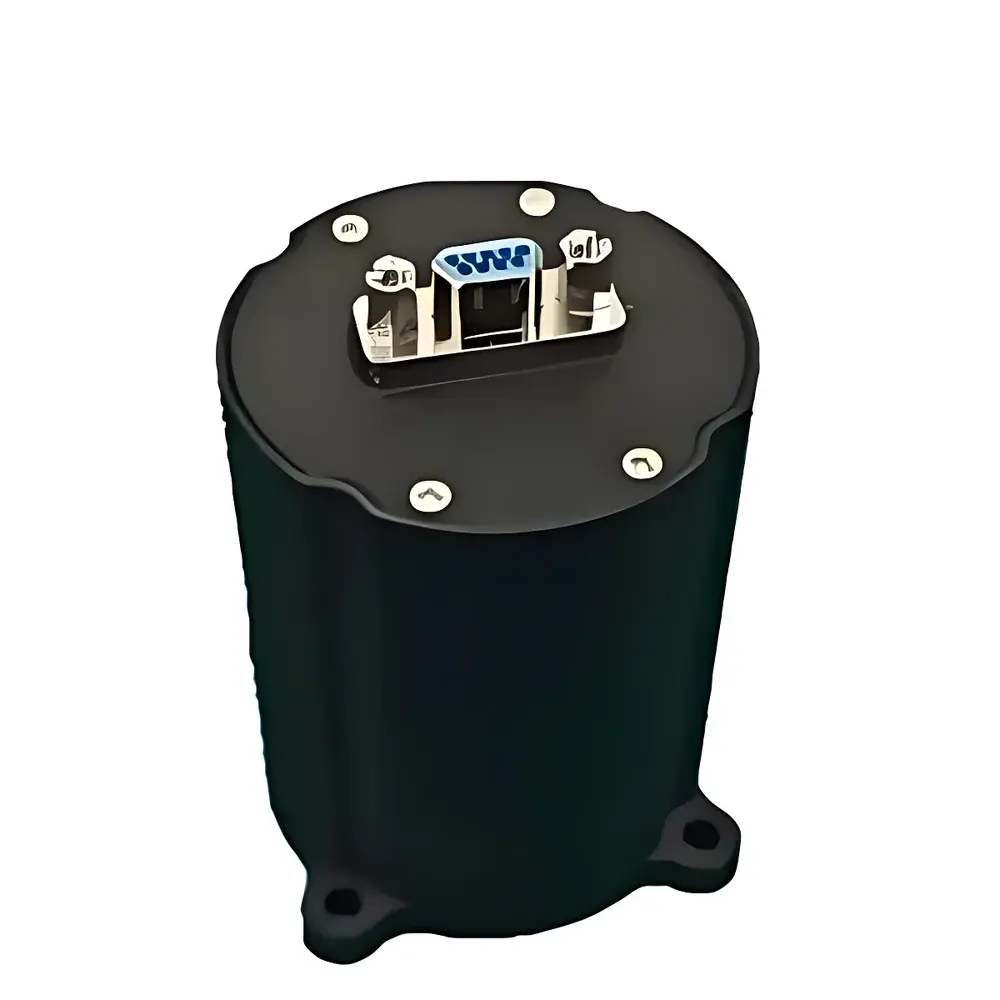
| Form Factor | Miniaturized, Low-Power, Lightweight Design |
| Compliance | Fully Domesticated Architecture |
Overview
The AY1000 Low-Noise Low-Frequency Micro-Vibration Analyzer is a precision inertial sensing instrument engineered for high-fidelity measurement of sub-Hz mechanical disturbances in ultra-stable environments. Based on high-stability MEMS or force-balance accelerometer architecture—optimized for minimal thermal drift and electronic noise—the AY1000 delivers calibrated velocity and acceleration spectral density data down to 0.01 Hz. Its design targets applications where mechanical isolation integrity, platform stability verification, and environmental vibration baseline characterization are mission-critical: satellite payload qualification, cleanroom semiconductor lithography tool monitoring, cryogenic interferometer support systems, and active vibration cancellation loop feedback sensing. Unlike conventional industrial-grade vibration meters limited to >1 Hz bandwidth and >100 ng/√Hz noise floors, the AY1000 maintains metrological traceability and signal integrity across the infrasonic regime, enabling quantification of ground tilt, building sway, acoustic-induced structural resonance, and low-frequency seismic coupling.
Key Features
- Ultra-low intrinsic noise floor: <10 ng/√Hz typical at 0.1 Hz, optimized for detection of micro-g-level disturbances
- Extended low-frequency response: DC-coupled operation with usable bandwidth from 0.01 Hz to 100 Hz (configurable)
- Fully domesticated hardware architecture: Indigenous sensor die, ASIC signal conditioning, and firmware—designed for supply chain resilience and export-control compliance
- Miniaturized form factor: Compact 60 × 60 × 35 mm housing with mass <180 g—suitable for integration into constrained-volume platforms including CubeSat payloads and wafer-stage enclosures
- Low-power operation: <150 mW typical consumption at 5 VDC, supporting battery-backed or PoE-derived deployment in remote or power-limited facilities
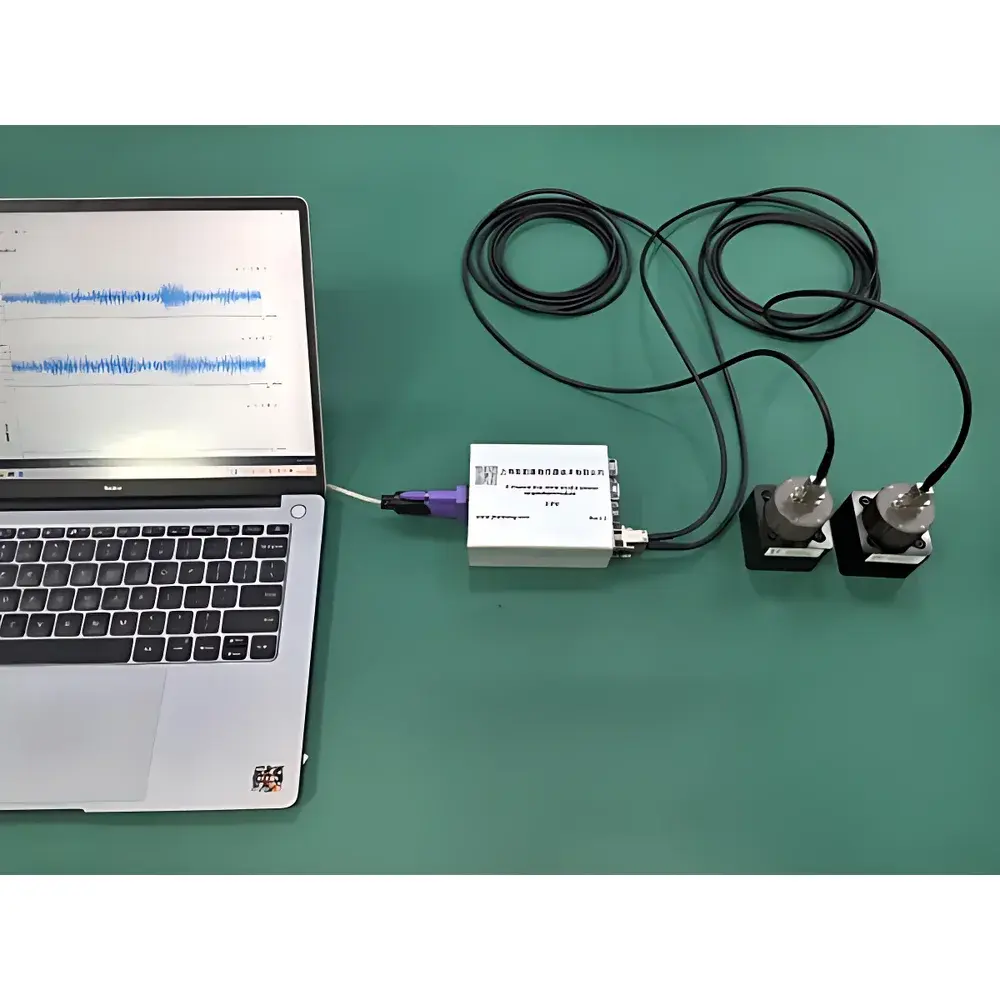
- Digital-native output: Direct RS422 differential serial interface eliminates need for external charge amplifiers or analog signal conditioning stages—reducing cabling complexity and EMI susceptibility
Sample Compatibility & Compliance
The AY1000 is compatible with rigid mounting on aluminum, stainless steel, and Invar substrates via M3 threaded inserts or adhesive bonding (with validated thermal expansion matching). It supports both triaxial and single-axis configurations (model variants). Calibration is performed per ISO 16063-21:2014 (Methods for the calibration of vibration and shock transducers — Part 21: Vibration calibration by comparison to a reference transducer) using laser interferometric reference standards traceable to NIM (National Institute of Metrology, China). While not certified to MIL-STD-810 or ECSS-Q-ST-70-08C out-of-the-box, its mechanical robustness (operating shock rating: 50 g, 11 ms half-sine) and thermal stability (±0.05 % FS/°C over 15–35 °C) align with typical requirements for space-qualified auxiliary sensors. For regulated environments, raw digital output enables audit-ready time-series logging compliant with GLP/GMP data integrity principles when paired with validated acquisition software.
Software & Data Management
The AY1000 communicates via ASCII-protocol RS422 at configurable baud rates (9.6 kbps to 115.2 kbps), delivering timestamped, 24-bit resolution acceleration samples at up to 512 Hz sampling rate. Vendor-provided PC software (Windows/Linux) provides real-time FFT, PSD estimation (Welch’s method), octave band analysis (1/3-octave per ISO 5349-1), and coherence calculation. Raw binary data streams are exportable in HDF5 and CSV formats—with embedded metadata (sensor ID, calibration coefficients, temperature, timestamp UTC sync via PPS input option). Integration with LabVIEW, MATLAB, and Python (via PySerial + NumPy stack) is supported through documented API and example scripts. All firmware updates and configuration changes are performed over the same RS422 link, ensuring secure, offline-capable maintenance without USB dependency.
Applications
- Satellite micro-vibration characterization during ground testing—quantifying reaction wheel jitter, cryocooler harmonics, and solar array drive disturbances
- In-process monitoring of EUV lithography tools: detecting sub-nm stage vibrations correlated with overlay error budgets
- Validation of active/passive optical table isolation performance—especially below 1 Hz where traditional accelerometers lack sensitivity
- Geotechnical and foundation stability assessment in metrology labs housing atomic clocks or gravitational wave prototype suspensions
- Feedback sensing in real-time adaptive damping systems for high-precision manufacturing equipment (e.g., electron beam welders, nanoimprint presses)
FAQ
What is the lowest measurable frequency with full dynamic range?
The AY1000 maintains specified linearity and noise performance down to 0.01 Hz; below this, response rolls off gradually per first-order high-pass characteristic inherent to its servo architecture.
Is factory calibration certificate included with shipment?
Yes—each unit ships with a NIST-traceable calibration report (per ISO/IEC 17025 accredited lab) covering sensitivity, phase response, and noise spectral density from 0.01 Hz to 100 Hz.
Can the AY1000 be used in vacuum environments?
The standard enclosure is rated for ambient air only; vacuum-compatible variants (with hermetic sealing and outgassing-tested materials) are available under custom order with lead-time extension.
Does the device support synchronization with external timing references?
Yes—optional TTL-compatible PPS (pulse-per-second) input enables sub-millisecond time alignment with GPS-disciplined oscillators or master DAQ systems.
How is long-term drift managed in extended deployments?
Built-in temperature compensation algorithms and periodic auto-zero routines (triggered via command or scheduled interval) mitigate thermal and bias drift; typical bias instability is <5 µg over 30 days at constant temperature.