
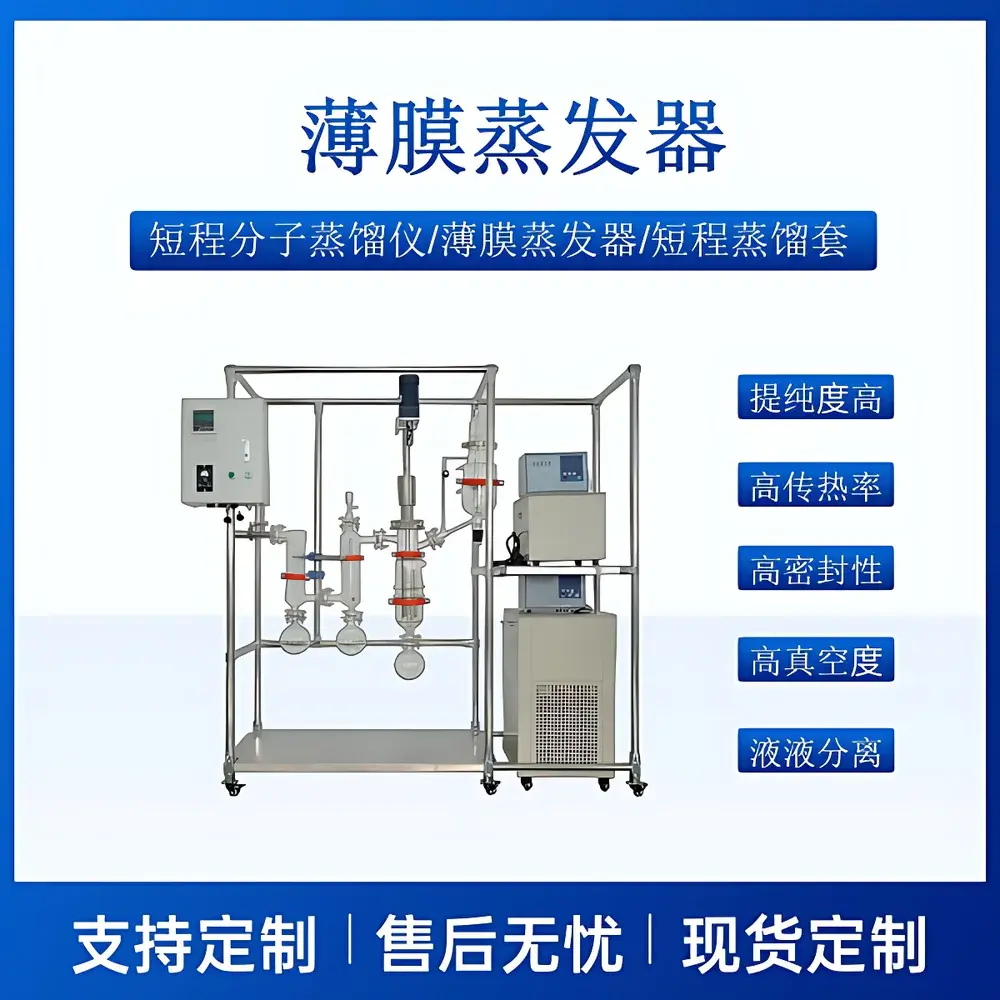
AYAN-B80 Laboratory Wiped-Film Molecular Evaporator (Anyan Instruments)
| Brand | Anyan Instruments |
|---|---|
| Origin | Zhejiang, China |
| Model | AYAN-B80 Wiped-Film Evaporator |
| Effective Evaporation Area | 0.1 m² |
| Evaporator Internal Diameter | 80 mm |
| Condenser Area | 0.15 m² |
| Feed Rate | 0.5–4.0 L/h |
| Ultimate Vacuum | <0.1 Pa |
| Film Thickness | <0.5 mm |
| Construction Materials | SS316L rotor & housing, PTFE刮板 (wiper blades), Fluoroelastomer (FKM) gaskets standard (optional PTFE gaskets) |
Overview
The AYAN-B80 Laboratory Wiped-Film Molecular Evaporator is a precision-engineered short-path distillation system designed for high-efficiency, low-temperature separation of thermally labile, high-boiling, and oxidation-sensitive compounds. Operating under ultra-high vacuum (<0.1 Pa), it utilizes molecular distillation principles—where mean free path exceeds evaporator dimensions—to enable phase separation based on differences in molecular weight and vapor pressure rather than boiling point alone. Unlike conventional distillation, the AYAN-B80 employs a rotating PTFE-coated wiper system to generate a uniform, sub-0.5 mm liquid film on a heated SS316L cylindrical evaporation surface. This geometry ensures minimal residence time (typically <30 seconds), rapid heat transfer, and negligible thermal degradation—making it ideal for isolating bioactive lipids, natural antioxidants, polymer precursors, and pharmaceutical intermediates where structural integrity is critical.
Key Features
- Ultra-high vacuum capability (<0.1 Pa) achieved via integrated high-vacuum pumping interface compatible with diffusion or turbomolecular pumps—ensuring molecular regime operation and suppression of oxidative side reactions.
- SS316L evaporation cylinder (80 mm ID) with precisely machined thermal jacket and uniform temperature control (±0.5 °C) across the active surface.
- Three-blade PTFE-wiper assembly mounted on a corrosion-resistant SS316L shaft; adjustable rotational speed (50–450 rpm) for optimized film formation and shear control.
- Integrated condenser with 0.15 m² active cooling area, cooled by circulating chiller (−20 °C to +10 °C range recommended); condenser geometry optimized for high capture efficiency of volatile fractions.
- Modular feed system with optional pre-heating vessel (temperature-controlled up to 120 °C) and calibrated peristaltic or gear pump for precise, pulse-free feeding (0.5–4.0 L/h).
- Full fluoropolymer sealing architecture: standard FKM gaskets at all flanged joints; optional PTFE gaskets available for aggressive solvents (e.g., chlorinated hydrocarbons, strong acids/bases).
- No boiling or foaming phenomena—evaporation occurs exclusively at the liquid–vapor interface under laminar flow conditions, eliminating entrainment and ensuring high-purity distillate collection.
Sample Compatibility & Compliance
The AYAN-B80 accommodates viscous, non-Newtonian, and particulate-laden feedstocks typical in fine chemical synthesis, nutraceutical extraction, and polymer processing—including fish oil triglycerides, lanolin esters, vitamin A/E acetates, polyglycerol esters, and synthetic lubricant base stocks. Its all-SS316L + PTFE wetted-path construction complies with ISO 8502-3 for stainless steel passivation and meets material compatibility requirements outlined in USP for extractables testing. While not certified for GMP manufacturing, the system supports GLP-compliant laboratory workflows: traceable temperature/vacuum logging, validated cleaning protocols (using ethanol, acetone, or isopropanol), and full documentation of operating parameters per batch. It is routinely employed in method development aligned with ASTM D2879 (Standard Test Method for Distillation Range of High-Boiling Materials) and ISO 11348 (for toxicity screening of distillate fractions).
Software & Data Management
The AYAN-B80 operates as a manually supervised benchtop instrument without embedded digital control software. However, it features analog and digital I/O ports (0–10 V / 4–20 mA) for integration with external data acquisition systems (e.g., LabVIEW, DeltaV, or custom SCADA). Users commonly log vacuum (capacitance manometer), evaporator wall temperature (PT100), condenser temperature (RTD), feed rate (pulse counter), and wiper RPM (tachometer signal) at ≥1 Hz resolution. Audit trails, electronic signatures, and 21 CFR Part 11 compliance are implemented externally via validated third-party acquisition platforms. All mechanical adjustments—including wiper gap, feed nozzle alignment, and condenser positioning—are documented in standardized SOP templates provided in the user manual.
Applications
- Fine Chemicals: Purification of aromatic oils (e.g., rose oxide, ionones), removal of catalyst residues from polycondensation intermediates, and isolation of chiral synthons under inert atmosphere.
- Pharmaceuticals: Solvent removal from API solutions post-extraction; concentration and fractionation of lipid-based nanocarriers; recovery of heat-sensitive vitamins (A, E, K) and carotenoids from botanical extracts.
- Food & Nutraceuticals: Deacidification of crude fish oil (FFA reduction from >15% to <0.1%), fractionation of omega-3 concentrates (EPA/DHA enrichment), and purification of plant sterols and squalene.
- Polymers & Materials: Devolatilization of silicone prepolymers, removal of unreacted monomers from acrylic resins, and purification of high-molecular-weight polyols prior to polyurethane synthesis.
- Environmental & Petrochemical: Recovery of used lubricants, separation of PAHs from contaminated soil leachates, and refining of tall oil fatty acids (TOFA) for surfactant production.
FAQ
What vacuum level is required to achieve molecular distillation with the AYAN-B80?
A base pressure ≤0.1 Pa must be stabilized prior to heating; this is typically achieved using a two-stage vacuum system (rotary vane backing pump + diffusion or turbomolecular pump). System leak rate should be <1×10⁻³ Pa·L/s after bake-out.
Can the AYAN-B80 handle solid-containing feeds?
Yes—feed suspensions with ≤5 wt% non-settling particles (e.g., activated carbon, silica gel fines) are compatible when using the optional coarse-mesh feed filter and reduced wiper speed (≤200 rpm) to prevent blade wear.
Is solvent compatibility data available for the PTFE wipers and FKM gaskets?
FKM gaskets resist aliphatic/aromatic hydrocarbons, ketones, and alcohols but swell in chlorinated solvents and esters; PTFE gaskets are supplied for full compatibility with THF, DCM, DMF, and concentrated acids.
How is residue removal performed between runs?
Residue is removed by hot nitrogen purging (80–100 °C) followed by solvent rinse (e.g., toluene or ethanol) through the feed line and condenser drain; final drying under vacuum ensures no carryover.
Does Anyan provide validation support for IQ/OQ protocols?
Yes—factory-issued calibration certificates (temperature, pressure, flow), dimensional drawings, material test reports (MTRs) for SS316L and PTFE components, and blank SOP templates for installation qualification (IQ) and operational qualification (OQ) are included with shipment.



