
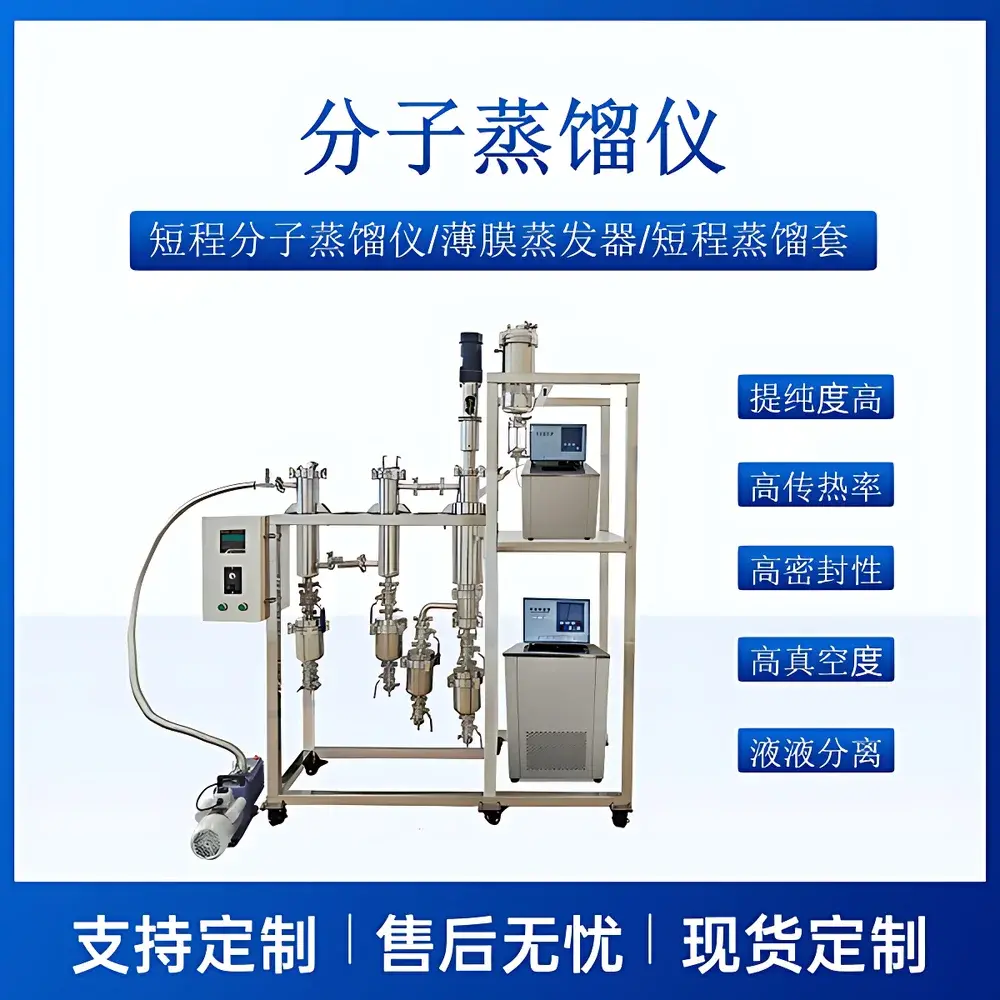
AYAN-F80-S ANYAN Wiped-Film Molecular Distillation System (Stainless Steel, 80 mm Evaporator ID)
| Key Features | Material – AISI 304/316L stainless steel |
|---|
Overview
The AYAN-F80-S is a laboratory- and pilot-scale wiped-film molecular distillation system engineered for high-efficiency thermal separation of thermally sensitive, high-boiling-point, or low-volatility compounds under high vacuum conditions. Operating on the principle of molecular distillation—where separation occurs based on differences in mean free path rather than boiling point—the system enables short-residence-time evaporation (typically <10 seconds) at significantly reduced temperatures compared to conventional vacuum distillation. This minimizes thermal degradation, making it suitable for heat-labile substances such as vitamins (e.g., vitamin A, E), polyunsaturated fatty acids (PUFAs), phospholipids, natural antioxidants, essential oils, and specialty polymers. The core evaporator features an 80 mm internal diameter vertical cylinder with a rotating PTFE- or carbon-blade wiper assembly, ensuring uniform, sub-millimeter liquid film formation across the heated surface. Integrated heating (electric or oil-jacketed options), cryogenic condensation, and multi-stage vacuum control (typically paired with dual-stage rotary vane + turbomolecular pump systems) support stable operation down to ≤0.1 Pa.
Key Features
- High-purity AISI 304 and 316L stainless steel construction throughout process-wetted components—including evaporator body, condenser, feed and distillate chambers—ensuring corrosion resistance, cleanability, and compliance with GMP-relevant surface finish standards (Ra ≤ 0.8 µm).
- Optimized wiped-film geometry: precision-machined rotor with adjustable刮片 angle and speed (0–300 rpm), enabling consistent film thickness control and enhanced interfacial mass transfer.
- Integrated automation architecture: programmable logic controller (PLC) coordinates feed pump rate, heating zone temperatures (up to 250 °C, ±0.5 °C stability), condenser cooling (−20 °C to −80 °C optional), vacuum setpoints, and fraction collection timing—reducing operator dependency and improving batch-to-batch reproducibility.
- Modular vacuum interface: standardized KF-40/KF-50 flanges allow seamless integration with vacuum gauges (capacitance manometer + Pirani), backing pumps, and turbomolecular pumps; system leak rate <5×10⁻⁹ mbar·L/s when properly conditioned.
- Dual-collection capability: two independently controllable receiving flasks enable real-time cut-point switching during multi-component separations—critical for isolating narrow boiling-range fractions in nutraceutical or pharmaceutical purification workflows.
Sample Compatibility & Compliance
The AYAN-F80-S accommodates viscous liquids (up to 5,000 cP), suspensions, and heat-sensitive melts without pre-dilution. It has been validated for use with edible oils, fish oil concentrates, CBD distillates, silicone monomers, and polymer oligomers. All wetted surfaces comply with FDA 21 CFR 177.2400 (food-contact plastics) and EU Regulation (EC) No. 1935/2004 material safety requirements. While not certified to ISO/IEC 17025, the system supports GLP-compliant documentation when paired with external audit-ready data loggers and electronic lab notebooks (ELNs). Its design aligns with ASTM D2892 and D5236 practices for high-vacuum fractional distillation characterization.
Software & Data Management
The embedded HMI touchscreen provides real-time visualization of 12+ process parameters—including evaporator wall temperature (dual-point RTD), condenser surface temperature, chamber pressure (absolute and relative), feed flow rate, rotor speed, and distillate mass accumulation. All data are timestamped and exportable via USB or Ethernet (Modbus TCP) to SCADA or LIMS platforms. Optional software add-ons include automated method storage (up to 99 protocols), trend-based alarm triggers (e.g., pressure excursion >±5% setpoint for >30 s), and CSV/Excel-compatible audit trails compliant with FDA 21 CFR Part 11 requirements when deployed with user authentication and electronic signature modules.
Applications
- Purification of omega-3 ethyl esters from crude fish oil hydrolysates, achieving >95% EPA/DHA concentration with <0.1% residual solvent carryover.
- Deodorization and tocopherol recovery from soybean and sunflower distillates—retaining >92% antioxidant activity post-distillation.
- Isolation of monoglycerides and diglycerides from glycerolysis reaction mixtures for food emulsifier synthesis.
- Removal of residual catalysts (e.g., tin octoate) and unreacted monomers from biodegradable polyester prepolymers (e.g., PLA, PCL).
- Concentration of natural astaxanthin from Haematococcus pluvialis extracts while preserving cis/trans isomer ratio and optical activity.
FAQ
What vacuum level is required for optimal performance?
Typical operating range is 0.001–0.1 Pa (1×10⁻⁵–1×10⁻⁴ mbar); stable operation below 0.05 Pa is recommended for high-molecular-weight compounds (MW >500 Da) to ensure mean free path exceeds evaporator–condenser distance.
Can the system handle solid-containing feeds?
Yes—pre-filtered suspensions with ≤5 wt% non-volatile solids are compatible; however, continuous operation requires periodic wiper blade inspection to prevent abrasive wear.
Is validation support available for regulated environments?
Factory-issued IQ/OQ documentation templates are provided; full PQ execution and 21 CFR Part 11 validation services are available through authorized third-party partners upon request.
What maintenance intervals are recommended?
Wiper blades: replace every 500 operational hours or after processing highly abrasive feeds; vacuum seals: inspect and re-torque flanges quarterly; heating oil (if jacketed): test for oxidation annually.
How does this compare to centrifugal molecular stills?
The wiped-film configuration offers superior scalability, lower rotational inertia, easier cleaning access, and higher tolerance to viscosity fluctuations—making it preferred for R&D and pilot-scale applications where flexibility and repeatability outweigh ultra-high throughput demands.



