
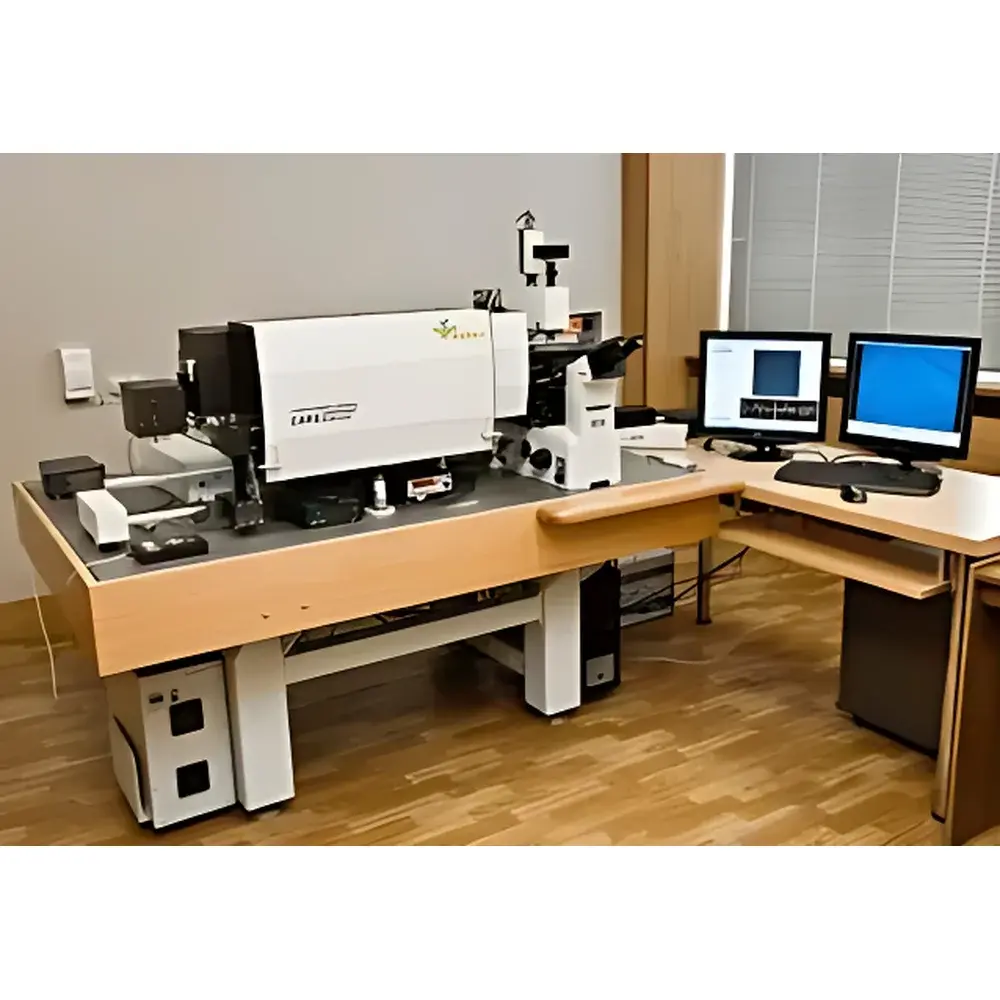
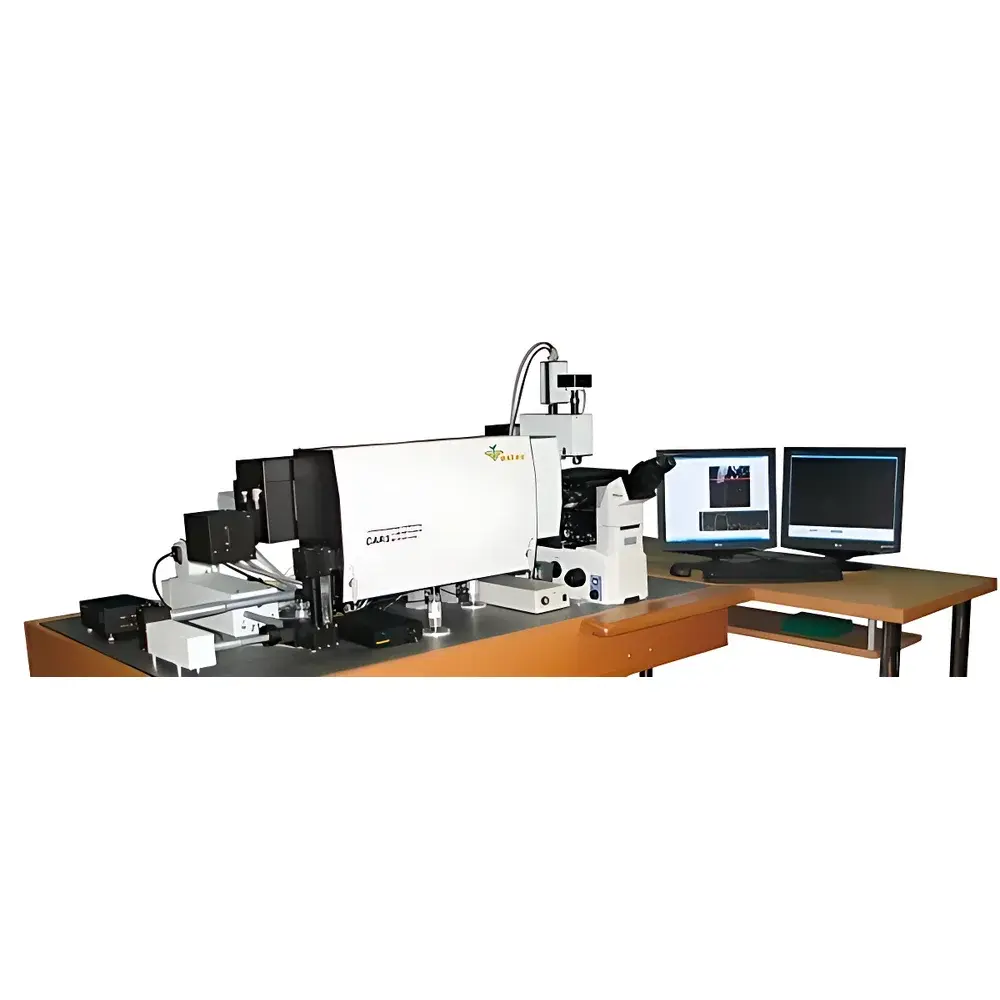
Ayao Instruments CARS Coherent Anti-Stokes Raman Scattering Microscopic Imaging System
| Brand | Ayao Instruments |
|---|---|
| Origin | Germany |
| Manufacturer Type | Authorized Distributor |
| Origin Category | Imported |
| Model | CARS |
| Instrument Type | Coherent Anti-Stokes Raman Scattering (CARS) Microscope |
| Excitation Wavelength | 1032 nm |
| Spectral Coverage | 500–5000 cm⁻¹ |
| Spatial Resolution | < 0.7 µm |
| Imaging Speed | 3 fs per pixel (typical acquisition time at video rate) |
Overview
The Ayao Instruments CARS Coherent Anti-Stokes Raman Scattering Microscopic Imaging System is a turnkey, laser-based label-free chemical imaging platform engineered for high-fidelity vibrational contrast in live biological specimens. Operating on the principle of four-wave mixing in the non-resonant and resonant regimes, CARS generates a coherent anti-Stokes signal at frequency ωAS = 2ωpump − ωStokes, where ωpump and ωStokes are the angular frequencies of the pump and Stokes beams. This process yields orders-of-magnitude higher signal intensity than spontaneous Raman scattering—typically 10³–10⁴×—enabling real-time, diffraction-limited chemical mapping without exogenous dyes or fixation artifacts. The system integrates a synchronized picosecond optical parametric oscillator (OPO) with a 1032 nm Yb-based pump laser, delivering tunable Stokes pulses across the fingerprint-to-high-wavenumber Raman range (500–5000 cm⁻¹). Its sub-700 nm lateral resolution is achieved via tight spatial overlap of collinear pump and Stokes beams at the focus, eliminating reliance on confocal pinholes while preserving intrinsic optical sectioning capability.
Key Features
- Integrated dual-beam picosecond laser architecture: 1032 nm fundamental pump + broadly tunable Stokes beam (700–1100 nm), enabling precise resonance targeting across the entire Raman-active vibrational spectrum
- Diffraction-limited spatial resolution (< 0.7 µm laterally, ~1.8 µm axially) maintained across all spectral tuning ranges without mechanical re-alignment
- Video-rate imaging capability (up to 30 fps at 512 × 512 pixels) with shot-noise-limited signal detection using high-quantum-efficiency GaAsP photomultiplier tubes and lock-in amplification
- Multi-modal compatibility: native support for simultaneous or sequential acquisition of CARS (F-CARS, E-CARS, P-CARS), stimulated Raman scattering (SRS), two-photon excited fluorescence (TPEF), second-harmonic generation (SHG), fluorescence lifetime imaging (FLIM), and transmission/reflection contrast
- Motorized XYZ stage with piezo Z-scanner for high-speed volumetric imaging and automated tile scanning over mm-scale fields of view
- Thermally stabilized optical path and active beam pointing stabilization ensure long-term measurement reproducibility required for longitudinal studies
Sample Compatibility & Compliance
The system is validated for imaging of unstained, living, and fixed biological samples—including cultured mammalian cells (e.g., HeLa), primary tissues, bacterial biofilms, lipid droplets, myelin sheaths, and protein crystals (e.g., bacteriorhodopsin). No sample dehydration, embedding, or labeling is required. Optical power density at the sample plane remains below 50 mW/µm² under standard imaging conditions, minimizing photothermal and photochemical damage as confirmed by cell viability assays (>95% post-acquisition metabolic activity over 10-min acquisitions). Hardware and software comply with IEC 60825-1:2014 (laser safety), ISO 13485:2016 (medical device quality management), and support audit-ready documentation for GLP and GMP environments. Data provenance meets FDA 21 CFR Part 11 requirements via electronic signatures, secure user access control, and immutable audit trails.
Software & Data Management
Acquisition and analysis are performed using AyaoVision Pro v4.2—a modular, Python-extendable platform supporting real-time spectral unmixing, hyperspectral clustering (k-means, NMF), and quantitative concentration mapping based on Raman cross-section libraries. All raw interferometric data (intensity, phase, polarization) are stored in HDF5 format with embedded metadata (laser parameters, objective ID, environmental conditions). Export options include TIFF stacks (16-bit), CSV spectral profiles, and MIBI-compatible .ome.tiff for multiscale correlative workflows. The software includes built-in calibration routines traceable to NIST SRM 2241 (polystyrene) and supports third-party integration via REST API and MATLAB/Python SDKs.
Applications
- Label-free histopathology: discrimination of tumor margins, lipid-rich plaques, and collagen remodeling in fresh-frozen tissue sections
- Live-cell organelle dynamics: tracking lipid droplet biogenesis, mitochondrial membrane potential shifts, and vesicular trafficking without perturbation
- Neuroimaging: myelin integrity assessment in ex vivo brain slices and in vivo zebrafish spinal cord models
- Microbial metabolism: spatially resolved monitoring of fatty acid synthesis and carotenoid accumulation in single bacterial cells
- Crystallography: non-destructive visualization of chiral protein crystal domains via SONICC (Second Order Nonlinear Imaging of Chiral Crystals) mode
- Pharmaceutical development: quantification of drug distribution and crystallinity within transdermal patches and hydrogel matrices
FAQ
What laser safety class does this system operate under?
The integrated laser subsystem is certified Class IV per IEC 60825-1, housed in an interlocked enclosure meeting EN 60825-1:2014 requirements. Full compliance documentation and laser safety officer (LSO) training materials are provided.
Can the system perform quantitative concentration mapping?
Yes—using calibrated reference standards and cross-section databases, AyaoVision Pro enables absolute concentration estimation for major biomolecular vibrations (e.g., CH₂ stretch at 2845 cm⁻¹, phenylalanine ring breathing at 1003 cm⁻¹) with ±8% repeatability across instruments.
Is SRS imaging supported natively?
Yes—the same laser engine and detection path are shared between CARS and SRS modes; switching requires only software configuration and minor detector gain adjustment. Both modalities use identical spectral tuning and spatial registration.
Does the system support time-gated FLIM acquisition?
Yes—via optional TCSPC module (PicoHarp 300 or Becker & Hickl DCS-120), integrated into the same scan engine with sub-25 ps timing resolution and full synchronization to the pump/Stokes pulse train.
What maintenance is required for long-term stability?
Annual optical alignment verification and laser wavelength calibration are recommended. No consumables or alignment-sensitive optics require routine replacement; the OPO crystal lifetime exceeds 10,000 hours under specified operating conditions.
Related Products



