
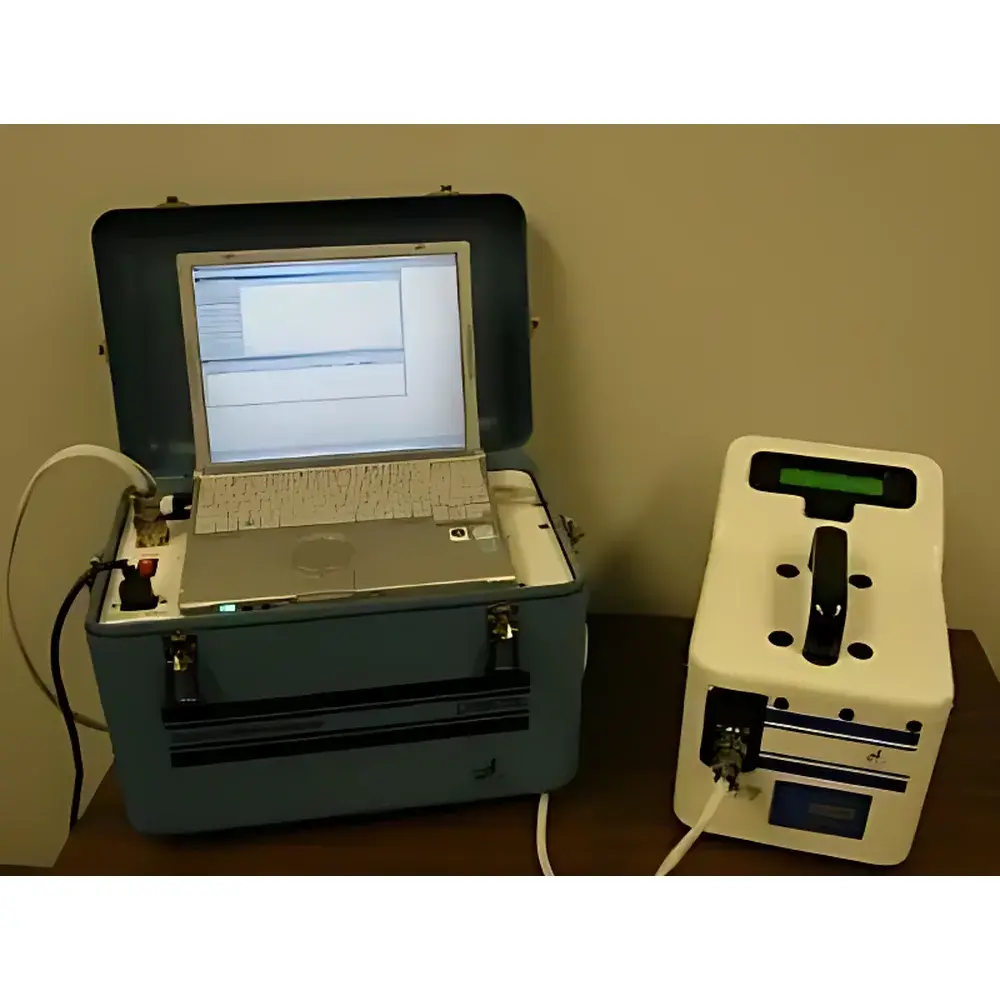
AZ Technology LPSR300 Portable Spectral Reflectometer (NIR-UV-VIS)
| Brand | AZ Technology |
|---|---|
| Origin | USA |
| Model | LPSR300 |
| Spectral Range | 250–2800 nm |
| Measurement Type | Spectral Total Hemispherical Reflectance |
| Repeatability | ±1% (250–2500 nm), ±2% (2500–2800 nm) |
| Spectral Resolution | Better than 5% of wavelength (250–2500 nm), better than 8% of wavelength (2500–2800 nm) |
| Sample Diameter | ≥0.5 inch |
| Full Scan Time | <2 minutes |
| Power Supply | 115 VAC / 60 Hz |
| Measurement Head Dimensions | 10 × 12 × 8 in |
| Measurement Head Weight | 15 lb |
| PC/Power Box Dimensions | 9 × 16 × 20 in |
| PC/Power Box Weight | 35 lb |
| Warranty | 1 year parts and labor |
| Compliance | ASTM E903, NASA-qualified design |
| Operating System | Windows XP (embedded) |
| Integrated Optical Database | Yes |
| Vacuum-Compatible Variant | LPSR300V available |
Overview
The AZ Technology LPSR300 Portable Spectral Reflectometer is a field-deployable, self-contained instrumentation system engineered for high-fidelity spectral total hemispherical reflectance measurements across the ultraviolet, visible, and near-infrared (UV-VIS-NIR) spectrum — from 250 nm to 2800 nm. Based on an integrating sphere optical architecture, the LPSR300 implements a monochromator with prism dispersion and user-selectable slit width to enable precise wavelength resolution control. Its core measurement principle follows ASTM E903–22 “Standard Test Method for Solar Absorptance, Reflectance, and Transmittance of Materials Using Integrating Spheres,” making it suitable for solar energy absorption characterization of thermal control coatings, spacecraft surface materials, architectural glazing, and advanced functional surfaces. Developed under NASA specification for extravehicular activity (EVA) material evaluation aboard the Mir space station, the LPSR300 delivers laboratory-grade repeatability (±1% within 250–2500 nm; ±2% up to 2800 nm) in a ruggedized portable configuration. Unlike benchtop spectrophotometers requiring external PCs or auxiliary optics, the LPSR300 integrates its measurement head, embedded Windows XP computing platform, power management, and data storage into a single operational unit.
Key Features
- Self-contained operation: No external computer, spectrometer, or optical bench required — all subsystems housed in two transportable enclosures (measurement head and PC/power box).
- Integrating sphere geometry optimized for total hemispherical reflectance (THR), compliant with ASTM E903 for solar absorptance calculation.
- Monochromator with prism-based dispersion and motorized slit width selection enables adaptive spectral resolution: better than 5% of wavelength from 250–2500 nm, and better than 8% from 2500–2800 nm.
- Dual-mode operation: Fully automated scan mode (user-defined start/stop wavelengths and step intervals) and manual mode (independent control of lamp source, detector gain, slit width, and grating position).
- Onboard 40 GB hard drive stores >5,000 full-spectrum scans with metadata (date, operator ID, sample ID, instrument settings).
- Integrated optical reference database supports real-time comparison of measured spectra against certified material standards (e.g., Spectralon®, Infragold®, and NASA-traceable calibration tiles).
- Vacuum-compatible variant (LPSR300V) available for in-situ testing in low-pressure environments, including thermal vacuum chambers used in aerospace qualification.
- Rugged mechanical design: Aluminum alloy housing, shock-mounted optics, and MIL-STD-810G-aligned vibration resistance for field deployment.
Sample Compatibility & Compliance
The LPSR300 accommodates flat, opaque, or semi-transparent samples with minimum diameter of 0.5 inches (12.7 mm); curvature and surface roughness are accommodated within the integrating sphere’s diffuse collection efficiency. It supports non-destructive, contactless measurement of paints, anodized metals, polymer films, ceramic coatings, and composite laminates. Regulatory and industry compliance includes full adherence to ASTM E903–22 for solar absorptance determination and alignment with ISO 9050 (optical properties of glazing) and ECSS-Q-ST-70-02C (spacecraft material optical property testing). While not FDA-regulated, its audit-ready data logging structure — including timestamped raw spectra, operator log entries, and hardware configuration snapshots — satisfies GLP and GMP documentation requirements for quality-controlled material verification workflows.
Software & Data Management
The embedded Windows XP platform hosts a purpose-built graphical user interface (GUI) with intuitive tabbed navigation. All spectral data are stored in vendor-neutral ASCII format (.csv) and native binary (.lpsr) files, enabling third-party analysis in MATLAB, Python (NumPy/Pandas), or commercial spectroscopy software (e.g., GRAMS, OriginPro). The system logs complete instrument configuration per scan (lamp type, integration time, slit width, detector voltage, calibration status), supporting 21 CFR Part 11–compliant audit trails when deployed with external identity management. Export functions include normalized reflectance curves, solar-weighted absorptance (αsolar) calculated per ASTM G173-20 reference spectrum, and spectral emittance derivation via Kirchhoff’s law (ελ = 1 − ρλ for opaque samples).
Applications
- Aerospace thermal control coating validation (e.g., Z-93, YB-71, and white acrylics per NASA-STD-6002).
- Solar absorber and selective surface R&D for concentrated solar power (CSP) and photovoltaic-thermal (PVT) systems.
- Architectural material certification for LEED daylighting and building envelope energy modeling.
- Quality assurance of reflective safety garments, road signage, and retroreflective sheeting (per ASTM D4956).
- In-process monitoring of thin-film deposition uniformity on curved substrates using spatially averaged THR.
- Forensic material identification via spectral library matching in defense and heritage conservation contexts.
FAQ
Is the LPSR300 compatible with modern Windows operating systems?
The embedded controller runs Windows XP for deterministic real-time I/O timing; however, exported data files are fully interoperable with Windows 10/11, macOS, and Linux platforms.
Can the system be calibrated traceably to NIST standards?
Yes — factory calibration uses NIST-traceable reflectance standards (SRM 2035, SRM 931d) and is documented in the Certificate of Conformance supplied with each unit.
What is the minimum sample thickness required for accurate measurement?
No minimum thickness applies for opaque samples; for translucent materials, thickness must exceed the optical penetration depth at the longest measured wavelength (~2.8 µm) to ensure negligible transmission contribution.
Does the LPSR300 support bidirectional reflectance distribution function (BRDF) measurements?
No — it measures total hemispherical reflectance only. For BRDF, directional reflectometers (e.g., SOC-410, 400T) are recommended as complementary instruments.
How is thermal drift managed during extended field operation?
The monochromator and detector subsystems incorporate thermoelectric stabilization; internal temperature is logged with every scan, and correction algorithms are applied during post-processing per ASTM E1421–21 Annex A2.
Related Products




