Azenta 4titude Automated and Semi-Automatic Microplate Heat Sealers
| Brand | Azenta (formerly 4titude) |
|---|---|
| Origin | United Kingdom |
| Manufacturer Authorization | Authorized Distributor |
| Import Status | Imported |
| Model | 4ti-0665 Automated Roll-Film Heat Sealer / XP-A Series Semi-Automatic Sheet-Film Heat Sealer / 59-2000 Heat Sealing Films |
| Automation Level | Fully Automatic (4ti-0665), Semi-Automatic (XP-A) |
| Compliance | ISO-manufactured components, SBS-compliant footprint, SiLA 1.2 compatible (4ti-0665), RS-232 interface (XP-A) |
| Cycle Time | 2–3 seconds per plate |
| Sealing Consistency | ≤±1.5% variation in seal integrity across 5,000 consecutive cycles (4ti-0665) |
| Power Supply | 100–240 V AC, 50/60 Hz |
Overview
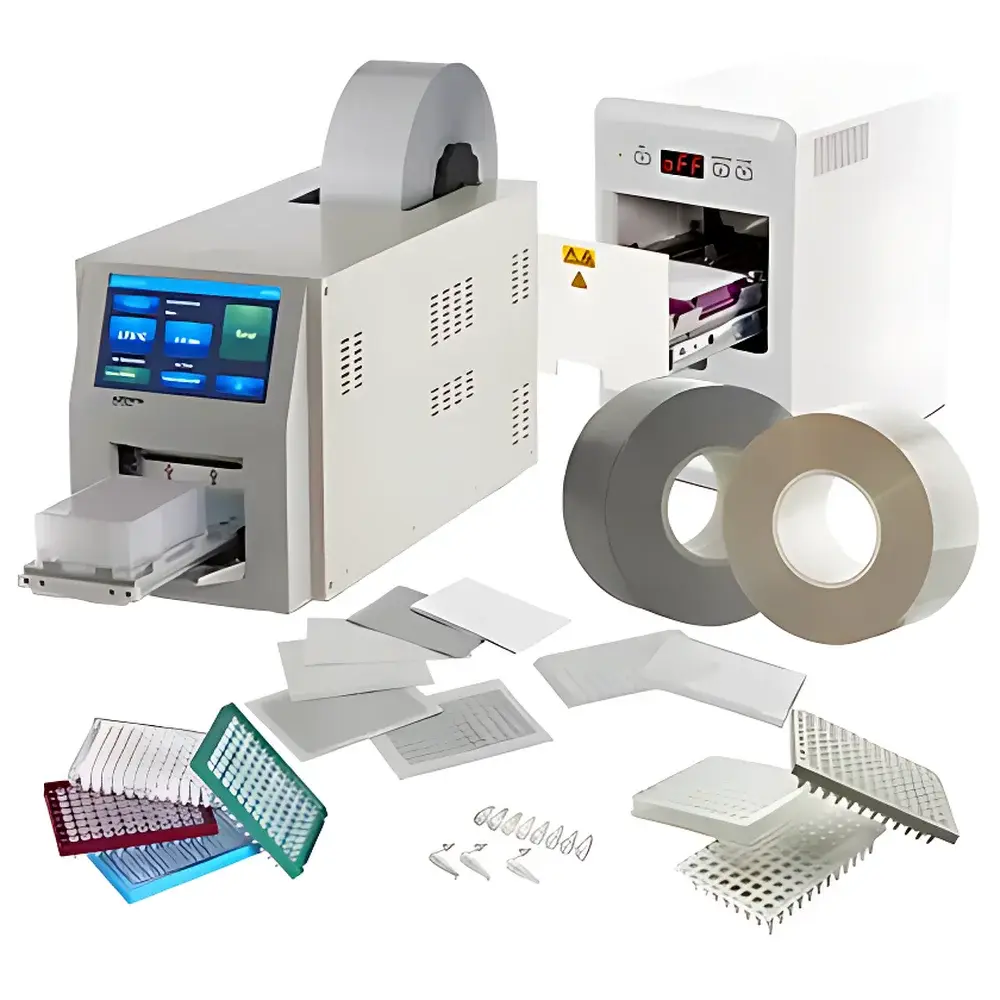
The Azenta 4titude microplate heat sealing platform—comprising the fully automated 4ti-0665 roll-film sealer and the semi-automatic XP-A sheet-film sealer—represents a precision-engineered solution for high-integrity thermal sealing of SBS-standard microplates (96-, 384-, and 1536-well formats). Unlike mechanical closures or adhesive-based methods, thermal sealing relies on controlled conduction heating to fuse polymer films (e.g., aluminum-laminated, foil, or PCR-grade polyester) directly onto plate rims, forming hermetic, low-permeability barriers. This process eliminates evaporation loss during thermal cycling (e.g., qPCR, RT-qPCR), prevents cross-contamination in sensitive nucleic acid workflows, and ensures long-term stability under cryogenic storage (−80 °C) or ambient transport conditions. The system’s core architecture integrates PID-regulated heating blocks, servo-controlled pressure actuators, and programmable dwell-time logic—enabling deterministic, physics-based seal formation governed by time–temperature–pressure (TTP) parameters rather than operator-dependent manual force.
Key Features
- Fully automated 4ti-0665 platform delivers >5,000 consecutive high-fidelity seals without recalibration or maintenance intervention—validated via dye penetration testing per ASTM F2096.
- SiLA 1.2 compliance enables seamless integration into LIMS-controlled robotic workcells (e.g., Hamilton STAR, Tecan Freedom EVO); supports command-driven plate loading/unloading via standardized instrument drivers.
- Uniform thermal distribution across the entire heating block (±0.3 °C spatial variance at 120 °C setpoint) ensures consistent melt-phase transition of film substrates—critical for reproducible burst strength (>300 kPa) and peel resistance (>1.2 N/mm).
- XP-A semi-automatic model features adjustable temperature (40–200 °C) and dwell time (0.1–10.0 s) dials with digital feedback; includes auto-standby mode (reduces power draw by 78% after 5 min idle) and RS-232 serial port for external script control.
- Modular film-feed mechanism accommodates standard roll widths (50–120 mm) and pre-cut sheets (up to 150 × 150 mm); dual-sensor jam detection halts operation upon film misfeed or tension anomaly.
- Integrated 4ti-0665 de-sealing module removes sealed films cleanly in <4 s per plate without residue or plate deformation—preserving well geometry for downstream automation handling.
Sample Compatibility & Compliance
All instruments are engineered to ANSI/SBS standards (ANSI SLAS 4-2004) for footprint, height, and robotic gripper clearance. Compatible with polypropylene, polystyrene, cyclic olefin copolymer (COC), and low-binding treated plates—including skirted, semi-skirted, and full-skirted variants. Sealing films (catalog #59-2000 series) meet USP Class VI biocompatibility requirements and exhibit ≤0.05 ng/cm² extractables (per ISO 10993-12). Device firmware complies with IEC 62304 Class B software safety requirements; audit trails, user access controls, and electronic signatures align with FDA 21 CFR Part 11 for regulated QC/QA environments. Manufacturing adheres to ISO 13485:2016 quality management systems.
Software & Data Management
The 4ti-0665 runs embedded firmware with local parameter storage (100+ protocol profiles), real-time thermal profiling logs (timestamped, CSV-exportable), and event-driven alerts (e.g., over-temperature, film depletion). Optional ConnectLink™ software (Windows/Linux) provides centralized fleet monitoring, remote firmware updates, and GLP-compliant report generation—including seal validation certificates traceable to NIST-calibrated thermocouples. XP-A units support basic parameter logging via RS-232 to third-party lab information systems (LIS) using ASCII command sets.
Applications
- High-throughput qPCR and digital PCR assay setup requiring vapor-tight containment across 40+ thermal cycles.
- Cryo-preservation of primary cell lysates and plasma samples where sublimation-induced concentration drift must be eliminated.
- Automated compound screening libraries (e.g., HTS, SAR studies) integrated with liquid handlers and plate readers—seal integrity verified prior to optical density or fluorescence measurement.
- GMP-compliant biobanking operations where chain-of-custody documentation and seal batch traceability are mandated.
- Diagnostic IVD kit manufacturing—validated per ISO 15189 for pre-analytical sample stabilization prior to ELISA or lateral flow analysis.
FAQ
What film types are supported by the 4ti-0665 and XP-A platforms?
Standard aluminum-laminated polyester (ALU-PET), clear polyester (PET), and specialty PCR-grade films (e.g., heat-stable fluoropolymer-coated variants) in roll or sheet form—catalog #59-2000 series includes options certified for UV transparency and low DNA binding.
Can the XP-A be used in a GxP environment?
Yes—when paired with optional ConnectLink™ software and configured with audit trail logging, electronic signatures, and role-based access control, it satisfies FDA 21 CFR Part 11 and EU Annex 11 requirements for computerized system validation.
Is plate height adjustment manual or automatic on the 4ti-0665?
Fully automatic: integrated capacitive height sensors detect plate stack thickness (0.5–25 mm) and dynamically adjust platen gap before sealing—no user calibration required.
Does the de-sealing function damage plate wells or barcodes?
No—the 4ti-0665 de-sealer uses vacuum-assisted peeling with edge-guided film lift-off; independent verification confirms zero deformation of well rims or scannable 2D barcodes (ISO/IEC 15415 Grade A compliant).
How is thermal uniformity validated during installation qualification (IQ)?
Each unit ships with a NIST-traceable thermal mapping certificate generated using 16-channel calibrated thermocouples across the heating surface at three operational setpoints (80 °C, 120 °C, 180 °C); IQ/OQ protocols are provided in the validation toolkit.