
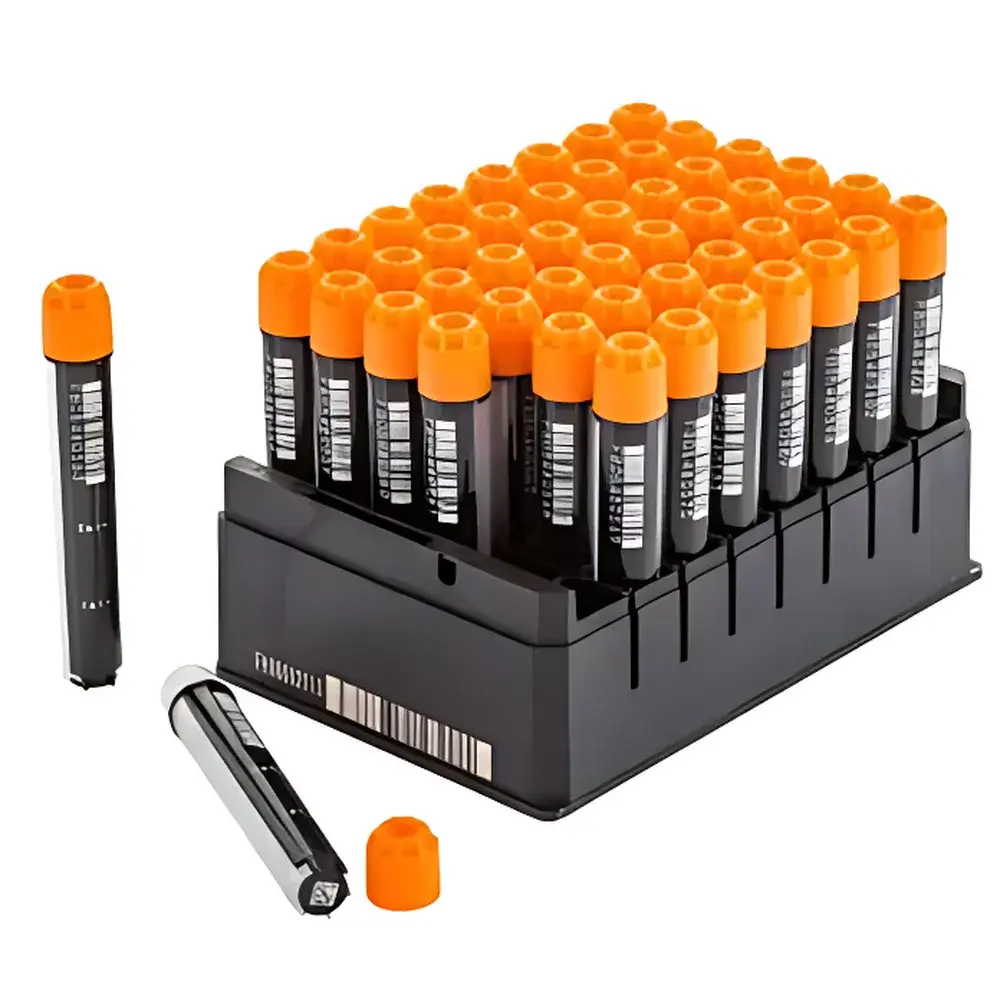
Azenta Brooks FluidX Dual-Code Cryovials Series
| Brand | Azenta Brooks FluidX |
|---|---|
| Origin | Japan |
| Model | 66-62325-Y6 |
| Volume Options | 0.3 mL, 0.5 mL, 0.7 mL, 0.9 mL (internal/external thread), 2.2 mL (external thread) |
| Format | 96-well SBS-compliant or 24-well for tissue tubes |
| Material | Virgin polypropylene (PP) |
| Max Operating Temperature | −196 °C (liquid nitrogen vapor phase only) |
| Cap Types | Automation-friendly screw caps with silicone O-rings or TPE septa |
| Tube Base | Permanently laser-etched 2D QR code + human-readable numeric ID |
| Rack Compatibility | LowBase/HighBase SBS racks, TwistLock/TubeLock/LidLock-enabled PC cryo-racks (14×14, 7×7) |
| Compliance | ASTM F2668, ISO 20365, USP <665>, GLP/GMP traceability ready |
Overview
The Azenta Brooks FluidX Dual-Code Cryovials Series represents a foundational component in modern biobanking, compound management, and high-integrity sample archiving infrastructures. Engineered for end-to-end chain-of-custody assurance, each vial integrates two permanent, machine-readable identifiers—laser-etched 2D QR codes on the base and side wall—paired with human-readable numerics. This dual-encoding architecture eliminates transcription errors and ensures unambiguous sample-to-data linkage across manual, semi-automated, and fully automated workflows. Designed to meet the physical and regulatory demands of long-term cryogenic storage, the series supports storage at −196 °C (vapor-phase liquid nitrogen only) and is manufactured from medical-grade virgin polypropylene compliant with USP extractables profiling and ISO 20365 biocompatibility standards. Unlike conventional barcoded tubes requiring removal from racks for scanning, FluidX Dual-Code vials enable non-invasive, rack-integrated reading—enabling seamless integration with industry-standard barcode readers (e.g., Azenta Life Sciences camera-based full-rack scanners), robotic liquid handlers, and LIMS platforms.
Key Features
- Permanent dual identification: Base-mounted 2D QR code + side-wall QR code + human-readable digits—laser-etched for abrasion resistance and frost/condensation resilience.
- Rack-integrated scanning: No tube ejection required; high-contrast etching ensures >99.9% read reliability under cryogenic conditions (−80 °C to −196 °C).
- Automation-optimized sealing: Internal- and external-thread variants feature dual-start threads (max 180° rotation) and compression-sealing geometry—eliminating over-torque risk and ensuring consistent torque distribution across robotic cappers.
- Leak-tested integrity: 100% batch-tested for hermeticity per ASTM F2668 (leak rate ≤1 × 10⁻⁶ mbar·L/s He), validated for long-term storage of DNA, RNA, proteins, cell lysates, and small-molecule compounds.
- Material consistency: Caps and tubes fabricated from identical virgin PP—minimizing differential thermal expansion during freeze-thaw cycles and preventing cap loosening or cracking.
- Structural rack enhancements: TwistLock prevents tube rotation during auto-capping; TubeLock secures tubes in open racks; LidLock enables 1-meter drop testing per ISTA 2A—certified for transport and archival handling.
Sample Compatibility & Compliance
The Dual-Code Cryovials are validated for use with biological specimens—including primary cells, PBMCs, plasma, serum, tissue homogenates—and chemical libraries (e.g., DMSO-solubilized compounds). They comply with critical regulatory frameworks governing sample integrity: FDA 21 CFR Part 11 (audit trail support via integrated LIMS), ISO 20387 (biobanking), and ISO/IEC 17025 (testing laboratories). All vials undergo 100% QC verification—including optical readability validation (ISO/IEC 15415 grade ≥C), dimensional tolerance checks (±0.05 mm), and functional leak testing. The virgin PP formulation meets USP Class VI requirements for extractables profiling and is free of detectable endotoxins (<0.03 EU/mL) and DNase/RNase activity. Not intended for direct immersion in liquid-phase nitrogen due to potential embrittlement risk.
Software & Data Management
Dual-Code vials interface natively with enterprise sample management systems (e.g., LabVantage, STARLIMS, SampleManager) and robotics middleware (e.g., Hamilton VANTAGE, Tecan Fluent). Rack-level QR codes—laser-etched on SBS-compliant LowBase/HighBase carriers—enable simultaneous decoding of rack ID and individual tube IDs using single-pass imaging, reducing cycle time in high-throughput archival operations. Integration supports bidirectional data synchronization: scan events trigger automatic metadata updates (e.g., location, freeze-thaw count, access log), while LIMS-initiated actions (e.g., sample retrieval requests) drive robotic dispatch with real-time confirmation. Audit trails include timestamped operator ID, instrument ID, and cryptographic hash of decoded payloads—fully compliant with GLP/GMP electronic record retention mandates.
Applications
- Biobanking: Long-term storage of clinical biospecimens with immutable audit trails for IRB and FDA submissions.
- Pharmaceutical compound management: High-density archiving of HTS libraries with automated inventory reconciliation.
- Genomics & proteomics core facilities: Traceable storage of NGS libraries, CRISPR guide RNAs, and affinity-purified antibodies.
- Cryo-electron microscopy (cryo-EM) sample preparation: Stable mounting of vitrified grids using compatible 24-well tissue vials with flat-bottom geometry.
- Regulatory submissions: Full traceability from collection to analysis—supporting ICH M4 dossier requirements for sample provenance documentation.
FAQ
Are FluidX Dual-Code vials compatible with liquid nitrogen immersion?
No. These vials are rated for vapor-phase storage at −196 °C only. Direct immersion may compromise structural integrity due to rapid thermal shock and material embrittlement.
What distinguishes internal-thread from external-thread vials?
Internal-thread vials (e.g., 0.3–0.9 mL) prioritize maximal working volume within compact footprints and integrate with standard SBS racks. External-thread variants (e.g., 2.2 mL tissue vials) offer enhanced mechanical strength, flat-bottom geometry for pipette access, and optimized ergonomics for manual handling with gloves or forceps.
Can rack-level QR codes be customized with institutional identifiers?
Yes. Azenta offers configurable rack encoding services—allowing institution-specific prefixes, project codes, or ISO 15189-accredited lab IDs to be laser-etched alongside standard SBS identifiers.
Do TPE septa caps meet USP requirements for resealability?
TPE septa are validated for ≥5 punctures with 22G needles and maintain seal integrity post-puncture per USP leakage criteria (≤0.5 mL air loss over 24 h at 20 psi).
Is batch-level certificate of analysis (CoA) available?
Yes. Each production lot includes CoA documenting dimensional compliance, readability grade (per ISO/IEC 15415), leak test results, extractables data (per USP ), and endotoxin/DNase testing—available upon request with purchase order.




