
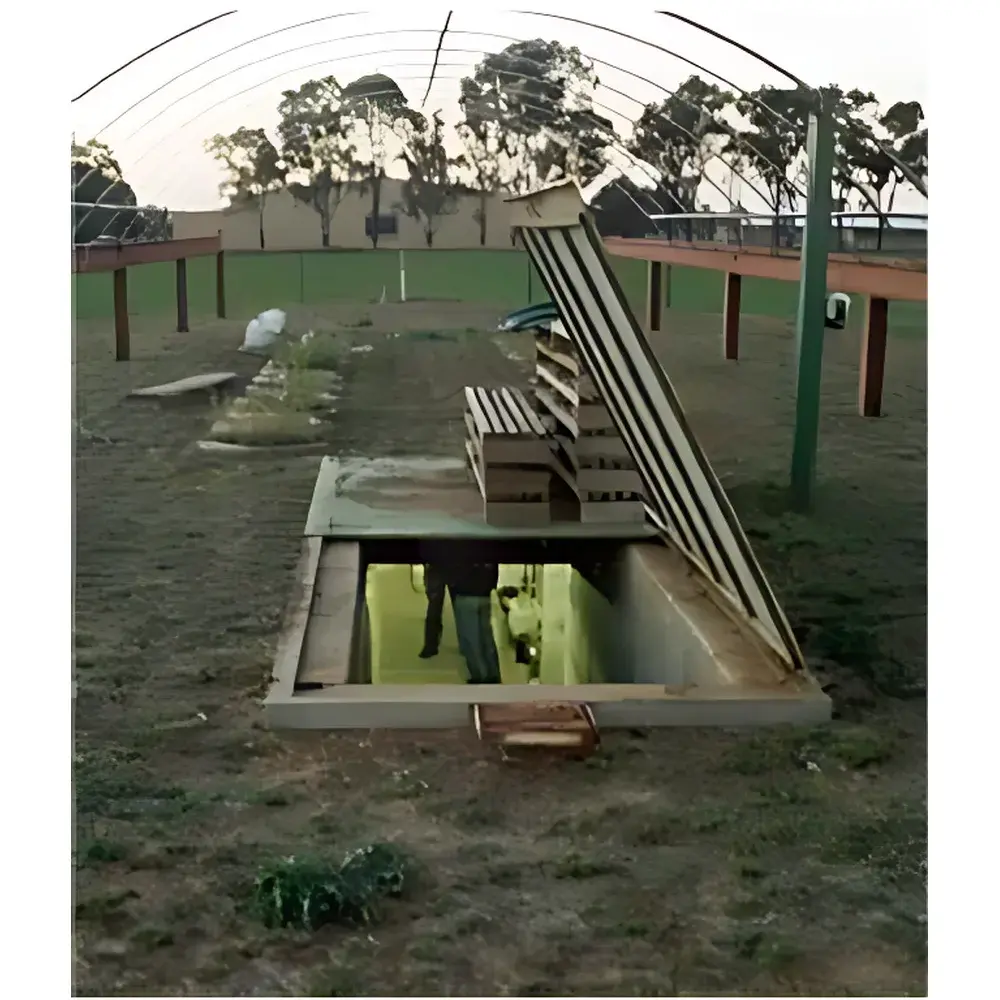
AZO Rhizoscope In Situ 3D Root Observation System
| Brand | AZO (Beijing AoZuo) |
|---|---|
| Origin | Beijing, China |
| Manufacturer Type | Direct Manufacturer |
| Country of Origin | China |
| Model | Rhizoscope |
| Price Range | USD 56,000 – 140,000 |
Overview
The AZO Rhizoscope In Situ 3D Root Observation System is an engineered research platform designed for non-invasive, long-term, three-dimensional quantification of root architecture and dynamics within intact soil columns. Unlike conventional minirhizotron systems—typically installed at 45° angles and limited to shallow, localized observation—the Rhizoscope employs a vertically oriented, 2.5 m deep × 0.8 m diameter monolithic soil monolith (lysimeter-style column), with horizontally embedded observation tubes across five discrete depth layers (0.2, 0.4, 0.65, 1.45, and 2.0 m). This configuration enables volumetric sampling of root distribution across the full vertical profile while minimizing mechanical disturbance during installation. The system integrates synchronized root imaging, volumetric soil water content measurement, and in situ soil solution extraction—all within a controlled, semi-field environment. Its architecture supports mechanistic studies of root-soil interactions under defined hydrological regimes, including simulated rainfall via precision drip irrigation, passive light transmission through an overhead greenhouse structure, and gravity-driven drainage control. The Rhizoscope is grounded in principles of lysimetry, optical phenotyping, and rhizosphere biogeochemistry, making it suitable for hypothesis-driven investigations in plant ecophysiology, climate-resilient crop breeding, and belowground carbon cycling.
Key Features
- Monolithic soil column: 2.5 m depth × 0.8 m diameter, extracted and installed as an undisturbed soil monolith using hydraulic coring equipment—preserving native soil structure, aggregation, and pore connectivity.
- Multi-level horizontal minirhizotron deployment: Five fixed-depth ports (0.2, 0.4, 0.65, 1.45, 2.0 m) accommodate interchangeable optical probes, TDR/FDR moisture sensors, and vacuum-based solution samplers—enabling co-located, time-synchronized measurements.
- High-resolution root imaging subsystem (AZR-300): 12-inch touchscreen interface; 3840 × 2880 pixel CMOS sensor (equivalent to 4800 dpi optical resolution); adjustable focus and LED illumination; field of view: 20 mm × 16 mm—optimized for fine root detection (≥0.1 mm diameter) and morphometric analysis (length, diameter, branching density, mortality staging).
- Integrated soil hydrometric monitoring: TRIME-PICO TDR sensors calibrated for bulk electrical conductivity ranges up to 15 dS/m; volumetric water content accuracy ±2–4% across 0–70% v/v range, validated per ASTM D5084 and ISO 11272 protocols.
- In situ soil solution collection (AZS-100): Nylon-polyethylene composite suction cups operating at ≤100 kPa vacuum pressure; compatible with sequential leachate sampling for dissolved organic carbon (DOC), nitrate, phosphate, and root exudate profiling.
- Controlled-environment infrastructure: Above-ground greenhouse enclosure ensures photosynthetically active radiation (PAR) transmission while excluding ambient precipitation; subterranean corridor (1.2 m wide) houses all columns and service lines—facilitating repeatable access and minimizing thermal fluctuation.
Sample Compatibility & Compliance
The Rhizoscope accommodates both herbaceous annuals (e.g., Triticum aestivum, Zea mays) and perennial forage species (e.g., Medicago sativa, Lolium perenne) grown from seed or transplant within the intact soil column. Root observation tubes are chemically inert and optically stable over multi-year deployments (>5 years typical service life). All embedded sensors comply with IEC 61326-1 (EMC for laboratory equipment) and IP67 ingress protection standards. Data acquisition workflows support GLP-compliant metadata tagging—including timestamped image capture, sensor calibration logs, and operator-defined experimental annotations. While not pre-certified for FDA 21 CFR Part 11, the system’s audit trail architecture (via optional AZO DataHub software module) meets baseline requirements for traceability in regulatory-adjacent environmental physiology studies.
Software & Data Management
Root image analysis is performed using AZO RootAnalyzer™ v3.x—a desktop application supporting batch processing of TIFF/RAW sequences, semi-automated root tracing (based on contrast-enhanced edge detection), and export of standardized morphometric outputs (total length, average diameter, tip count, intersection density per depth layer). Sensor data streams (soil moisture, temperature, suction potential) are logged at user-defined intervals (1 min to 24 h) into SQLite databases with UTC timestamps and column-specific identifiers. Export formats include CSV, NetCDF4, and MIAME-compliant XML for integration with FAIR-aligned repositories (e.g., Dryad, PANGAEA). Optional cloud synchronization enables remote monitoring and collaborative annotation across distributed research teams.
Applications
- Quantifying vertical redistribution of root biomass under progressive drought stress—supporting trait discovery for water-use efficiency in breeding programs.
- Assessing root turnover rates and decomposition kinetics via repeated imaging combined with 14C or 13C pulse-labeling experiments.
- Mapping spatial coupling between root exudation hotspots (via soil solution chemistry) and microbial community shifts (16S/ITS amplicon sequencing).
- Evaluating deep-rooting capacity of cover crops in subsoil carbon sequestration trials.
- Validating root growth modules in process-based crop models (e.g., APSIM, HYDRUS-1D) using empirically constrained 3D architectural parameters.
- Studying root-mediated bioturbation effects on soil hydraulic conductivity profiles across seasonal wet-dry cycles.
FAQ
What soil types are compatible with the Rhizoscope monolith installation?
The system has been successfully deployed in loam, clay loam, sandy loam, and silty clay soils. Installation feasibility is assessed via pre-site cone penetration testing (CPT) to ensure structural integrity of the 2.5 m column during hydraulic coring.
Can the system be relocated after initial installation?
No. The monolith is designed for permanent, in situ deployment. Relocation would compromise soil structural continuity and invalidate longitudinal root growth metrics.
Is real-time root growth tracking possible?
Yes—via programmable imaging schedules (e.g., daily scans at fixed depths). However, true “real-time” sub-second imaging is not supported; temporal resolution is optimized for diurnal-to-weekly biological dynamics.
How is root identification validated against ground-truth methods?
Validation is performed via destructive sampling of adjacent control columns, followed by WinRHIZO or similar scanner-based root mapping and statistical comparison (Lin’s concordance correlation coefficient ≥0.92 reported in peer-reviewed validation studies).
Does the system support isotopic tracer studies?
Yes—vacuum samplers enable collection of pore water for δ2H/δ18O analysis; root images can be co-registered with autoradiographs from 33P or 11C labeling when used in shielded facilities.




