
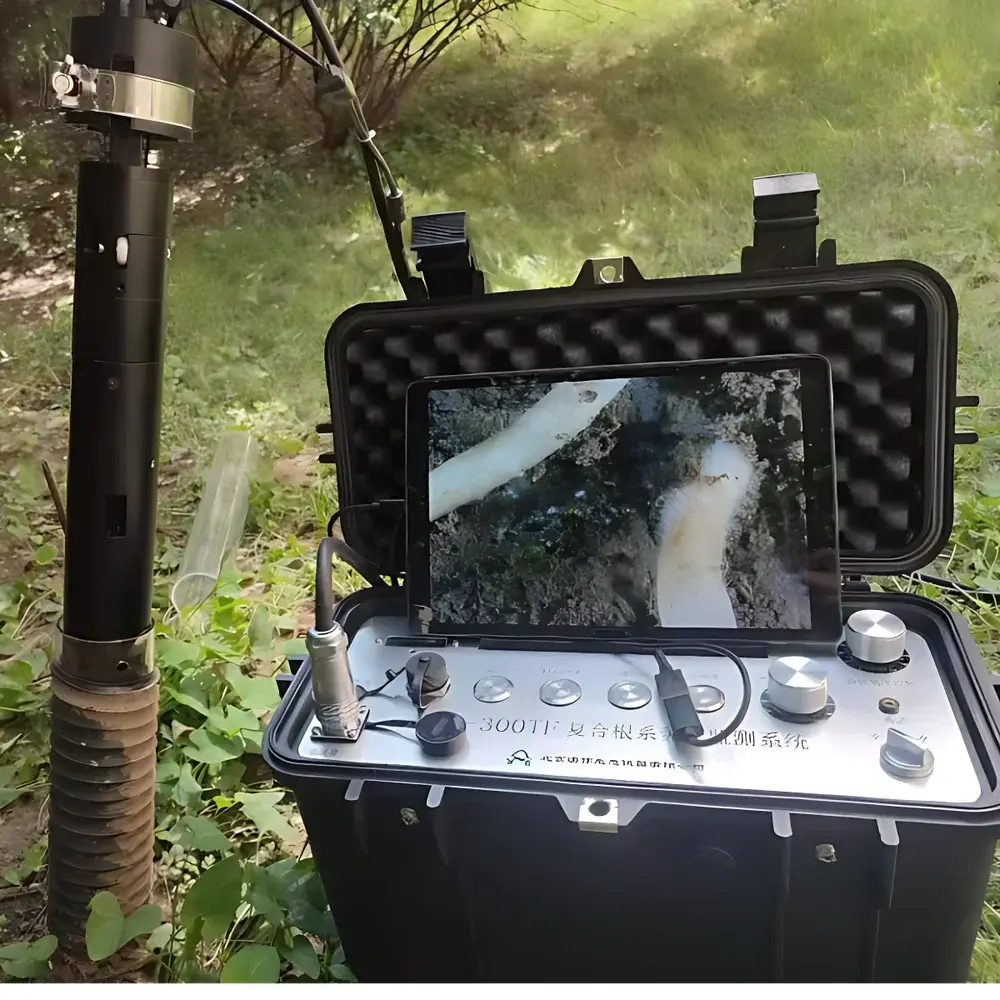
AZR-300PLUS Minirhizotron-Based Root Growth Dynamic Monitoring System
| Brand | AZ (Beijing Aozuo) |
|---|---|
| Origin | Beijing, China |
| Manufacturer Type | Original Equipment Manufacturer (OEM) |
| Model | AZR-300PLUS |
| Power Supply | 12 V rechargeable battery (≥6 h operation) |
| Operating Temperature | 0–55 °C |
| Relative Humidity | 0–100% RH (non-condensing) |
| Camera Resolution | 3840 × 2880 pixels (adjustable) |
| Field of View | 20 × 16 mm |
| Probe Dimensions | 36 cm × 6.2 cm (L × Ø) |
| Root Tube ID | 50 mm |
| length options | 1 m or 2 m |
| TDR Soil Moisture Range | 0–100% volumetric water content |
| EC Accuracy | ±2% (0–40% VWC), ±3% (40–70% VWC) |
| EC range | 0–15 dS/m |
| Vacuum Sampling Pressure | 0 to −85 kPa |
| Sampling Tube Lengths | 20, 40, 50, 100, 200 cm |
| Sampling Head | Ø22 mm × 60 mm |
Overview
The AZR-300PLUS Minirhizotron-Based Root Growth Dynamic Monitoring System is a field-deployable, non-destructive imaging platform engineered for long-term in situ observation of root architecture, phenology, and rhizosphere dynamics. It operates on the established minirhizotron principle—inserting a transparent acrylic tube into undisturbed soil and repeatedly imaging root growth through a rotating high-resolution camera probe. Unlike destructive coring or excavation methods, this system preserves soil structure, microbial habitat integrity, and root-soil continuity, enabling longitudinal tracking of individual root segments across days, weeks, or seasons. The system integrates synchronized environmental sensing (soil moisture, electrical conductivity, temperature) and porewater sampling capabilities, supporting mechanistic studies linking root physiological responses—such as elongation rate, mortality timing, branching density, and exudation patterns—to spatiotemporally resolved rhizosphere conditions.
Key Features
- 3840 × 2880 pixel CMOS camera with adjustable resolution and dual illumination modes (white light + UV), enabling high-fidelity visualization of fine roots (diameter ≥ 0.1 mm), root hairs, mycorrhizal hyphae, and soil fauna including collembola, enchytraeids, nematodes, and arthropods.
- 360° motorized rotational scanning probe with precision depth control via calibrated handle, ensuring repeatable positioning and full-circumferential imaging within the minirhizotron tube.
- 10-inch touchscreen tablet interface for real-time image acquisition, parameter adjustment (exposure, white balance, focus), and on-device preview—operable under field conditions without external computing infrastructure.
- Modular sensor integration: ENVILog/IPH modules employ Time-Domain Reflectometry (TDR) to deliver co-located, depth-resolved measurements of volumetric water content (VWC) and bulk electrical conductivity (EC) at standard depths (20, 40, 60, 80 cm).
- AZW-100 porewater sampler utilizes regulated vacuum extraction (0 to −85 kPa) through ceramic or stainless-steel suction cups, enabling quantitative collection of interstitial soil solution for subsequent laboratory analysis of nutrients (NO₃⁻, NH₄⁺, PO₄³⁻), dissolved organic carbon (DOC), heavy metals, or metabolites.
- Robust mechanical design: segmented 2-m telescoping probe rod with integrated depth stop mechanism; lightweight host unit (900 g); IP65-rated control box (39 × 21 × 5 cm); and corrosion-resistant minirhizotron tubes (50 mm ID, 1–2 m lengths).
Sample Compatibility & Compliance
The AZR-300PLUS is compatible with all standard minirhizotron installation protocols used in agronomic, ecological, and forestry research—including auger-driven, hydraulic push, or vibratory insertion methods. Tubes are chemically inert (acrylic), UV-stabilized, and optically clear to minimize imaging artifacts. All embedded sensors comply with ASTM D5084 (TDR-based VWC measurement) and ISO 11274 (soil water retention characterization). Data logging firmware supports timestamped metadata embedding (GPS optional via external module), facilitating traceability in GLP-aligned experimental workflows. While not certified to FDA 21 CFR Part 11, the system’s audit-ready software architecture (user logins, version-controlled analysis scripts, raw image immutability) meets common institutional requirements for reproducible plant phenotyping data management.
Software & Data Management
Two dedicated software suites operate in tandem: (1) RootCapture Pro, the acquisition and control interface running natively on the Android-based tablet, manages camera positioning, illumination sequencing, image tagging (by depth, rotation angle, date/time), and local storage in lossless TIFF format; (2) RootAnalyzer Suite, a Windows-based desktop application, performs semi-automated root segmentation, skeletonization, and morphometric quantification—including total root length, surface area, average diameter, tip count, branching frequency, and spatial distribution metrics across time-series stacks. Image stitching algorithms ensure seamless mosaic generation from overlapping 360° scans. Export formats include CSV (morphometrics), GeoJSON (spatial coordinates), and standardized MIAPPE-compliant JSON-LD metadata for FAIR data deposition.
Applications
This system supports hypothesis-driven research across multiple domains: root response to drought stress and rewetting cycles; genotype-by-environment interactions in breeding programs; carbon allocation dynamics during symbiotic establishment (e.g., legume-Rhizobium, tree-ectomycorrhiza); rhizodeposition-mediated biogeochemical cycling (e.g., Fe/Mn redox gradients, phosphate solubilization); root-pathogen interaction kinetics (e.g., Phytophthora, Fusarium); and belowground herbivory monitoring (e.g., root-feeding larvae, nematode infestation progression). Its modular architecture also enables cross-disciplinary use in wetland biogeochemistry (porewater solute flux modeling), landfill leachate plume tracking, and restoration ecology (native vs. invasive root competitiveness).
FAQ
What is the minimum detectable root diameter under optimal lighting and soil conditions?
Under high-contrast conditions (e.g., sandy loam, low organic matter, UV-enhanced imaging), roots ≥ 0.1 mm in diameter are reliably resolved and segmentable using RootAnalyzer Suite.
Can the system be deployed in saturated or flooded soils?
Yes—the probe housing and control electronics are rated IP65; however, minirhizotron tube installation must follow standard hydrological best practices to prevent lateral water intrusion and sediment clogging.
Is calibration required before each deployment?
Camera focus and white balance are user-adjustable per site; TDR sensors ship with factory calibration certificates traceable to NIST standards, though field verification using gravimetric samples is recommended for critical studies.
How is data synchronization handled between imaging and sensor modules?
All modules share a common internal clock; timestamps are embedded at acquisition level and aligned during post-processing using RootCapture Pro’s metadata reconciliation engine.
Does the system support remote telemetry or cloud upload?
Not natively—but raw image and sensor data folders can be manually transferred via USB or SD card; third-party IoT gateways (e.g., LoRaWAN, cellular) may be integrated using the system’s RS-485 and analog voltage output ports.





