
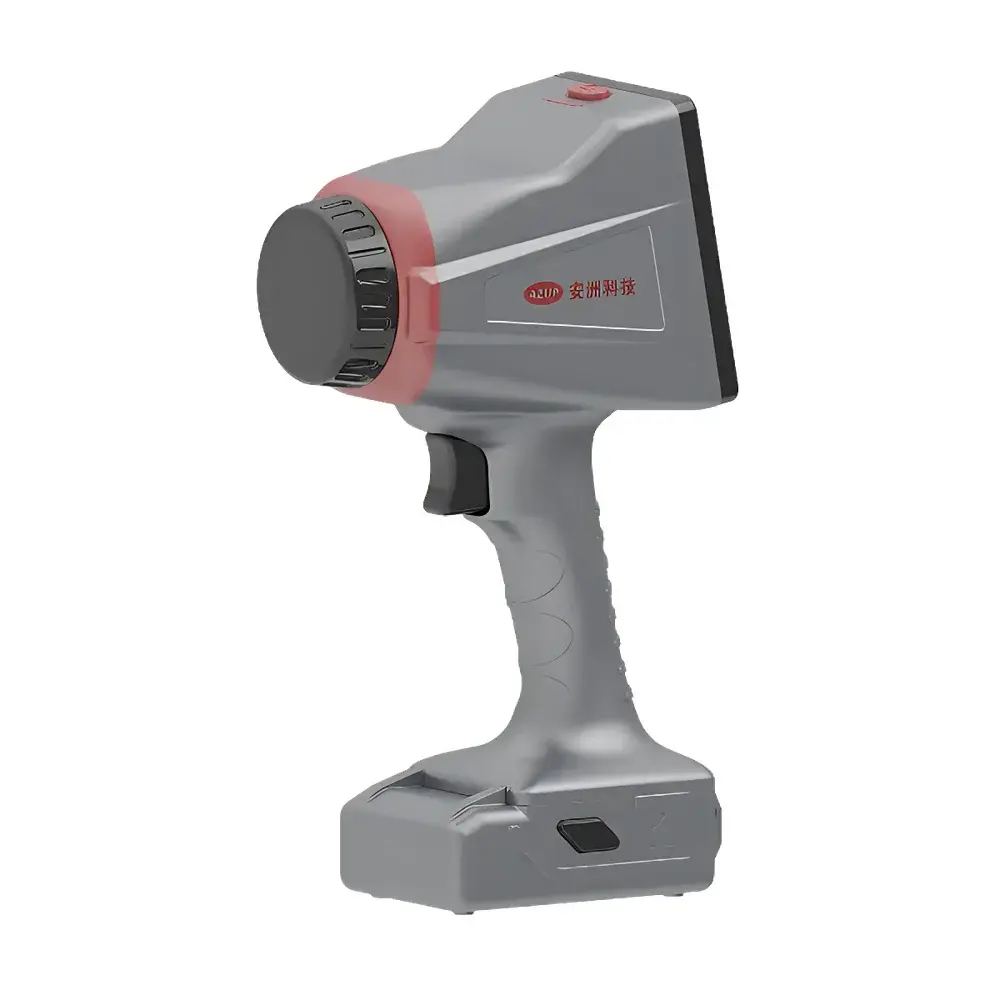
AZUP EM100 Portable Hemispherical Emissivity Meter
| Brand | AZUP |
|---|---|
| Origin | Beijing, China |
| Manufacturer Type | Direct Manufacturer |
| Country of Origin | China |
| Model | EM100 |
| Price | USD 112,000 (FOB Beijing) |
| Measurement Principle | Fourier Transform Infrared (FTIR)-based Directional-Hemispherical Reflectance (DHR) at 20° and 60° incidence angles |
| Spectral Range | 1–25 µm |
| Weight | <1.0 kg |
| Operating Modes | Handheld standalone mode & PC-controlled mode via USB/Bluetooth |
| Display | 5.0″ full-color capacitive touchscreen |
| User Interface | Graphical UI with guided workflow, ISO/IEC 17025-aligned measurement protocol sequencing |
Overview
The AZUP EM100 Portable Hemispherical Emissivity Meter is an engineered field-deployable instrument designed for rapid, non-contact determination of directional-hemispherical reflectance (DHR) and derived hemispherical emissivity (εh) across the mid- to far-infrared spectrum (1–25 µm). It operates on a calibrated FTIR-based optical architecture, integrating dual-angle (20° and 60°) collimated beam illumination with a thermoelectrically cooled MCT detector and reference blackbody calibration source. Unlike conventional single-angle or broadband pyrometric methods, the EM100 implements ASTM E1933-19 and ISO 9277-compliant DHR acquisition protocols to compute εh via the reciprocity-based relation εh = 1 − ρh, where ρh is reconstructed from bidirectional reflectance distribution function (BRDF) sampling at two discrete incidence angles. Its compact form factor and battery-powered operation enable in-situ measurements on aerospace thermal control surfaces, building envelope materials, industrial furnace linings, and space-grade coatings—without requiring sample removal or vacuum chamber integration.
Key Features
- Dual-angle DHR acquisition at precisely controlled 20° and 60° incidence angles—enabling robust εh estimation under real-world angular scattering conditions
- Extended spectral coverage from 1 to 25 µm (4000–400 cm−1), optimized for peak sensitivity in the 3–14 µm atmospheric window where most thermal radiation exchange occurs
- Modular optical head with motorized focus adjustment and auto-alignment feedback loop—ensuring consistent spot size (Ø3 mm ±0.2 mm) across convex, concave, and planar geometries
- Integrated NIST-traceable blackbody reference (±0.15 K stability at 50 °C) and internal cavity calibration routine executed prior to each measurement sequence
- Real-time spectral validation: onboard signal-to-noise ratio (SNR) monitoring and spectral flatness diagnostics prevent erroneous εh reporting due to detector saturation or stray light contamination
- Compliance-ready data logging: timestamps, GPS coordinates (optional external module), operator ID, ambient temperature/humidity (via integrated sensors), and full interferogram storage
Sample Compatibility & Compliance
The EM100 accommodates heterogeneous surface topographies without contact or masking—validated for use on polished metals (Al, Cu, Ti alloys), ceramic tiles, anodized aluminum, polymer composites, low-emissivity glass, and oxidized steel substrates. Its non-destructive methodology satisfies ASTM C1371-22 (Standard Test Method for Determination of Emittance of Materials Near Room Temperature Using Portable Emissometers) and supports GLP/GMP audit trails per FDA 21 CFR Part 11 when operated in PC-synchronized mode with electronic signature capture. All firmware and calibration certificates are version-controlled and digitally signed; calibration validity intervals are automatically tracked and flagged upon expiry.
Software & Data Management
The proprietary EM-Suite v3.2 software (Windows 10/11 compatible) provides three operational layers: (1) QuickScan mode for one-touch εh reporting with pass/fail thresholds against user-defined spec limits; (2) Advanced Analysis mode for BRDF reconstruction, spectral emissivity curve fitting (Planck-weighted or wavelength-specific), and comparative overlay of up to eight datasets; (3) Compliance Export mode generating PDF reports compliant with ISO/IEC 17025:2017 Clause 7.8.2—complete with uncertainty budgets (k=2) propagated from spectral noise, angle repeatability (±0.3°), and reference source drift. Raw interferograms (.ifg) and processed spectra (.spc) are stored in ASTM E131-compliant format for third-party spectral analysis tools.
Applications
- Thermal management validation of satellite radiators and multi-layer insulation (MLI) blankets
- Quality assurance of architectural low-e coatings during fabrication and on-site installation
- In-process emissivity verification for heat-treatment furnaces and induction heating systems
- Material qualification for nuclear containment coatings per ASME BPVC Section III, Division 1, Appendix XXVI
- Research-grade characterization of metamaterials and selective solar absorbers in renewable energy labs
- Forensic analysis of fire-damaged structural components via post-exposure εh degradation mapping
FAQ
What standards does the EM100 comply with for emissivity measurement?
ASTM E1933-19, ASTM C1371-22, ISO 9277, and ISO 10545-10 for ceramic tile emissivity testing.
Can the EM100 measure curved or textured surfaces without sample preparation?
Yes—its adaptive optical path and 3 mm spot size accommodate radii of curvature ≥15 mm and surface roughness Ra ≤10 µm without contact or averaging artifacts.
Is spectral emissivity data exportable for external modeling (e.g., ANSYS Fluent, COMSOL)?
Yes—CSV and ASTM E131-compliant .spc files include wavenumber, absorbance, and calculated ε(λ) columns suitable for thermal simulation input.
How often does the instrument require factory recalibration?
Annually under normal use; the onboard self-diagnostic suite alerts users 30 days prior to scheduled recalibration based on operational cycle count and environmental exposure logs.
Does the handheld mode support offline measurement storage?
Yes—internal 32 GB eMMC stores >5,000 full-spectrum measurements with metadata; synchronization to PC occurs via encrypted USB transfer or Bluetooth 5.0 LE.
Related Products



