
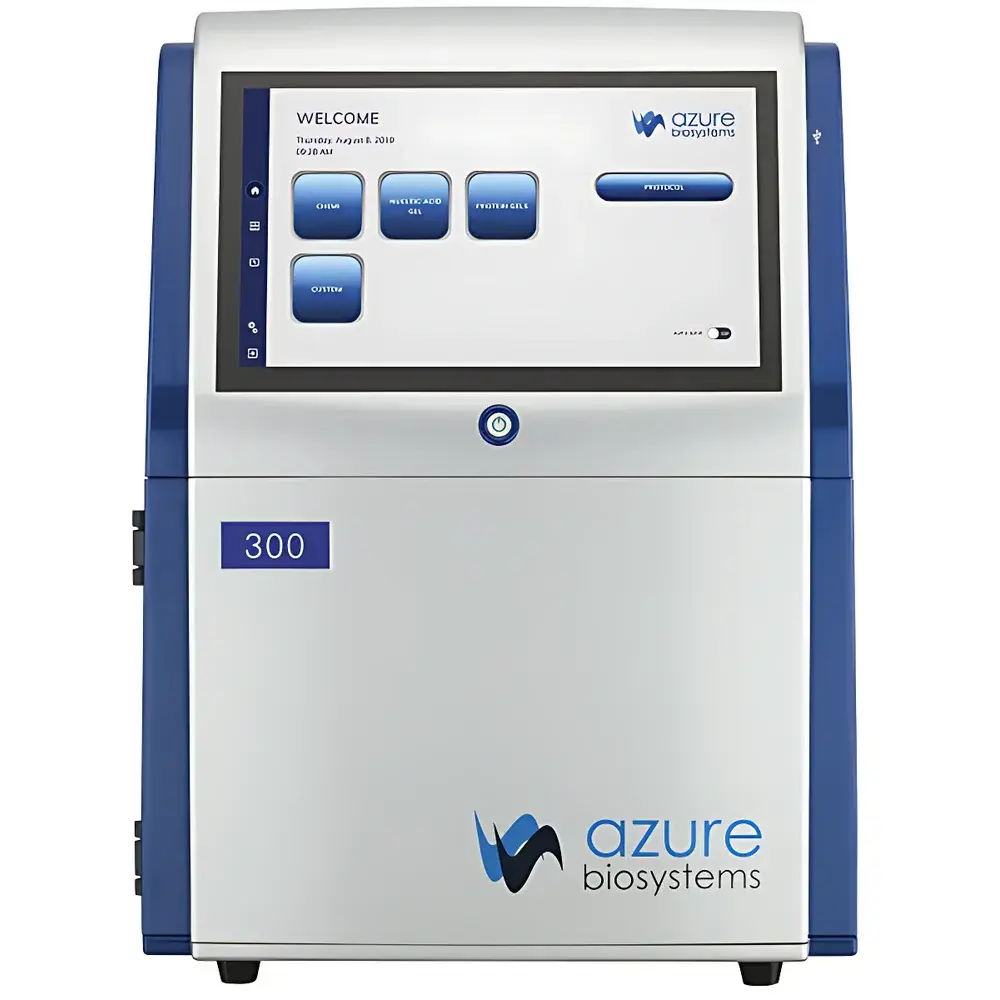
Azure Biosystems Azure 300 Chemiluminescent Gel Imaging System
| Brand | Azure Biosystems |
|---|---|
| Origin | USA |
| Model | Azure 300 |
| Instrument Type | Chemiluminescent Gel Imaging System |
| CCD Resolution | 9.1 MP |
| Bit Depth | 16-bit |
| Dynamic Range | 4.8 OD |
| CCD Sensor Size | 2/3-inch |
| Detection Sensitivity | sub-femtogram (fg) level |
| Signal-to-Noise Ratio | High |
| Lens | Fixed-focus, large-aperture optics |
Overview
The Azure Biosystems Azure 300 Chemiluminescent Gel Imaging System is a fully integrated, benchtop digital imaging platform engineered for high-sensitivity detection and quantitative analysis of nucleic acids and proteins in electrophoretic gels and blots. Utilizing cooled, scientific-grade 16-bit CCD imaging technology with a 2/3-inch sensor and large-aperture fixed-focus lens, the system captures chemiluminescent, fluorescent, and UV-visible signals with exceptional signal fidelity and low-noise performance. Its optical architecture is optimized for chemiluminescence—leveraging photon-efficient light collection, precise exposure control, and thermal stabilization to ensure reproducible quantitation across repeated experiments. Designed for compliance-driven life science laboratories, the Azure 300 supports GLP- and GMP-aligned workflows through audit-trail-enabled software and configurable user access controls.
Key Features
- Integrated 13.3-inch high-resolution touchscreen computer eliminates external PC dependency and conserves valuable bench space.
- Dual-wavelength UV transilluminator (254 nm and 302 nm) and blue-light (470 nm) excitation source enable safe, high-efficiency visualization of ethidium bromide, SYBR Safe, and other nucleic acid stains without UV-induced DNA damage.
- Cooled 9.1-megapixel CCD detector with 4.8 optical density (OD) dynamic range ensures linear response across broad intensity scales—from faint chemiluminescent bands to saturated protein ladder signals.
- Automated imaging protocols include auto-focus, auto-exposure, and auto-light-source selection—minimizing operator variability and enabling standardized acquisition across users and shifts.
- Pre-calibrated optical path and factory-aligned lens system eliminate manual alignment drift, supporting long-term measurement stability and inter-instrument comparability.
Sample Compatibility & Compliance
The Azure 300 accommodates standard electrophoresis formats including mini-gels (up to 15 × 15 cm), western blot membranes (PVDF and nitrocellulose), dot/slot blots, and colony/lower-density arrays. It supports all major chemiluminescent substrates (e.g., luminol-based, peroxyoxalate, and acridan derivatives) and fluorescence dyes (SYPRO Ruby, Deep Purple, Alexa Fluor conjugates). The system complies with ISO/IEC 17025 documentation requirements for calibration traceability and meets analytical validation criteria outlined in ICH Q2(R2) for qualitative and semi-quantitative gel-based assays. Software functionality includes full FDA 21 CFR Part 11 compliance—supporting electronic signatures, role-based permissions, immutable audit trails, and secure data archiving.
Software & Data Management
Powered by AzureSpot™ imaging and analysis software, the Azure 300 delivers end-to-end workflow integration—from image acquisition to publication-ready figure generation. The software provides background subtraction, band intensity normalization (against internal loading controls or total lane protein), molecular weight estimation, and multiplex ratio analysis. All processing steps are logged with timestamped metadata, enabling full experimental traceability. Export options include TIFF (uncompressed), PDF, PNG, and Excel-compatible CSV files—with embedded EXIF tags containing instrument parameters, exposure settings, and user annotations. Data integrity is reinforced via optional networked storage with automatic backup and version-controlled project folders.
Applications
- Quantitative analysis of Western blots using enhanced chemiluminescence (ECL) and near-infrared (NIR) fluorescent detection.
- High-resolution imaging of agarose and polyacrylamide gels stained with DNA/RNA-binding dyes or protein-specific fluorescent reagents.
- Detection and densitometric quantification of low-abundance targets in immunoprecipitation (IP) and chromatin immunoprecipitation (ChIP) assays.
- Validation of CRISPR editing efficiency via T7E1 or Surveyor nuclease assays on denaturing gels.
- Documentation and comparative analysis of electrophoretic mobility shift assays (EMSAs) and native PAGE gels.
FAQ
Does the Azure 300 support time-lapse chemiluminescent imaging?
Yes—the system enables programmable multi-frame acquisition with user-defined intervals, ideal for kinetic ECL signal decay studies.
Can I export raw 16-bit TIFF images for third-party analysis tools like ImageJ or FIJI?
Absolutely—all acquired images are saved in lossless 16-bit TIFF format with full metadata embedding, ensuring compatibility with open-source and commercial analysis platforms.
Is remote operation supported without connecting an external PC?
Yes—via built-in Wi-Fi or Ethernet, the integrated touchscreen computer allows secure remote access using VNC or Azure’s web-based dashboard for protocol management and image retrieval.
How is calibration maintained over time?
The system includes automated daily dark-current and flat-field correction routines; optional annual NIST-traceable photometric calibration services are available through Azure Biosystems’ certified service network.
Does the software support multi-user environments with permission hierarchies?
Yes—AzureSpot™ implements configurable roles (Administrator, Analyst, Viewer) with granular access control to instruments, protocols, projects, and audit logs—fully aligned with ISO 13485 and CLIA laboratory requirements.





