
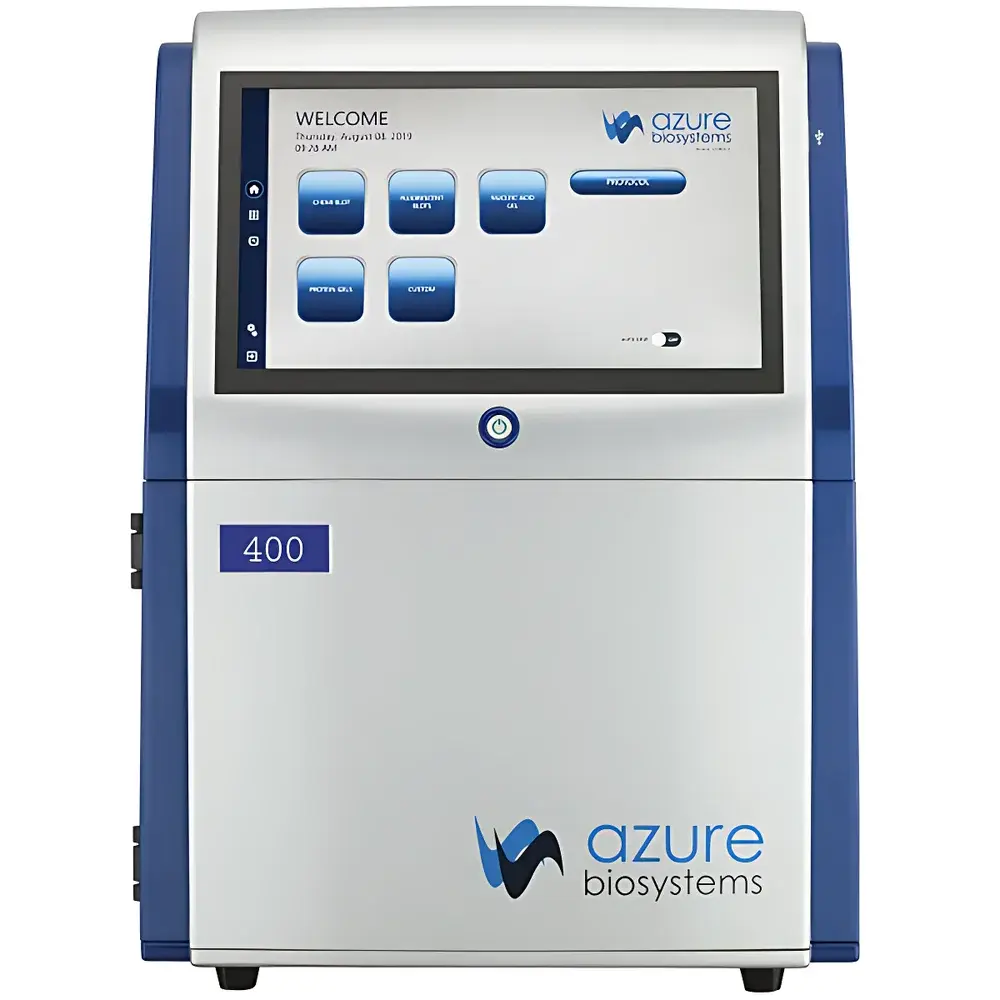
Azure Biosystems Azure 400 Visible Fluorescence Gel Imaging System
| Brand | Azure Biosystems |
|---|---|
| Origin | USA |
| Model | Azure 400 |
| Instrument Type | Multicolor Fluorescence Gel Imaging System |
| CCD Resolution | 9.1 MP |
| Bit Depth | 16-bit |
| Dynamic Range | 4.8 OD |
| CCD Sensor Size | 2/3-inch |
| Detection Sensitivity | fg-level |
| Signal-to-Noise Ratio | High |
| Lens | Fixed-focus, Large-aperture Optical Lens |
Overview
The Azure Biosystems Azure 400 Visible Fluorescence Gel Imaging System is a fully integrated, benchtop gel documentation platform engineered for precision, reproducibility, and regulatory compliance in molecular biology and protein analysis laboratories. Utilizing high-quantum-efficiency 16-bit CCD imaging with a 2/3-inch sensor and large-aperture fixed-focus optics, the system captures high-fidelity digital images across multiple excitation modalities—including dual-wavelength UV (254 nm and 302 nm), blue light (470 nm), and RGB fluorescence channels (470/530 nm, 530/590 nm, 630/690 nm). Its 4.8 optical density (OD) dynamic range enables accurate quantification of both faint and saturated bands within a single exposure—critical for comparative densitometry and publication-grade data generation. Designed around a self-contained architecture, the Azure 400 integrates a 13.3-inch HD touchscreen computer directly into the imaging cabinet, eliminating external peripherals while maintaining full computational capability for real-time image acquisition, processing, and export.
Key Features
- Integrated 13.3-inch capacitive touchscreen PC running Windows OS—no external computer required for routine operation
- Dual UV transilluminator (254 nm and 302 nm) with uniform illumination and electronic shutter control for DNA visualization and UV-based staining
- Blue-light transilluminator (470 nm) optimized for SYBR Safe, SYBR Gold, and other blue-excitable dyes—reducing photodamage to nucleic acid samples
- RGB fluorescence excitation module supporting simultaneous or sequential acquisition across three discrete spectral bands, enabling multiplexed fluorescent detection without filter wheel latency
- High-sensitivity 9.1-megapixel CCD sensor with thermoelectric cooling to −25 °C, minimizing dark current and ensuring consistent low-noise performance across long exposures
- Automated workflow functions including auto-focus, auto-exposure, and auto-light selection—programmable as user-defined protocols for inter-run standardization
- FDA 21 CFR Part 11-compliant software architecture with audit trail, electronic signatures, and role-based access control for GLP/GMP environments
Sample Compatibility & Compliance
The Azure 400 accommodates standard electrophoretic formats including mini-gels (up to 15 × 15 cm), midi-gels, and blot membranes (PVDF and nitrocellulose). It supports all major nucleic acid and protein stains—including ethidium bromide, GelRed, SYBR series, Coomassie Blue, Silver Stain, and fluorescent antibodies—without hardware modification. All imaging modes comply with ISO/IEC 17025 requirements for measurement traceability when used with calibrated reference standards. The system meets analytical validation criteria outlined in USP Analytical Instrument Qualification and supports IQ/OQ/PQ documentation packages. Data files are saved in vendor-neutral TIFF and multi-page PDF formats, preserving raw pixel values and metadata for third-party reanalysis.
Software & Data Management
Acquisition and analysis are performed using AzureSpot™ Software v6.x—a modular, FDA 21 CFR Part 11-ready application with embedded calibration management and version-controlled protocol libraries. The software provides lane and band detection with background subtraction algorithms optimized for low-S/N gels; integrated molecular weight and intensity calibration tools; and batch-processing workflows for replicate gels. Export options include publication-ready PNG, EPS, and SVG with embedded scale bars and annotation layers. Raw image archives support DICOM-compatible metadata tagging and can be linked to LIMS via secure REST API. Audit logs record every acquisition parameter change, user login event, and file export action with timestamp and operator ID.
Applications
- Agarose and polyacrylamide gel electrophoresis (DNA/RNA sizing and purity assessment)
- SDS-PAGE and native PAGE protein separation with Coomassie, silver, or fluorescent stain detection
- Chemiluminescent Western blot imaging using HRP- and AP-conjugated secondary antibodies
- Multiplex fluorescent Westerns and far-red NIR-compatible assays (e.g., LI-COR 800 nm channel emulation)
- Colorimetric ladder imaging with automatic marker alignment and band indexing
- Total protein normalization using REVERT or Stain-Free technologies
- Quantitative comparison across time-series or dose-response experiments under identical acquisition conditions
FAQ
Does the Azure 400 require an external computer for operation?
No—the system includes an embedded 13.3-inch touchscreen PC with full Windows OS functionality. External control is optional via Ethernet or Wi-Fi for centralized lab management.
Can the Azure 400 perform chemiluminescence imaging?
Yes—it supports high-sensitivity chemiluminescent detection with extended exposure times up to 60 minutes and real-time preview mode for optimal signal capture.
Is the software compliant with FDA 21 CFR Part 11 for regulated laboratories?
Yes—AzureSpot™ Software includes electronic signature capability, audit trail logging, and configurable user roles aligned with Part 11 Annex A guidance.
What file formats does the system export for data sharing and publication?
TIFF (16-bit raw), multi-page PDF, PNG, EPS, and SVG—with embedded metadata, scale bars, and customizable annotations.
How is focus consistency maintained across multiple users or experiments?
The auto-focus algorithm uses contrast-based edge detection on live preview frames and stores focal position per sample type; custom protocols lock focus, exposure, and lighting parameters for cross-user repeatability.
Related Products




